


Show Notes 12 June 2026
Text highlighted in blue identifies notes I have inserted.
Story 1: Student-Built Car Hits 2,145 MPG And Beats Every Production Vehicle
Source: AutoBlog.com Story by Rex Sanchez
Link: https://www.autoblog.com/news/student-built-car-hits-2145-mpg-and-beats-every-production-vehicle
See YouTube video here: https://www.youtube.com/watch?v=tz84xF6tn-M
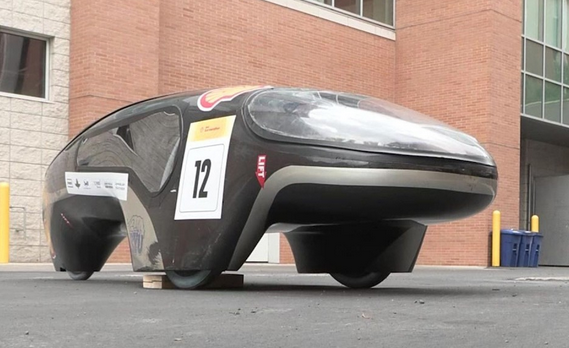
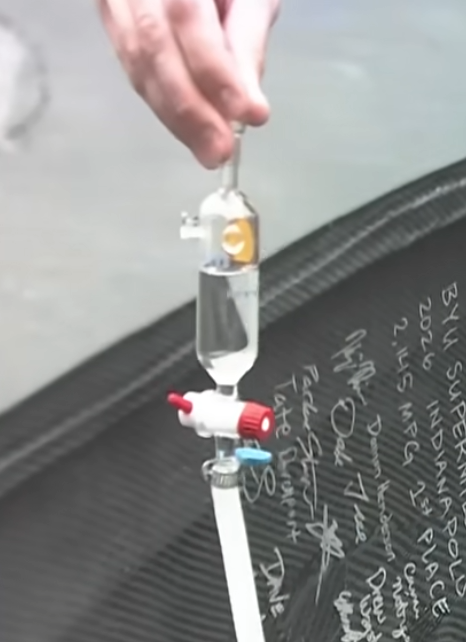
Tiny 30-milliliter ethanol fuel tank
- A team of engineering students at Brigham Young University built an experimental vehicle that achieved an incredible 2,145 miles per gallon [of ethanol] during the Shell Eco-marathon.
- Side note – The Shell Eco-marathon is a unique, global academic program and engineering competition focused on energy efficiency. Instead of racing to see who can go the fastest, high school and university student teams from around the world compete to see who can design, build, and drive the most ultra-energy-efficient vehicle.
- The article explains that this result easily beats the fuel economy of any normal production car, including efficient hybrids like the Toyota Prius. However, the vehicle was designed purely for efficiency competition purposes and is not practical for everyday driving.
- The student-built car, called a “Supermileage” vehicle, was created by a team of around 20 students. To maximize fuel efficiency, the car was stripped down to the bare essentials.
- It has no air conditioning, very limited features, and uses a lightweight carbon-fiber body. The entire vehicle weighs only about 108 pounds.
- The car’s design also comes with major compromises. It can only reach a top speed of about 23 mph, and the driver must be under 5-foot-4 and weigh less than 120 pounds.
- The vehicle was tested at the Indianapolis Motor Speedway using a tiny 30-milliliter ethanol fuel tank. At its recorded efficiency, the article says the car could theoretically travel from Utah to New York on a single gallon of fuel.
- The article concludes that while this kind of vehicle is unrealistic for consumers, it demonstrates how far engineers can push fuel efficiency when comfort, speed, and practicality are removed from the equation.

Story 2: Bacteria Live in Fog Droplets and Clear Toxins from Earth’s Air
Source: Astrobiology.com Story by Keith Cowing
Link: https://astrobiology.com/2026/05/bacteria-live-in-fog-droplets-and-clear-toxins-from-earths-air.html
See also: https://futurism.com/science-energy/something-living-inside-fog
See research paper here: https://journals.asm.org/doi/10.1128/mbio.00463-26
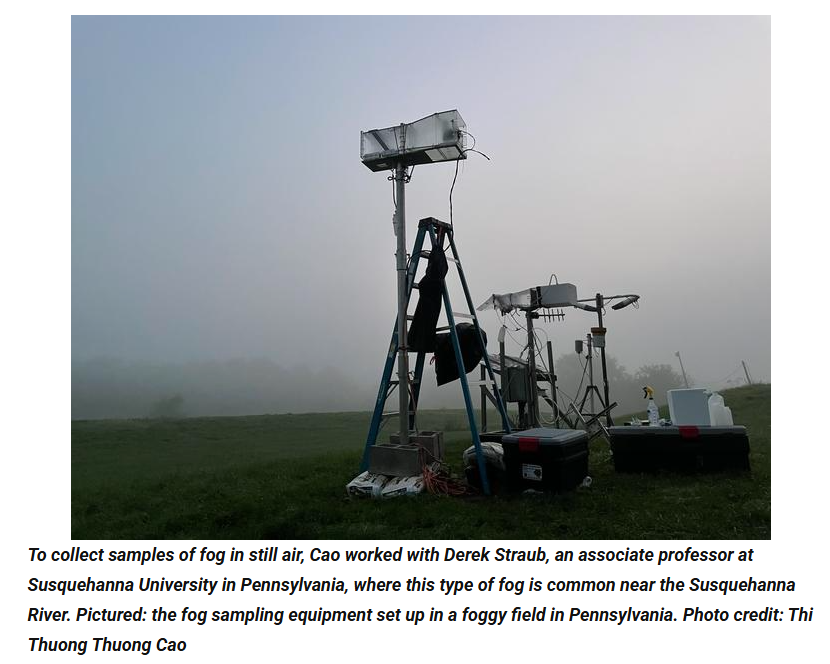
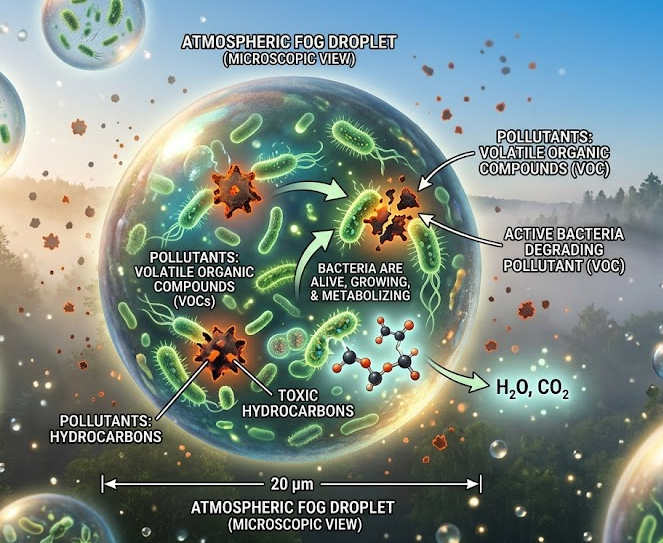
- A groundbreaking study by researchers at Arizona State University reveals that fog is not just a passive, sterile mist, but a temporary aquatic ecosystem teeming with life.
- The research shows that bacteria suspended in tiny fog droplets are actively alive, growing, and performing a crucial environmental service: cleaning the atmosphere by breaking down toxic pollutants.
- By examining “radiation fog” [a type of fog that forms close to the ground in calm conditions] scientists tracked air masses before, during, and after fog events.
- They discovered that the cumulative microbial concentration across a fog event is incredibly dense, rivaling the bacterial levels found in the Earth’s oceans. In fact, a single thimble’s worth of fog water can contain roughly 10 million bacteria.
- One group of microbes, known as methylobacteria, spikes significantly during fog events. These bacteria feed on simple carbon compounds, including formaldehyde—a widespread, hazardous pollutant that contributes to ozone smog and threatens human health.
- Under microscopic and laboratory analysis, researchers observed these bacteria expanding and dividing inside the water droplets. They found that the microbes consume formaldehyde as food to fuel their growth.
- Because high levels of formaldehyde are toxic to them, the bacteria rapidly break the chemical down into harmless carbon dioxide to protect themselves.
- This finding carries significant implications for climate science, weather modeling, and even public health. For example, communities considering “fog harvesting” to collect safe drinking water may now need to implement advanced purification processes to account for these active microbial ecosystems.
Story 3: Solar cells just did the “impossible” with this 130% breakthrough – A new “spin-flip” breakthrough could let solar panels generate more energy than they receive
Source: ScienceDaily.com Story from Kyushu University
Link: https://www.sciencedaily.com/releases/2026/03/260328024517.htm
See research paper here: https://pubs.acs.org/doi/10.1021/jacs.5c20500
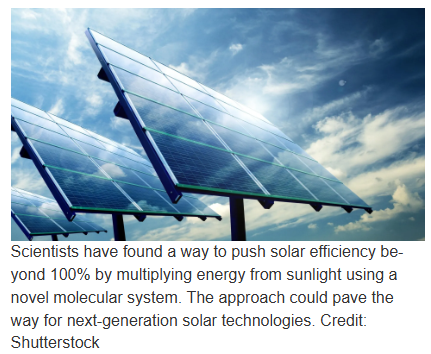
- Researchers at Kyushu University [in Japan] and Johannes Gutenberg University Mainz [in Germany] may have found a way to make future solar panels much more efficient. Their study, published in the Journal of the American Chemical Society, describes a new method that achieved about 130% energy conversion efficiency in laboratory tests.
- Normally, solar cells work when sunlight hits a material and excites electrons, creating electricity. However, today’s solar panels waste a lot of energy.
- Some light particles, called photons, do not have enough energy to be useful, while others lose extra energy as heat. Because of this, standard solar cells are limited by what scientists call the Shockley–Queisser limit, which caps how much sunlight can be converted into electricity.
-
Side note – The Shockley–Queisser limit is the theoretical maximum efficiency of a single-junction solar cell under normal sunlight. It was calculated in 1961 by William Shockley and Hans-Joachim Queisser.
- For an ideal single-layer solar cell illuminated by standard sunlight, the limit is about:
- ~33.7% efficiency for a semiconductor band gap near 1.34 eV
- In practice, commercial silicon solar panels are usually around 20–27%
- The key idea is that a normal solar cell loses energy in several unavoidable ways:
- Low-energy photons are not absorbed
If sunlight photons have less energy than the material’s band gap, they pass through unused. - Excess photon energy becomes heat
If a photon has more energy than needed, the extra energy is lost as heat. - Radiative recombination
Some excited electrons recombine before contributing electrical power. - These effects create a hard thermodynamic ceiling for ordinary one-junction photovoltaic cells.
- To overcome this, the researchers used a process called “singlet fission.” In simple terms, one photon of sunlight can create two energy-carrying particles instead of one.
- Scientists have studied this idea for years, but capturing and using the extra energy efficiently has been difficult.
- The breakthrough came from using a specially designed molybdenum-based “spin-flip” material. This material was able to collect the extra energy before it was lost through competing processes.
- Side note: Molybdenum (pronounced muh-LIB-duh-num) is a chemical element with the symbol Mo and atomic number 42. In simple terms, it is a hard, silvery-white metal that is best known for its incredible resistance to heat and corrosion. Because it doesn’t melt or soften easily under extreme temperatures, it is primarily used as an ingredient to strengthen steel and make it more durable.
- In experiments with tetracene-based materials, the team successfully generated about 1.3 energy carriers for every photon absorbed.
- Side note – It’s like putting a dollar bill into a vending machine and getting $1.30 worth of change back. It means the material is incredibly efficient at converting light into usable power without letting it go to waste.
- Side note – Tetracene (also known as naphthacene) is an organic chemical compound made up of four benzene rings fused together in a straight line. In simple terms, it is a pale orange, crystalline powder that belongs to a family of compounds called polycyclic aromatic hydrocarbons (PAHs). Unlike typical metals or plastics, tetracene is highly valued in modern technology as an organic semiconductor—a material that can conduct electricity under specific conditions.
- The technology is still in an early proof-of-concept stage, so it is not ready for commercial solar panels yet. However, the discovery could eventually lead to more powerful solar cells, better LEDs, and advances in quantum technologies.

Story 4: Scientists reverse brain aging, with a nasal spray – New therapy is turning back the clock in aging brains, healing inflammation, restoring memory and reshaping the future of brain age-related therapies.
Source: Texas A&M Stories Story by Zaid Elayyan
Link: https://stories.tamu.edu/news/2026/04/14/scientists-reverse-brain-aging-with-a-nasal-spray/
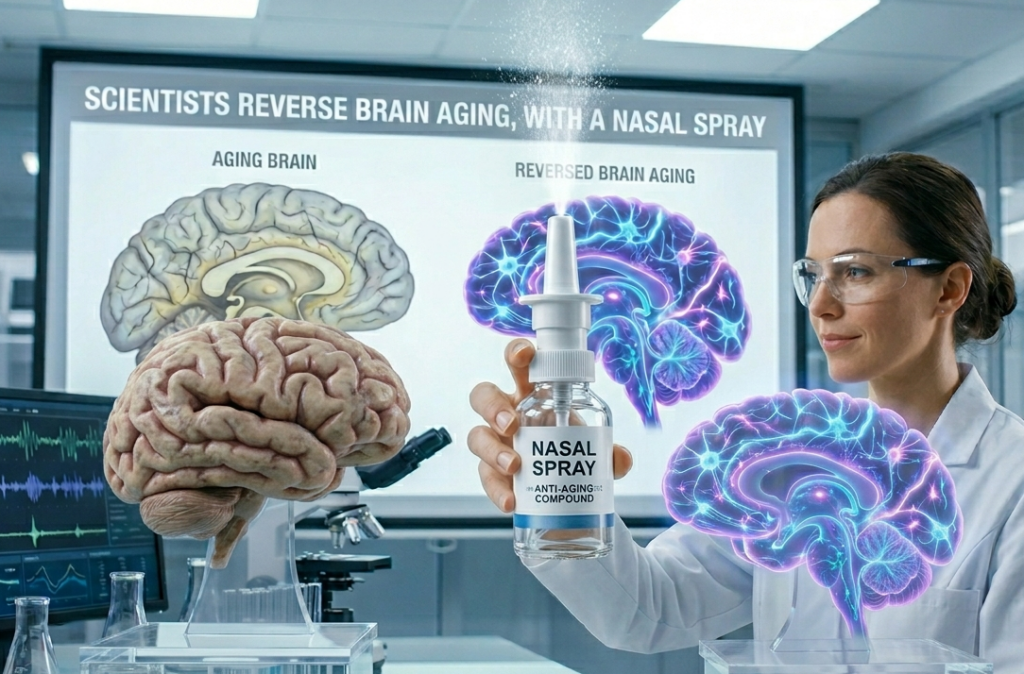
- Researchers at Texas A&M University have developed an experimental nasal spray that may reverse some effects of brain aging.
- The study focuses on “neuroinflammaging,” a chronic, low-level inflammation in the brain linked to memory loss, brain fog, and diseases such as Alzheimer’s.
- Scientists long believed this process was an unavoidable part of aging, but the new findings suggest it may be reversible.
- The research team created a spray containing tiny biological particles called extracellular vesicles. These extracellular vesicles carry microRNAs, molecules that help regulate genes and cell activity.
- Delivered through the nose, the treatment bypasses the brain’s protective barrier [the blood brain barrier] and travels directly into brain tissue.
- In tests on aged mice, just two doses significantly reduced inflammation in the hippocampus, the brain region involved in memory and learning. The treatment also restored mitochondrial activity, helping brain cells regain energy and function more effectively.
- As a result, the mice showed major improvements in memory, object recognition, and awareness of changes in their environment. The benefits appeared within weeks and lasted for months.
- Researchers believe this therapy could eventually lead to simpler, less invasive treatments for dementia and other age-related brain disorders.
- However, the spray has only been tested in animals so far, and more research and human clinical trials are still needed before it could become an approved treatment.

Honorable Mentions
Story: Scientists Create First-Ever ‘Smell Map’ – A detailed diagram of smell receptors in the nose fills in missing details of how olfaction works
Source: Harvard School of Medicine Website Story by Catherine Caruso
Link: https://hms.harvard.edu/news/scientists-create-first-ever-smell-map

- In the article “Scientists create first-ever ‘smell map,’” researchers at Harvard Medical School describe a major breakthrough in understanding how the sense of smell works.
- Led by neurobiologist Sandeep (Robert) Datta, the team created the first detailed map showing how thousands of smell receptors are arranged inside the nose. Until now, scientists believed the organization of these receptors was mostly random, unlike the structured sensory maps known for vision, hearing, and touch.
- Using advanced techniques such as single-cell sequencing and spatial transcriptomics, the researchers analyzed approximately 5.5 million olfactory neurons from more than 300 mice. They discovered that smell receptors are actually arranged in organized horizontal stripes running from the top to the bottom of the nasal tissue. This organization was remarkably consistent across animals and corresponded closely with odor-processing maps in the brain’s olfactory bulb.
- The study also identified retinoic acid, a molecule involved in regulating gene activity, as a key factor guiding this spatial arrangement. By altering retinoic acid levels, researchers could shift the receptor map up or down within the nose, revealing how developmental processes establish the system’s precise structure.
- Beyond advancing basic neuroscience, the findings may have important medical applications. The researchers believe the new map could help scientists develop treatments for smell loss caused by aging, COVID-19, injury, or neurological disease. Datta emphasized that restoring smell requires first understanding its underlying biological organization.
////////////////////////////////////////////////////////////////////////////////////////////////////////////////////////////////////////////
Story: AI-powered spectrometer chip shrinks lab technology to the size of a grain of sand – Scientists built a grain-of-sand-sized AI chip that could turn future gadgets into powerful chemical and medical scanners.
Source: ScienceDaily.com
Link: https://www.sciencedaily.com/releases/2026/05/260525000501.htm
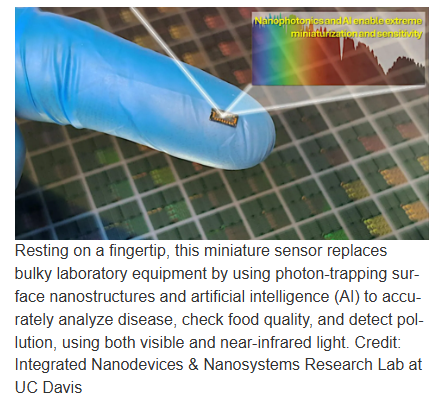
- Researchers at University of California Davis have created an extremely small AI-powered spectrometer chip that could replace large laboratory machines used to analyze light and chemicals. The new device is so tiny that it is close to the size of a grain of sand, yet it can still perform detailed measurements that normally require bulky equipment.
- Traditional spectrometers work by splitting light into different colors using prisms or gratings. Because light must travel through several components, these systems are usually large, expensive, and difficult to shrink. The UC Davis team solved this problem by using artificial intelligence instead of traditional optics.
- The chip contains 16 specially designed silicon detectors. Each detector reacts differently to incoming light, collecting partial information about the light spectrum. A neural network trained on thousands of examples then reconstructs the full spectrum from these signals. This AI-based method allows the chip to achieve high accuracy without the need for large optical parts.
- The researchers also improved the chip’s ability to detect near-infrared light, which is useful for medical imaging because it can penetrate deeper into human tissue. They achieved this by adding special photon-trapping textures to the silicon surface, increasing the chip’s sensitivity.
- The completed system measures only 0.4 square millimeters but could eventually be used in portable medical devices, wearable health monitors, food safety testing, and pollution detection systems.
////////////////////////////////////////////////////////////////////////////////////////////////////////////////////////////////////////////
Story: Each atom in the universe might be unique
Source: Scientific American Story by K. R. Callaway
Link: https://www.scientificamerican.com/article/each-atom-in-the-universe-might-be-unique/

- Scientists have long believed that atoms of the same type are completely identical. For example, every hydrogen atom is assumed to behave exactly like every other hydrogen atom because they contain the same number of protons, neutrons, and electrons.
- This idea is one of the foundations of modern physics and helps explain how chemistry, materials, and technologies such as quantum computing work. However, surprisingly, this assumption has never actually been tested directly in an experiment.
- A physicist named Mark Raizen is proposing experiments to test whether atoms might have tiny, hidden differences. His idea is that atoms could be a little like two cars of the same model: they look identical at first glance, but close inspection might reveal small differences.
- Another physicist, Christian Sanner, uses this comparison to explain the concept.
- To test this, researchers would use lasers to cool and trap individual atoms inside extremely precise atomic clocks. They would then measure subtle magnetic properties created by the atom’s nucleus. If any tiny differences appear between supposedly identical atoms, it could challenge a major assumption in physics.
- Even scientists who doubt atoms are actually unique still think the experiment is important. Science advances by testing assumptions, even deeply accepted ones.
- The researchers emphasize that speculation alone is not enough—only experiments can decide whether atoms are truly identical or whether every atom in the universe might somehow be unique.
////////////////////////////////////////////////////////////////////////////////////////////////////////////////////////////////////////////
Story: New panels produce hydrogen fuel using only water, sunlight and no electricity
Source: Interesting Engineering Story by Aman Tripathi
Link: https://interestingengineering.com/energy/panels-produce-hydrogen-fuel-water-sunlight

- Researchers in Germany have developed a new type of solar panel that can make hydrogen fuel using only sunlight and water—without needing electricity from the power grid.
- Instead of using the usual two-step process (solar panels making electricity, then electricity splitting water), this technology combines everything into one system. The special panel uses light-sensitive materials that absorb sunlight and directly split water into hydrogen and oxygen through a process called photocatalysis.
- The technology was created by a startup called Photreon, a spin-off from the Karlsruhe Institute of Technology (KIT). They recently demonstrated a prototype panel about one square meter in size.
- The goal is to make hydrogen production simpler, cheaper, and easier to use in places where traditional hydrogen systems are too expensive or impractical. Unlike standard “green hydrogen” systems, these panels do not require bulky electrolyzers or electrical connections to the grid.
- The researchers designed the panels to be made from common materials using standard manufacturing methods, which could make large-scale production easier. Because the panels are modular, they could work in many settings—from rooftops at factories to large solar farms in sunny regions.
- Industries like food production, specialty chemicals, or metalworking might eventually produce their own hydrogen fuel on-site rather than relying on deliveries.
- However, the technology is still in an early stage. While promising, experts note that key questions remain, including how efficient the panels are, how durable they will be over time, and whether hydrogen storage and handling can be done economically at scale.
- For now, the system is best viewed as an exciting experimental step toward cleaner energy rather than a ready-to-deploy replacement for existing hydrogen production methods.