

Show Notes 12 December 2025
Story 1: Hyundai wants to cut EV charging time to 3 minutes, as fast as filling up a gas car
Source: Electrek.com Story by Peter Johnson
Link: https://electrek.co/2025/11/20/hyundai-cut-ev-charging-time-3-minutes/
- My comment – key trend to watch are efforts to dramatically cut charging time for EVs.
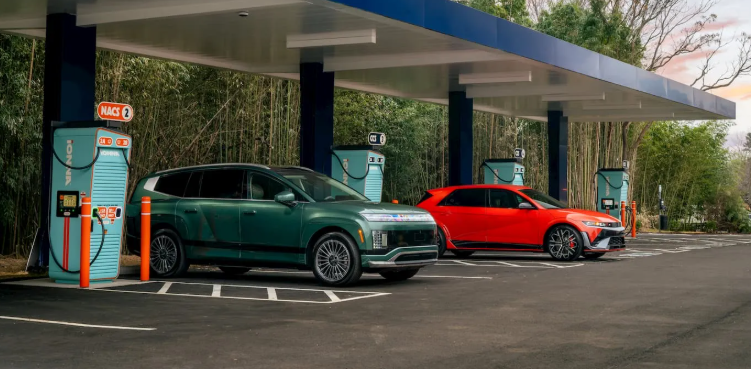
- Hyundai’s electric vehicles, like the IONIQ 5, are among the fastest charging EVs, but the company says it’s still not quick enough. To match a typical gas fill-up, Hyundai believes 3 minutes is the magic number for EV charging times.
- Built on the E-GMP platform, the Hyundai IONIQ 5 and IONIQ 6 can recharge from 10% to 80% in as little as 18 minutes using a 350 kW DC fast charger and 800V system.
- More on the E-GMP platform – The E-GMP (Electric Global Modular Platform) is Hyundai Motor Group’s dedicated electric vehicle architecture, launched in 2021, designed to underpin Hyundai, Kia, and Genesis EVs with high efficiency, flexibility, and advanced technology.
- Key Features of E-GMP
- Dedicated EV Platform: Unlike modified gasoline platforms, E-GMP is built exclusively for battery electric vehicles (BEVs).
- Skateboard Design: Houses a flat, liquid-cooled battery pack between the axles, maximizing cabin space and lowering the center of gravity.
- Flexible Layouts: Supports rear-wheel drive, front-wheel drive, and dual-motor all-wheel drive configurations.
- High Performance:
- Range: Over 500 km (WLTP) on a full charge
- Fast Charging: Up to 80% in 18 minutes with 800V charging
- Acceleration: 0–100 km/h in under 3.5 seconds for performance models
- Advanced Power Electronics: Uses silicon carbide semiconductors for efficiency and integrates inverter, motor, and transmission into a compact Power Electric (PE) system.
- Bi-Directional Charging: Vehicles can supply power externally (Vehicle-to-Load), enabling them to run appliances or even charge other EVs.
- Safety & Stability: Optimized crash structures and battery protection enhance passenger safety.
- Although that’s already among the best in the industry, Hyundai is pushing for even faster charging. According to Tyrone Johnson, head of Hyundai Motor Europe Technical Center, drivers are looking for EV charging times of around 3 minutes.
- To achieve 3-minute charging times, Hyundai is working to bring 400 kW charging to market. By doing so, Hyundai will not only cut EV charging times to match the time it takes to fill up a gas tank but also provide a longer driving range without using a bigger, more expensive battery.

Story 2: Japanese scientists unveil a quantum battery that defies energy loss
Source: ScienceDaily.com Story from RIKEN
Link: https://www.sciencedaily.com/releases/2025/10/251023031612.htm
See research paper here: https://journals.aps.org/prl/abstract/10.1103/PhysRevLett.134.180401
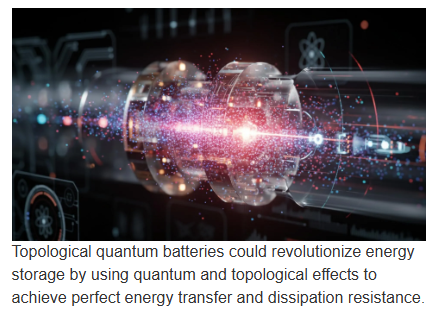
- Japanese researchers at RIKEN [which refers to Institute of Physical and Chemical Research] have designed a breakthrough topological quantum battery that resists energy loss and decoherence, two major hurdles in quantum energy systems.
- Side note – A quantum battery is a new type of energy storage device that uses the principles of quantum mechanics—like superposition, entanglement, and quantum coherence—to store and release energy far more efficiently than traditional chemical batteries.
- Traditional batteries (like lithium-ion) rely on chemical reactions to store and release energy.
- Quantum batteries instead use quantum states of atoms, ions, or photons to hold energy.
- Because of quantum effects, they can theoretically achieve instant charging, lossless energy transfer, and infinite cycle life
- Side note – why “topological” quantum battery? In physics, topology refers to properties of a system that remain stable even when the system is disturbed. A topological quantum battery leverages these properties to protect energy transfer from dissipation (loss). This means energy can be stored and moved with remarkable stability.
- How the Institute of Physical and Chemical Research battery works: It uses the topological characteristics of photonic waveguides and the quantum behavior of two-level atoms to store and transfer energy.
-
Advantages Over Conventional Batteries:
- Faster charging
- Higher capacity
- Long-distance energy transfer
- Immunity to dissipation
- Potential uses include nanoscale energy storage, optical quantum communication, and distributed quantum computing systems.
- Researchers aim to bridge the gap between theory and practice, moving toward real-world deployment of quantum batteries.
- Quantum batteries could revolutionize energy storage by eliminating inefficiencies tied to chemical reactions.
- They’re especially promising for quantum computers and communication systems, where traditional batteries are impractical.
- Lithium-ion will remain dominant for everyday devices until quantum batteries move from theory to practice.

Story 3: Smart Bandage Uses Electricity and Drugs to Heal Wounds – The device uses an AI model to guide the healing process
Source: IEEE Spectrum Story by Diya Swarakanath
Link: https://spectrum.ieee.org/smart-bandage-ai-electrical-stimulation
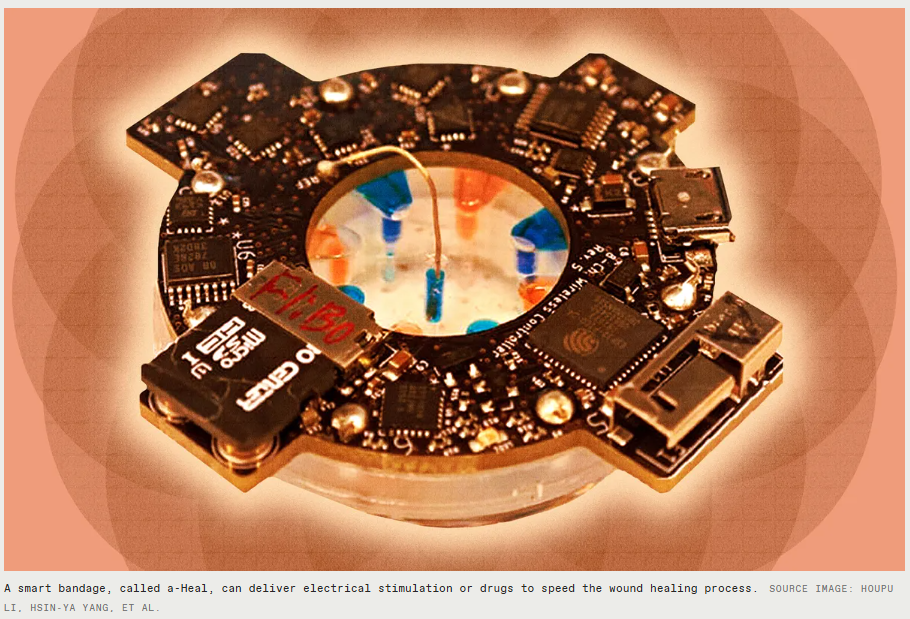
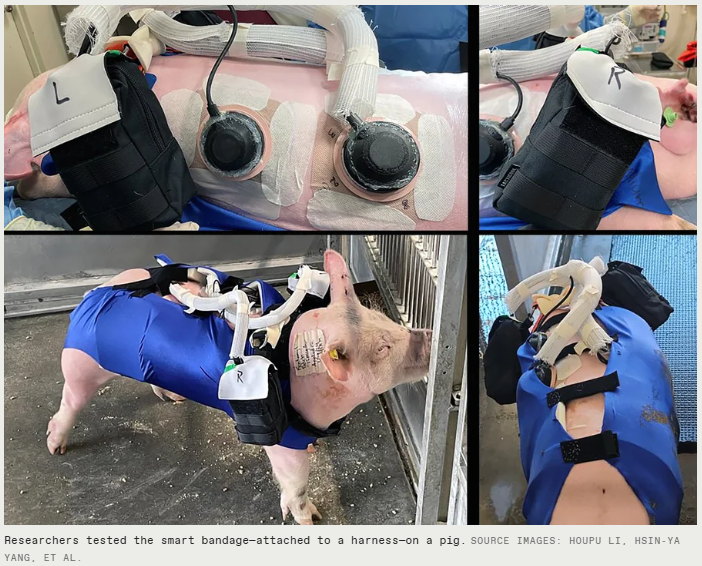
- Researchers from the University of California, Santa Cruz, in collaboration with UC Davis, and supported by DARPA’s BETR (Bioelectronics for Tissue Regeneration) program have developed a prototype smart bandage called a-Heal, which uses AI-guided electrical stimulation and drug delivery to accelerate wound healing.
- Tested on pigs, it showed faster tissue growth and reduced inflammation compared to traditional dressings.
- Device Overview:
- a-Heal fits inside a commercial colostomy bandage.
- Side note –
- A commercial colostomy bandage usually looks like a flat adhesive barrier with a central opening for the stoma, attached to a small pouch or covered with absorbent material if used temporarily instead of a pouch.
- A stoma is a surgically created opening on the body that allows waste (stool, urine, or air) to exit when the normal route isn’t possible.
- a-Heal is equipped with a camera that takes wound images every two hours.
- Wirelessly connected to a machine learning module called ML Physician.
- AI Functionality:
- ML Physician analyzes wound images, compares them with training data, and determines healing stage.
- Based on analysis, it decides whether to apply electrical stimulation or deliver fluoxetine (a drug that promotes tissue growth).
- Uses a closed-loop feedback system to continuously adjust treatment.
- Treatment Mechanism:
- Electrical stimulation reduces inflammation.
- Drug delivery via iontophoresis precisely controls dosage.
- Side note – Iontophoresis is a way of using a very gentle electrical current to push medicine or block sweat through the skin without needles.
- The bandage alternates treatments depending on healing stage probabilities.
- Results from Pig Trials:
- After 7 days, wounds treated with a-Heal had 50% new skin coverage, compared to 20% in control wounds.
- Inflammation reduced by 61%.
- Improvements noted in the process by which a wound or exposed surface becomes covered with new epithelial tissue, restoring the protective outer layer of the skin or mucous membrane. As well as blood vessel growth, and wound maturation.

Story 4: Focused Ultrasound Passes First Test in Treatment of Brain Cancer in Children
Source: Columbia University Irving Medical Center
See the research paper here: https://www.science.org/doi/10.1126/scitranslmed.adq6645
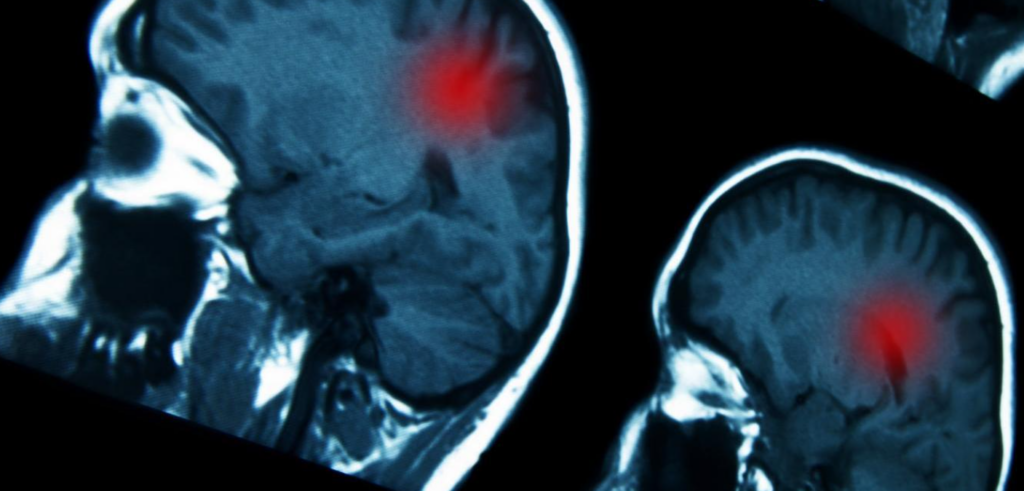
- Columbia University researchers are the first to show that focused ultrasound—a non-invasive technique that uses sound waves to enhance the delivery of drugs into the brain—can be safely used in children being treated for brain cancer.
- The focused ultrasound technique, developed by Columbia engineers, was tested in combination with chemotherapy in three children with diffuse midline glioma, a rare and aggressive brain cancer that is universally fatal.
- The study found that focused ultrasound successfully opened the blood-brain barrier in all three patients, allowing the chemotherapy drug to reach the tumors and leading to some improvement in patient mobility, though all three patients eventually died from their disease or complications of COVID.
- Side note – The blood-brain barrier (BBB) is a protective, semi-permeable filter formed by tightly packed cells in the brain’s blood vessels that shields the brain from harmful substances while allowing essential nutrients to pass through.
- Columbia has already launched a follow-up trial using focused ultrasound with etoposide, an FDA-approved chemotherapy drug that has shown activity against brain cancer cells.

Honorable Mentions
Story: Research team develops game-changing material that could transform future buildings: ‘Challenges the idea’
Source: The Cool Down via MSN Story by Rick Kazmer
-
Re:Shell Project – Turning Eggshells into Building Material
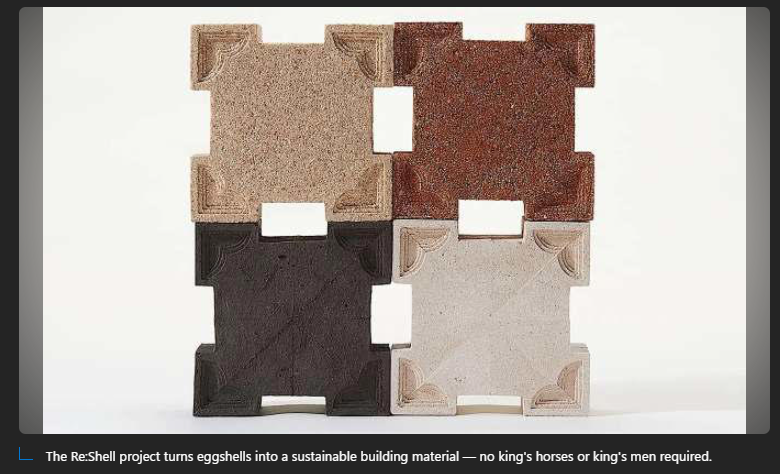
- A South Korea–based initiative called Re:Shell is transforming discarded eggshells into a sustainable construction material.
- Eggshells are combined with clay, wheat bran, and straw to create a breathable, lightweight, and durable substance that eventually biodegrades in soil.
-
Environmental Context
- Globally, 7.2–10 million tons of eggshell waste are produced annually, which contributes to methane emissions when trashed.
- Concrete production accounts for about 8% of global CO₂ emissions, making alternatives like Re:Shell vital for reducing pollution.
- Other eco-friendly building concepts include fungal-based materials and self-repairing substances.
-
Korea’s Building Waste Problem
- Around 45% of Korea’s total refuse comes from demolition debris, especially from aging 1970s-era buildings.
- Re:Shell aims to prevent this cycle by offering biodegradable materials that don’t leave lasting waste.
-
How It Works
- Eggshells are washed, dried, and ground into powder.
- Mixed with other natural materials, the result is a durable yet biodegradable construction material.
- Eggshells are rich in calcium carbonate, a binding agent also found in concrete, making them effective for construction use.
////////////////////////////////////////////////////////////////////////////////////////////////////////////////////////////////////////////
Story: Science history: Experiment shows mutations arise spontaneously, supporting pillar of Darwinian evolution
Source: LiveScience.com Story by Tia Ghose
- Summary: The article highlights the landmark 1943 experiment by Salvador Luria and Max Delbrück, which demonstrated that genetic mutations in bacteria arise spontaneously rather than as a direct response to environmental pressures. This finding provided crucial evidence supporting Charles Darwin’s theory of evolution by natural selection and refuted Jean-Baptiste Lamarck’s idea that organisms adapt through need-driven changes.
- On November 20, 1943, Luria and Delbrück published their experiment results, marking a pivotal moment in evolutionary biology.
-
The Experiment:
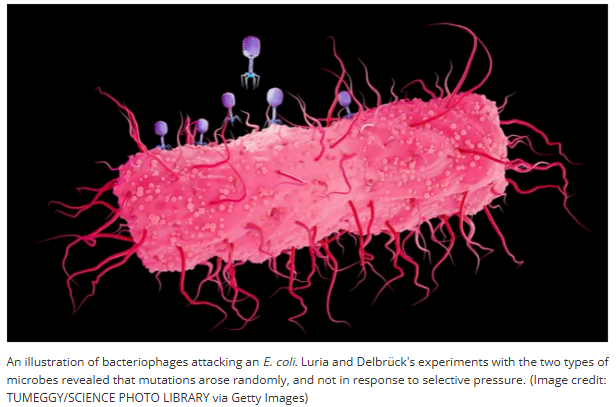
- They studied E. coli bacteria exposed to bacteriophages (viruses that infect bacteria).
- If mutations were induced by the environment (Lamarckian view), every bacterial culture should show similar resistance levels.
- Instead, they observed wide variation in resistance across cultures, indicating mutations occurred randomly before exposure.
-
Impact on Evolutionary Theory:
- Their work confirmed that mutations are random events, not purposeful adaptations.
- This randomness is a cornerstone of Darwinian evolution, where natural selection acts on pre-existing variation rather than directing it.
-
Scientific Legacy:
- The experiment became known as the Luria-Delbrück fluctuation test.
- It laid the foundation for modern molecular genetics and reinforced the role of chance in evolutionary processes.
-
Why It Matters
- Darwin vs. Lamarck: The study decisively shifted scientific consensus toward Darwin’s model, showing that evolution depends on random mutations filtered by natural selection.
- Modern Relevance: Today, the principle underpins research in genetics, antibiotic resistance, and evolutionary biology.
- In short, the article celebrates the Luria-Delbrück experiment as a pillar of evolutionary science, proving that mutations are spontaneous and random, not directed by environmental need.
////////////////////////////////////////////////////////////////////////////////////////////////////////////////////////////////////////////
Story: Breakthrough Helps Scientists Grow More Realistic Human Brain Models
Source: ScienceAlert.com Story by David Nield
Link: https://www.sciencealert.com/breakthrough-helps-scientists-grow-more-realistic-human-brain-models
See research paper here: https://advanced.onlinelibrary.wiley.com/doi/10.1002/adfm.202509452
- Scientists have developed a new scaffold system that allows donated neural stem cells to grow into more realistic human brain tissue models, potentially revolutionizing neuroscience research.
- Studying real, living human brain tissue is nearly impossible because it’s needed by its owner. Traditional lab-grown brain organoids often lack realistic structure and function.
- Breakthrough innovation: Researchers at the University of California, Riverside (UCR) created a tiny scaffold about 2 millimeters wide that supports the growth of neurons from donated stem cells.
- The scaffold system: Named BIPORES (Bijel-Integrated PORous Engineered System), it’s made mostly of polyethylene glycol (PEG), a common polymer. This porous structure provides a supportive environment for cells to attach, grow, and form networks.
- Why it matters:
- Enables scientists to grow more realistic brain tissue models in the lab.
- Could improve studies of neurodegenerative diseases like Alzheimer’s and Parkinson’s.
- Offers a safer, more ethical alternative to experimenting on living brain tissue.
- Future potential: These engineered brain models may help test new drugs, study brain development, and explore how neurons interact in complex networks, bringing us closer to understanding the human brain at a deeper level.
- Why This Is Significant – This breakthrough bridges a critical gap in neuroscience: the ability to replicate realistic brain tissue outside the body. By combining stem cells with engineered scaffolds, researchers can create lab-grown models that mimic the brain’s structure and function far better than previous organoids. This could accelerate discoveries in neurological disorders, drug testing, and regenerative medicine.
////////////////////////////////////////////////////////////////////////////////////////////////////////////////////////////////////////////
Story: MIT Is One Step Closer to Having Building-Sized Batteries With This Innovative Tech
Source: Slashgear Story by Bob Sharp
Link: https://www.slashgear.com/2009844/mit-one-step-closer-building-sized-concrete-batteries/
See also: https://news.mit.edu/2025/concrete-battery-now-packs-ten-times-power-1001
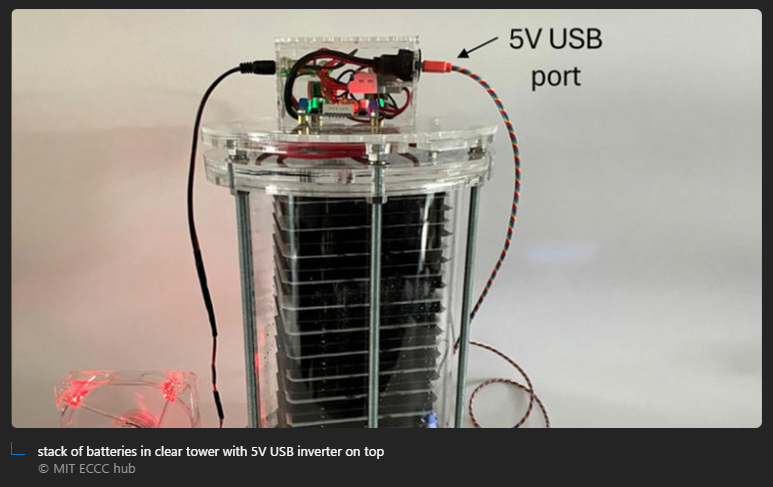
- MIT researchers have developed electron-conducting carbon concrete (ec³), a new type of concrete that can store and release energy.
- This innovation could transform concrete from a simple building material into a giant battery system.
-
How It Works
- The material combines ultra-fine carbon black (a petroleum byproduct used in tires) with an electrolyte.
- Together, they allow concrete structures to function like batteries, storing and discharging electricity.
-
Advancements
- Since 2023, MIT engineers have improved the energy density ninefold.
- The latest version of ec³ can store enough energy to power an average home in about 5 cubic meters of concrete (roughly the size of a basement wall).
-
Potential Impact
- Beyond powering homes and offices, the vision is for entire cities to act as massive batteries, integrating energy storage directly into infrastructure.
- This could support renewable energy adoption by stabilizing supply and demand.