


Show Notes 23 January 2026
Story 1: MIT just made aluminum 5x stronger with 3D printing – it is stronger, lighter, and tough enough to reshape the future of flight
Source: ScienceDaily Based on MIT news announcement
Link: https://www.sciencedaily.com/releases/2025/12/251226045316.htm
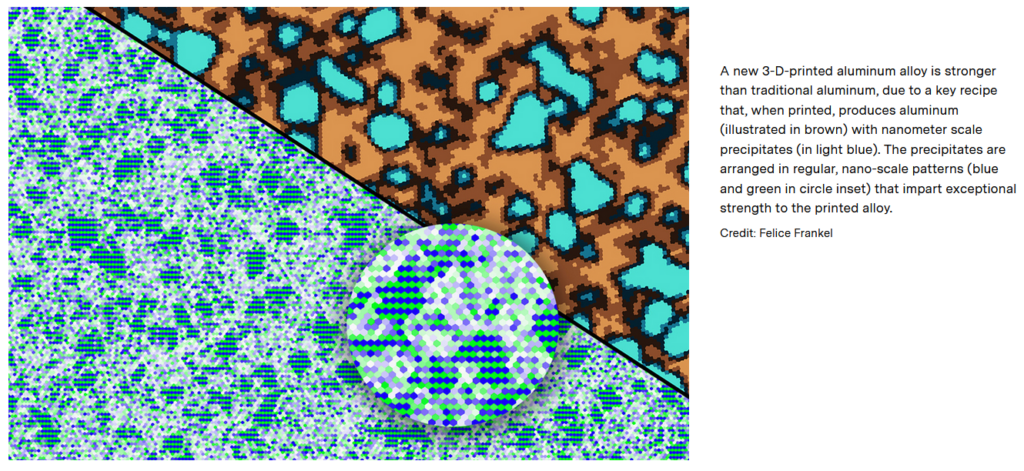
- MIT engineers created a new 3D-printable aluminum alloy that is five times stronger than standard cast aluminum.
- The alloy also stays stable at extreme temperatures (up to 400°C – about 752 °F), which is unusually high for aluminum.
- How They Did It
- Instead of testing over 1 million possible alloy combinations, researchers used machine learning to narrow the search to 40 candidates.
- The winning formula produces nanometer-scale precipitates—tiny internal structures that dramatically increase strength.
- Side note – A precipitate is what you get when two liquids react and make a solid that wasn’t there before. That solid often looks cloudy, grainy, or settles at the bottom.
- 3D printing (using laser powder bed fusion) cools the metal extremely fast, preserving these ultra-fine structures that traditional casting would destroy.
-
Side note about laser powder bed fusion:
- Laser Powder Bed Fusion is one of the most advanced and widely used metal 3D‑printing technologies. It’s the process behind many aerospace turbine blades, medical implants, rocket components, and high‑performance automotive parts. The technique is precise, powerful, and capable of producing geometries that traditional machining simply can’t achieve.
- Laser Powder Bed Fusion is an additive manufacturing process where a high‑powered laser selectively melts thin layers of metal powder to build a part layer by layer. Each layer is typically only 10–200 micrometers thick. After a layer is melted, the build platform lowers, a new layer of powder is spread, and the laser repeats the pattern.
- Why It Matters
- The alloy could replace heavier, more expensive metals like titanium in:
- Jet engine fan blades
- High-end automotive parts
- Vacuum pumps
- Data-center cooling systems
- Lighter, stronger parts mean major energy savings in transportation and industry.
- This is a materials-science milestone: Machine learning + 3D printing = alloys that were previously impossible to design or manufacture.
- MIT expects this approach to reshape how high-performance metals are engineered.

Story 2: New ‘physics shortcut’ lets laptops tackle quantum problems once reserved for supercomputers and AI
Source: LiveScience.com Story by Owen Hughes
- Researchers at the University at Buffalo have developed a new physics-based shortcut that allows ordinary laptops to solve certain quantum physics problems that previously required supercomputers or advanced AI systems.
- The breakthrough is connected to quantum systems, entanglement, and quantum mechanics, areas that normally demand massive computational power.
- The technique dramatically reduces the computational load by using insights from physics rather than brute-force calculation.
- The article frames this as a major step toward making quantum research more accessible, potentially accelerating progress in quantum technologies.
- What This Breakthrough Actually Means – A plain-language explanation of the “physics shortcut”
- 1. The core problem
- Quantum systems — things like entanglement, interacting particles, and quantum materials — are incredibly hard to simulate.
Why? Because the amount of information you need to track grows exponentially as the system gets bigger.
- Traditionally, only supercomputers or large AI models could handle these calculations.
-
2. The new idea: use physics to skip the hard parts
- Instead of crunching every possible quantum state (which is impossible on a normal computer), researchers found a shortcut based on the structure of quantum mechanics itself.
- Think of it like this:
- Instead of calculating everything,
- They identify patterns and constraints built into quantum physics,
- And use those to jump directly to the answer.
- It’s similar to solving a maze by knowing the layout rules instead of exploring every path.
- This dramatically reduces the computational load.
- 3. Why a laptop can now do what a supercomputer did
- Because the shortcut avoids the exponential explosion of calculations, a regular laptop can now solve certain quantum problems that used to be out of reach.
- It’s not that laptops suddenly got more powerful — it’s that the math got smarter.

Story 3: Hyperloop shock: China’s maglev hits 435 mph in 2 seconds, sets world record
Source: Interesting Engineering Story by Sujita Sinha
Link: https://interestingengineering.com/transportation/china-maglev-hits-435-mph-in-2-seconds

- Researchers from the National University of Defense Technology in China have set a new world record for superconducting maglev technology by accelerating a 1.1-ton test vehicle to 700 km/h (435 mph) in just two seconds on a 400-meter track.
- Reminder – Maglev is short for magnetic levitation, a transportation technology where vehicles—e.g. trains—float above a guideway using magnetic forces instead of wheels.
- The system also demonstrated precise, rapid braking, marking a major leap in ultra-high-speed electromagnetic propulsion.
- This breakthrough solves several long-standing challenges:
- Ultra high-speed electromagnetic propulsion
- Stable electric suspension and guidance
- High power energy storage and conversion
- Control of high field superconducting magnets
- Beyond Trains: Broader Applications – the same tech could:
- Provide ground-based launch assistance for rockets or aircraft
- Reduce fuel use during takeoff
- Enable hyperloop style vacuum tube transport
- Support aerospace testing by simulating extreme speeds without flight

Story 4: Nasal drops fight brain tumors noninvasively – Nano-sized medicine boosts anti-cancer immune response, eradicates tumors in mice
Source: Washington University Taylor Family Department of Neurosurgery
Link: https://neurosurgery.wustl.edu/nasal-drops-fight-brain-tumors-noninvasively/
- Glioblastoma tumors form from brain cells called astrocytes and are the most common kind of brain cancer, affecting roughly three in 100,000 people in the U.S.
- Glioblastoma is an aggressive, fast-growing cancer of the brain or spinal cord. It begins in astrocytes, which are star shaped support cells that help nerve cells function.
- Glioblastoma generally progresses very quickly and is almost always fatal.
- There are no curative treatments for the disease, in part because delivering medicines to the brain remains extremely challenging.
- Researchers at Washington University School of Medicine in St. Louis, along with collaborators at Northwestern University, have developed a noninvasive approach to treat one of the most aggressive and deadly brain cancers.
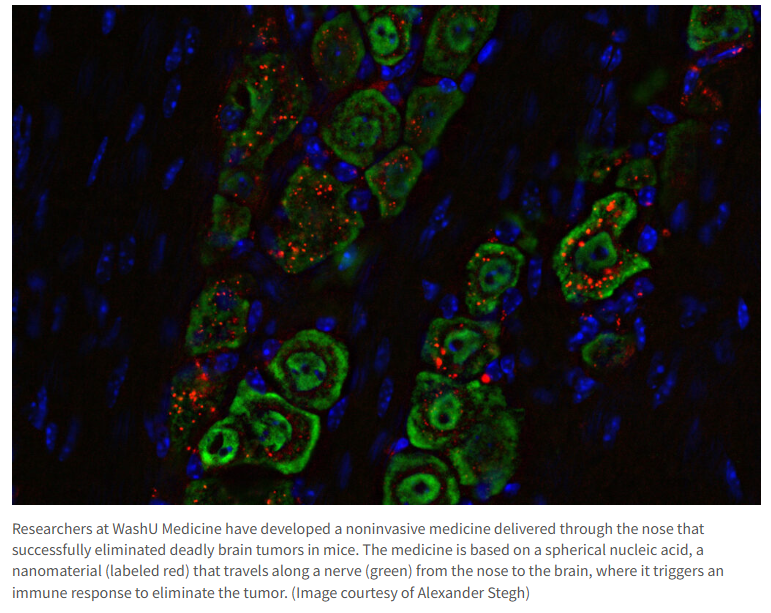
- Their technology uses precisely engineered structures assembled from nano-size materials to deliver potent tumor-fighting medicine to the brain through nasal drops.
- The novel delivery method is less invasive than similar treatments in development and was shown in mice to effectively treat glioblastoma by boosting the brain’s immune response.
- How it works: The medicine “rides” a nerve highway that directly connects the inside of the nose to the brain.
- Here’s how it works step by step:
- 1. The drops [nanomedicine] are placed inside the nasal passages
- 2. The particles in the nasal drops latch onto a major nerve that runs from the face to the brain
- This nerve is the trigeminal nerve, which has branches that end inside the nasal cavity.
- This nerve provides a direct physical pathway into the brain—no bloodstream required.
- 3. The nanoparticles move along the nerve fibers and can bypass the blood–brain barrier, which normally blocks most drugs.
- Reminder – The blood-brain barrier is a highly selective, semipermeable barrier formed by specialized cells lining the brain’s blood vessels. It regulates what can move from the blood into the brain, protecting neural tissue from harmful substances while allowing essential nutrients to pass through.
- 4. After traveling along the nerve, the nanoparticles reach the brain tissue, including the glioblastoma tumor.
- 5. Once inside the brain, the drug triggers an immune attack on the tumor.

Honorable Mentions
Story: This 3D-printed, carbon-absorbing bridge is inspired by bones
Source: CNN Story by Rebecca Calms
Link: https://www.cnn.com/science/diamanti-3d-printed-concrete-sustainable-bridge-hnk-spc-intl


- Affordable, versatile, incredibly strong and locally available, concrete is the world’s most used manmade material.
- But it also has a huge carbon footprint, accounting for around 8% of global greenhouse emissions.
- The concrete and cement sector has been trying to reduce its environmental impact for years through sustainable concrete mixtures or efficient designs.
- Now, a research team at the University of Pennsylvania has combined both novel materials and a material-saving design, without compromising on strength and durability.
- The project, called Diamanti, takes inspiration from nature and uses a robotic 3D printer to create complex, lattice-like patterns with a sustainable concrete mixture.
- While most regular concrete absorbs carbon dioxide (up to 30% of its production emissions over its entire life cycle, according to some research), Diamanti’s enhanced concrete mixture absorbs 142% more carbon dioxide than conventional concrete mixes.
- Diamanti’s concrete mixture uses diatomaceous earth (DE), a naturally porous, silica-rich material made from fossilized algae, to replace some of the cement.
- Its first design, a pedestrian bridge, uses 60% less material while retaining mechanical strength, says Masoud Akbarzadeh, an associate professor of architecture at the University of Pennsylvania and director of the lab that spearheaded the project.
- By mimicking the structures in certain porous bones — known as triply periodic minimal surface (TPMS) structures, Diamanti also increased the surface area of the bridge, increasing the concrete mixture’s carbon absorption potential by another 30%.
- The project, launched in 2022 in collaboration with Swiss-headquartered chemical company Sika and with grants from the US Department of Energy, is now gearing up to build its first full-size prototype in France.
////////////////////////////////////////////////////////////////////////////////////////////////////////////////////////////////////////////
Story: New drug stalls Alzheimer’s development in breakthrough trial
Source: ScienceAlert.com Story by David Nield
Link: https://www.sciencealert.com/new-drug-stalls-alzheimers-development-in-breakthrough-trial

- A new experimental drug has shown the ability to stall early Alzheimer’s progression in a breakthrough clinical trial.
- The treatment appears to work by targeting reactive astrogliosis, a process involving astrocytes—support cells in the brain that become overactive when neurons are stressed.
- Traditional Alzheimer’s trials have often failed because they focused mainly on amyloid plaque removal, but this study suggests that astrocyte activity may be a crucial missing link.
- Early evidence indicates the drug may help protect neurons and slow cognitive decline.
- The article briefly mentions related research, including work on microdosing cannabis and its potential effects on Alzheimer’s progression.
////////////////////////////////////////////////////////////////////////////////////////////////////////////////////////////////////////////
Story: Scientists build a quantum computer that can repair itself using recycled atoms
Source: Phys.org Story by Robert Egan
Link: https://phys.org/news/2025-12-scientists-quantum-recycled-atoms.html

- Scientists at Atom Computing, which is a US-based company have developed a new type of quantum computer capable of self-repair by recycling atoms.
- The system uses optical tweezers—highly focused laser beams—to trap, move, and rearrange atoms with extreme precision.
- Five Distinct Functional Zones – The architecture is divided into five zones, each with a specific role:
- Self-Repair Through Atom Recycling – When atoms are lost or become unusable, the system can replace them with recycled atoms, maintaining the integrity of the quantum processor.
////////////////////////////////////////////////////////////////////////////////////////////////////////////////////////////////////////////
Story: New Image Sensor Breaks Optical Limits – My subhead: a lens‑free system that achieves sub‑micron, 3D resolution across a wide field of view, something previously considered impossible with optical wavelengths
Source: University of Connecticut Story by Sarah Redmond
Link: https://today.uconn.edu/2025/12/new-image-sensor-breaks-optical-limits/
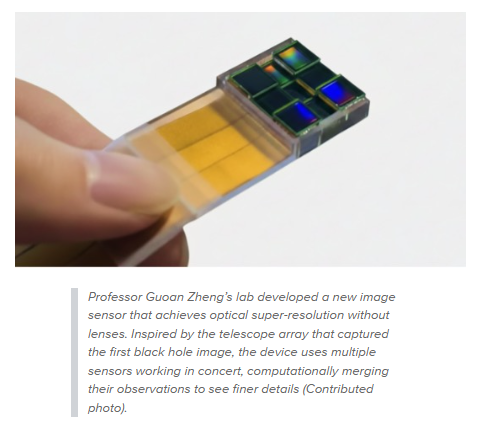
- UConn engineers have developed a breakthrough imaging technology called the Multiscale Aperture Synthesis Imager (MASI) — a lens‑free system that achieves sub‑micron, 3D resolution across a wide field of view, something previously considered impossible with optical wavelengths.
- No lenses required. Instead of focusing light with glass, MASI uses an array of coded sensors that capture raw diffraction patterns.
- Computational phase synchronization. Traditional optical synthetic aperture systems fail because sensors must be aligned with nanometer precision. MASI bypasses this by letting each sensor operate independently and then synchronizing their data computationally.
- Inspired by the Event Horizon Telescope. Like the telescope array that imaged a black hole, MASI merges multiple sensors’ wavefield measurements to simulate a much larger aperture.