


Show Notes 7 November 2025
Bonus fun virtual experience – Google’s virtual Route 66 driving adventure. Check it out at https://artsandculture.google.com/project/route-66 Created by Google Arts & Culture in collaboration with the National Trust for Historic Preservation


- Google’s virtual Route 66 driving adventure, “Route 66 Rewind,” is an immersive online experience that lets users travel the iconic American highway from Chicago to Los Angeles—without leaving home.
- Created by Google Arts & Culture in collaboration with the National Trust for Historic Preservation, this interactive journey celebrates the centennial of Route 66 by spotlighting 33 quirky and historic roadside attractions across all eight states the highway crosses. Users can toggle between present-day Google Street View and AI-generated, historically inspired video footage that evokes the sights and spirit of mid-century road trips. The project blends archival photos, community stories, and cultural landmarks to honor the “Mother Road” as both a symbol of American freedom and a living thread connecting diverse communities.
Story 1: Powered by mushrooms, living computers are on the rise – Neural organics lead to lower energy costs, faster calculation speeds
Source: Ohio State News Story by Tatyana Woodall
Link: https://news.osu.edu/powered-by-mushrooms-living-computers-are-on-the-rise/
See also: https://bioengineer.org/mushroom-powered-technology-the-emergence-of-living-computers/
See research paper here: https://journals.plos.org/plosone/article?id=10.1371/journal.pone.0328965
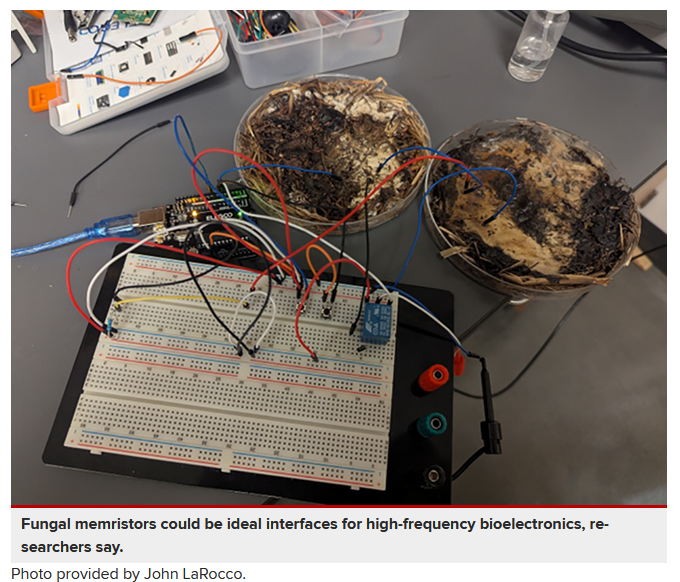
- Fungal networks may be a promising alternative to tiny metal devices [as you will see in the abstract below, this refers to semiconductor-based neuromorphic chips] used in processing and storing digital memories and other computer data, according to a new study from researchers at Ohio State.
- Side note – here is the abstract from the research paper:
- Neuromorphic computing, inspired by the structure of the brain, offers advantages in parallel processing, memory storage, and energy efficiency. However, current semiconductor-based neuromorphic chips require rare-earth materials and costly fabrication processes, whereas neural organoids need complex bioreactor maintenance.
- In this study, we explored shiitake (Lentinula edodes) fungi as a robust, sustainable alternative, exploiting its adaptive electrical signaling, which is akin to neuronal spiking.
- We demonstrate fungal computing via mycelial networks interfaced with electrodes, showing that fungal memristors can be grown, trained, and preserved through dehydration, retaining functionality at frequencies up to 5.85 kHz, with an accuracy of 90 ± 1%.
- Notably, shiitake has exhibited radiation resistance, suggesting its viability for aerospace applications.
- Our findings show that fungal computers can provide scalable, eco-friendly platforms for neuromorphic tasks, bridging bioelectronics and unconventional computing.
- Mushrooms have long been recognized for their extreme resilience and unique properties. Their innate abilities make them perfect specimens for bioelectronics, an emerging field that, for next-gen computing, could help develop exciting new materials.
- For example, researchers from The Ohio State University recently discovered that common edible fungi, such as shiitake mushrooms, can be grown and trained to act as organic memristors, a type of data processor that can remember past electrical states.
- Side note – A memristor (short for memory resistor) is a type of passive electrical component that can both control electrical current and remember the amount of charge that has previously flowed through it—even after power is turned off.
- Their findings showed that these shiitake-based devices not only demonstrated similar reproducible memory effects to semiconductor-based chips but could also be used to create other types of low-cost, environmentally friendly, brain-inspired computing components.

Story 2: Kubota Claims World’s First Hydrogen Fuel Cell, Self-Driving Tractor
Source: Equipmentworld.com Story by Don McLoud
See video here: https://www.youtube.com/watch?v=yzIBOK_fkfU
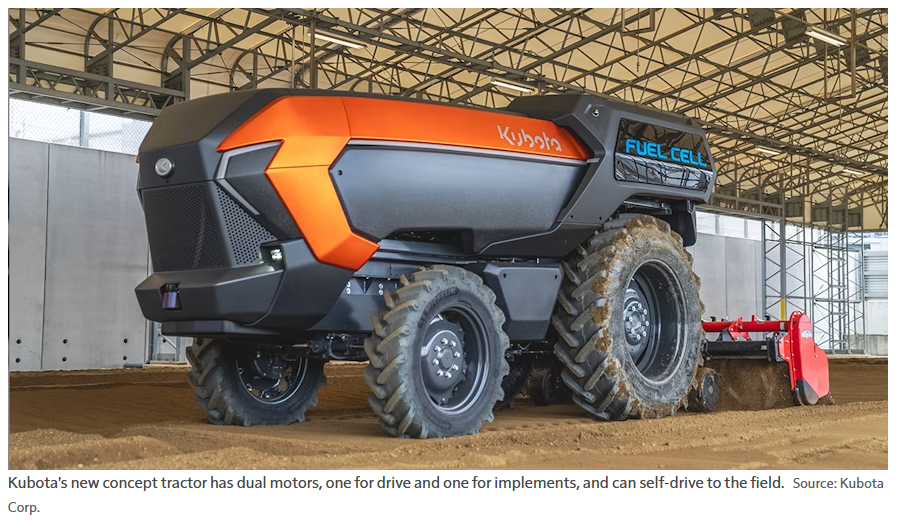
- At the Expo 2025 at Osaka, Japan last month Kubota unveiled a concept tractor the company says is the world’s first autonomous, hydrogen fuel cell tractor.
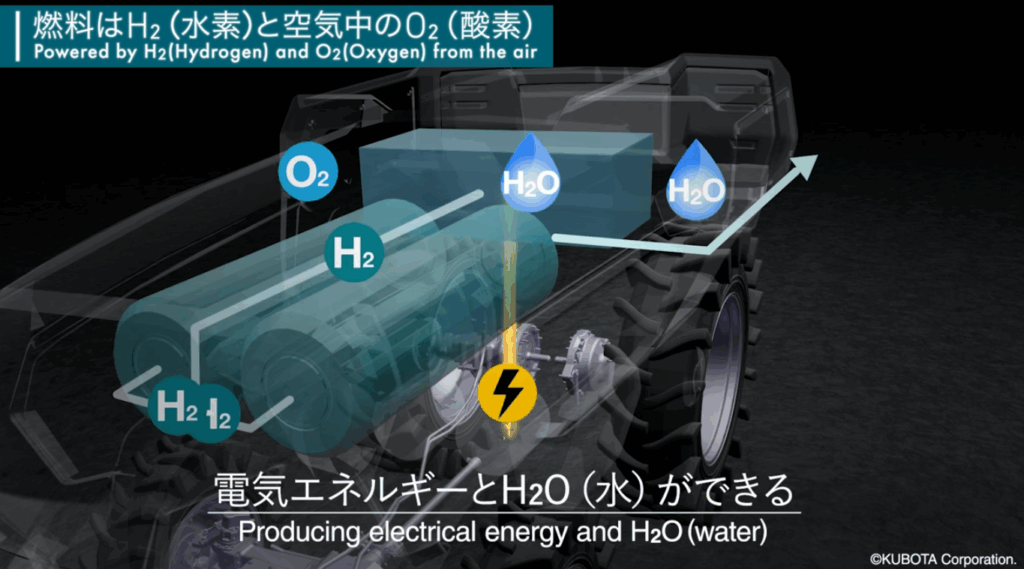
- It is powered by compressed hydrogen, which is pumped into the tractor’s hydrogen tanks similar to a gas or diesel pump. Its output is equivalent to a 100-horsepower diesel engine, the company says.
- The tractor consists of two motors, one for drive and one for Power Take-Off to power implements.
- Side note – A Power Take-Off is a device that transfers mechanical power from the tractor’s engine to an attached implement or accessory—like a mower, tiller, or baler. It’s a common feature in agricultural and industrial equipment, allowing tools to draw energy directly from the tractor’s engine via a rotating shaft. But, in this case, one motor drives the tractor itself, and the other powers the PTO system to operate external implements.
- To operate, the system first supplies hydrogen from the tanks to the solid polymer fuel cell module. Hydrogen then reacts with oxygen from the air, producing electrical energy and water. The electrical energy powers the motor, and water is its only emission.
- Side note – A solid polymer fuel cell module is a compact energy system that uses a solid polymer membrane to convert hydrogen and oxygen into electricity, water, and heat. It’s also known as a proton exchange membrane (PEM) fuel cell.
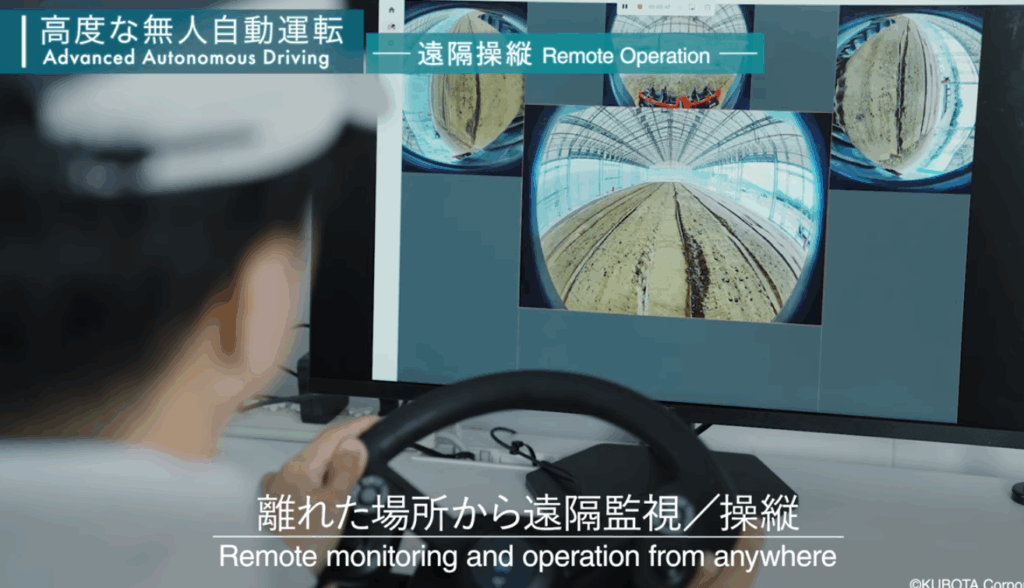
- The tractor can drive itself to the field by using advanced sensors and AI cameras for perception and to maneuver around obstacles.
- It can be operated by remote control from anywhere or on site. In a video, the company shows a remote monitoring and control station where an operator uses a steering wheel, foot pedal and large wall-mounted screens to run the tractor. It also shows an operator using a laptop-like device with shoulder harness to control the tractor close-up in person.
- The futuristic-looking tractor does not have an operator station for a person to ride in.
- The next step is to conduct field tests in Japan.

Story 3: Eye prosthesis is the first to restore sight lost to macular degeneration
Source: Stanford Medicine News Center Story by Nina Bai
Link: https://med.stanford.edu/news/all-news/2025/10/eye-prosthesis.html
See research paper here: https://www.nejm.org/doi/10.1056/NEJMoa2501396

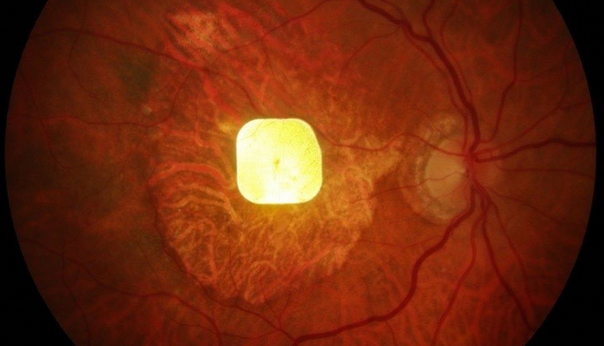
- A tiny wireless chip implanted in the back of the eye and a pair of high-tech glasses have partially restored vision to people with an advanced form of age-related macular degeneration.
- Side note – About 6% of Americans—roughly 19.8 million people—are affected by macular degeneration.
- Macular degeneration destroys light-sensitive photoreceptors in the center of the retina, the thin neural tissue in the back of the eye that converts light into electrical signals that then travel to the brain.
- In a clinical trial led by Stanford Medicine researchers at Stanford University, along with international collaborators, 27 out of 32 participants had regained the ability to read a year after receiving the device.
- With digital enhancements enabled by the device, such as zoom and higher contrast, some participants could read with acuity equivalent to 20/42 vision.
- The device, called PRIMA, is the first eye prosthesis to restore functional sight to patients with incurable vision loss, giving them the ability to perceive shapes and patterns — also known as form vision.
- The co-senior author of the team’s research paper noted, “All previous attempts to provide vision with prosthetic devices resulted in basically light sensitivity, not really form vision. We are the first to provide form vision.”
- How the Stanford system works:
- The two-part device consists of a small camera, mounted on a pair of glasses, that captures images and projects them in real time via infrared light to a wireless chip in the eye.
- The chip converts the images into electrical stimulation, effectively taking the place of natural photoreceptors that have been damaged by disease.
- PRIMA is the culmination of decades of development, prototypes, animal trials and a small first-in-human trial.

Story 4: Scientists Reverse Alzheimer’s in Mice with a Single Injection – It only took two hours for a visible difference
Source: ZME Science Story by Mihai Andrei
See research paper here: https://www.nature.com/articles/s41392-025-02426-1
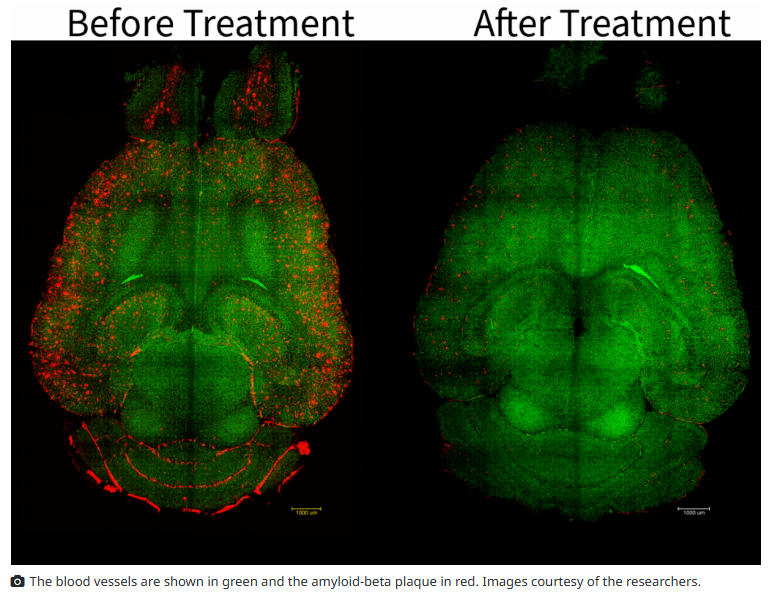
- First some background on today’s treatments for Alzheimer’s disease—specifically targeting [or attacking] amyloid plaques in the brain. Today’s treatments have advanced significantly, though they remain limited to early stages of the disease.
- Side note – Neurological Plaques – In Alzheimer’s disease, plaques are dense clusters of beta-amyloid protein in the brain. These interfere with neuron function and are a hallmark of the disease.
- Here’s a breakdown of current approaches:
- FDA-Approved Plaque-Targeting Therapies – These treatments aim to reduce beta-amyloid plaques, a hallmark of Alzheimer’s:
-
Lecanemab (Leqembi)
- Type: Monoclonal antibody (immunotherapy)
- Use: Early-stage Alzheimer’s or mild cognitive impairment
- Mechanism: Helps clear beta-amyloid plaques from the brain
- Administration: IV infusion every two weeks
- Side Effects: Brain swelling or bleeding (ARIA), flu-like symptoms, blood pressure changes
-
Donanemab (Kisunla)
- Type: Monoclonal antibody
- Use: Early-stage Alzheimer’s
- Mechanism: Similar to lecanemab, targets beta-amyloid
- Administration: IV infusion every four weeks
- Side Effects: Similar risks to lecanemab, including rare serious complications
- Here’s the big news – Now, in a stunning new breakthrough, an international team of researchers headed by the University College London has flipped the script. Instead of attacking the plaques, they rebooted the brain’s natural cleaning system, giving it the tools to clean itself.
- Using nanoparticles as a kind of “Trojan horse,” they restored the function of the blood-brain barrier (BBB) [i.e. the brain’s waste clearance system] and the results were striking. In just two hours, they cleared nearly half of the amyloid plaque from the brains of mice with advanced Alzheimer’s.
- Even more impressive, the cognitive recovery stuck around. Treated mice regained memory and learning abilities comparable to their healthy peers and the benefits lasted for at least six months after a single treatment.
- Lead researcher Giuseppe Battaglia noted, “There’s still important work ahead before human testing, but the results give us strong hope. Our next steps involve confirming safety and reproducibility in larger preclinical models and conducting detailed toxicology studies in accordance with regulatory standards. If these confirm what we’ve already seen, a strong recovery with no toxicity, we plan to move toward early clinical trials. The goal is to bring this approach from the lab to patients, offering a new way to treat Alzheimer’s by restoring the brain’s own defense and repair systems.”

Honorable Mentions
Story: Hydrogen Production Takes Flight at Hamburg Airport with New Infrastructure Roadmap
Source: Hydrogenfuelnews.com Story by Allen Brown

- Hamburg Airport is advancing its commitment to sustainable aviation by launching a new hydrogen infrastructure roadmap.
- The initiative includes plans for onsite hydrogen production, storage, and refueling capabilities to support both ground operations and future hydrogen-powered aircraft.
- The airport is collaborating with energy and aviation partners to create a scalable, modular system that could serve as a blueprint for other airports.
- This move aligns with broader European goals for decarbonizing transportation and positions Hamburg as a leader in green airport innovation.
////////////////////////////////////////////////////////////////////////////////////////////////////////////////////////////////////////////
Story: Smart elastomer muscles give soft robotics record 2,000x lifting capability
Source: Interesting Engineering Story by Aamir Khollam

- A global research team led by the University of Waterloo has developed a new smart elastomer material that acts as an artificial muscle.
- This material enables soft robots to lift up to 2,000 times their own weight — a record-setting capability.
- Why It Matters
- Unlike traditional robots with rigid motors and gears, soft robots use flexible materials that allow safer interaction with humans and delicate environments.
- Applications include:
- Minimally invasive surgeries
- Drug delivery inside the body
- Assembling fragile electronics
- Assisting workers in manufacturing
- Overcoming Limitations
- Previous soft robotic systems struggled with weak and imprecise motion due to limited muscle strength.
- The new elastomer addresses this by offering both strength and flexibility, potentially expanding soft robotics beyond niche uses
////////////////////////////////////////////////////////////////////////////////////////////////////////////////////////////////////////////
Story: Toyota to launch world’s first EV with a solid-state battery by 2027 — they’re expected to last longer and charge faster
Source: Livescience.com Story by Skyler Ware
See press release here: https://global.toyota/en/newsroom/corporate/43380876.html

-
Background side note – Solid-state batteries use a solid electrolyte instead of the liquid or gel electrolyte found in lithium-ion batteries. This makes them:
- Safer (less risk of fire or leakage)
- More energy-dense (longer range in cars)
- Better in cold temperature
- One of the world’s biggest car manufacturers has announced plans to mass-produce a type of battery for electric vehicles (EVs) that can last far longer and charge much quicker than current technologies.
- Last month, Toyota and the Japan-based Sumitomo Metal Mining Company announced a joint venture to mass-produce cathode materials for solid-state batteries, to be used in the automaker’s battery-powered EVs.
- Toyota plans to launch a line of cars featuring the new solid-state battery in 2027 or 2028, company representatives said in a statement.
////////////////////////////////////////////////////////////////////////////////////////////////////////////////////////////////////////////
Story: AI identifies batteries in the waste stream
Source: Recycling-magazine.com
Link: https://www.recycling-magazine.com/2024/05/21/ai-identifies-batteries-in-the-waste-stream/
See company website here: https://lionvision.co.uk/
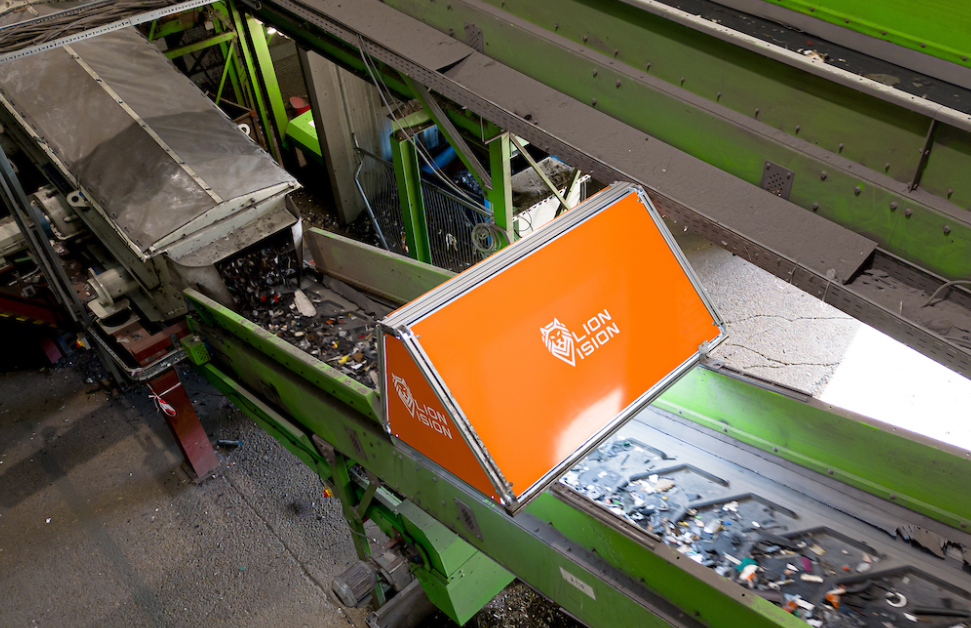
- Lion Vision has developed a system that combines machine vision systems with machine learning techniques to detect, visualize and remove lithium-ion batteries and other hazardous items from the waste stream.
- The Lion Vision system can analyze more than half a million images in a 24-hour window and detect more than 600-cylinder batteries per hour as the waste passes beneath it. Although the system currently focuses on detecting cylinder batteries, it can be programmed to detect more than 40 battery subtypes and other hazardous objects such as vapes.
- Lion Vision’s detection system is in use at various sites across the UK, most notably at SWEEEP in Kent, where 100 tons of waste electrical and electronic equipment (WEEE) is processed every day. Amongst this waste, the Lion Vision system is detecting approximately more than 4500-cylinder batteries every day.