


Show Notes 2 October 2026
All Medical Tech Special
Text highlighted in blue identifies notes I have inserted.
Story 1: New imaging combines light and sound to watch brain oxygen supply in real time
Source: MedicalXpress.com Story by Gaby Clark
Link: https://medicalxpress.com/news/2026-09-imaging-combines-brain-oxygen-real.html
See research paper here: https://www.nature.com/articles/s41467-026-75603-7

- Researchers at Washington University in St. Louis, Missouri have developed a new brain-imaging system that allows scientists to watch neurons and their oxygen supply working together in real time.
- Side note – the article assumes you are an expert in the field and immediately understand the headline benefits statement. I wanted to understand up front before highlighting the article news what this new imaging system will do to help doctors. Among several benefits are:
- Decoding Stroke and Ischemia: By watching oxygen supply fail or fluctuate in real time alongside neuronal distress, researchers can better understand tissue damage during strokes, transient ischemic attacks, or oxygen deprivation, potentially leading to better neuroprotective strategies.
- Insights into Neurodegenerative Diseases: Conditions like Alzheimer’s and vascular dementia are heavily linked to compromised blood flow and oxygen delivery in the brain. This technology allows scientists to investigate whether micro-vascular dysfunctions precede neuron death or vice versa.
- Now, back to the news about a new brain-imaging system that allows scientists to watch neurons and their oxygen supply working together in real time.
- The new technology combines two existing imaging methods—two-photon microscopy and photoacoustic microscopy—into a single system called TPM-PAM.
- Two-photon microscopy uses fluorescent markers to show when individual neurons become active. Photoacoustic microscopy uses light-generated sound waves to measure blood flow and oxygen levels.
- Side note – “Light-generated sound waves” usually means sound created when light energy is absorbed and converted into tiny pressure changes in a material.
- By combining these techniques, researchers can simultaneously observe brain activity and see how red blood cells deliver oxygen to nearby neurons.
- The team successfully tested the system in awake mice. They recorded calcium activity in individual neurons while tracking oxygen release from individual red blood cells moving through tiny blood vessels.
- This ability to observe both activity and oxygen delivery at the cellular level could help scientists better understand what happens during strokes, Alzheimer’s disease, and other neurodegenerative conditions.
- The researchers hope their work will eventually improve understanding of how functional MRI scans interpret brain activity, since MRI currently estimates neural activity indirectly through changes in blood oxygen levels.

Story 2: Mini ‘arteries-on-a-chip’ could help predict a person’s risk of stroke – new models of the carotid artery can be personalized for different people, revealing subtle differences in stroke risk.
Source: LiveScience.com Story by Victoria Atkinson

- Side note before we begin: In this context, the “chip” is not an electronic computer chip. Instead, it’s a tiny laboratory device, usually made from clear silicone-like materials and about the size of a microscope slide, that contains microscopic channels through which fluids can flow. Researchers often call these devices “organ-on-a-chip” systems.
- Now for the news: Scientists at the University of Sydney [New South Wales, Australia] have developed tiny, personalized models of human arteries that could eventually help doctors better predict a patient’s risk of stroke and choose the most effective treatment.
- The researchers created miniature copies of patients’ carotid arteries, the major blood vessels that carry blood to the brain.
- Using CT scans, they 3D-printed replicas of individual arteries, including narrowed areas caused by fatty plaque buildup. The inside of each model was then coated with collagen and lined with living cells similar to those found in real blood vessels.
- The researchers passed human blood through these artificial arteries at speeds and pressures similar to those in the body. Using a laser, they created small injuries in the artery lining and observed how blood clots formed under a microscope.
- The experiments revealed that arteries with similar levels of disease can behave very differently. Their three-dimensional shapes create different patterns of blood flow, which can influence whether a blood clot remains attached to the artery wall or breaks into fragments that could travel to the brain and cause a stroke.
- The research is still experimental, involving only six patients. However, scientists hope these personalized “arteries-on-a-chip” could one day become an additional tool between medical imaging and treatment decisions.
Story 3: [a company called] Vara receives CE mark for first autonomous breast cancer screening – The AI-enabled device can report screenings it determines are normal without radiologist review.
Source: MedTechDive.com Story by Elise Reuter
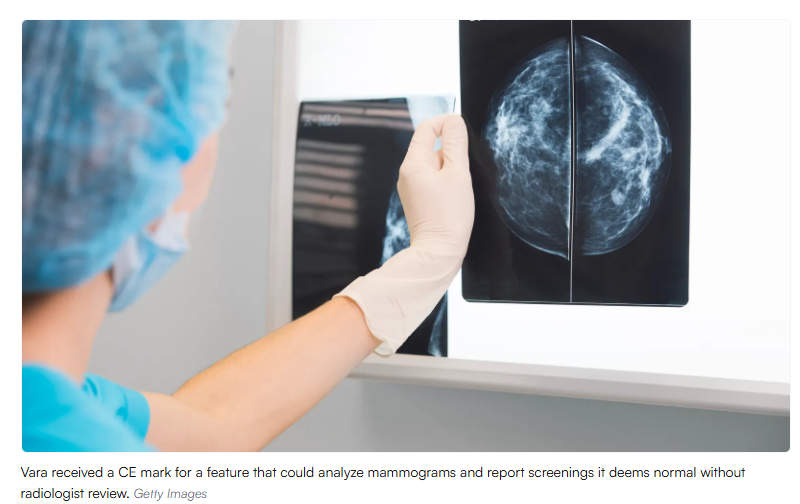
- Side note: CE Mark is short for “European Conformity” and refers to an official regulatory approval granted to products sold within the European Economic Area.
- A company called Vara has received European approval for an artificial intelligence system that can independently analyze certain breast cancer screening mammograms.
- The CE mark allows Vara’s technology to report mammograms classified as clearly normal without requiring a radiologist to review them first. The company says this is the first breast cancer screening AI system in Europe authorized to operate in this fully autonomous way.
- Normally, European mammograms are reviewed by two radiologists. Vara’s technology could reduce the workload for radiologists by automatically identifying examinations that appear normal.
- The need for such technology is growing because many countries face shortages of radiologists.
- Mammograms that are abnormal, unclear, or outside the system’s confidence limits would still be sent to a radiologist for review.
- A large study involving more than 460,000 women previously found that AI-supported mammogram readings detected more breast cancers than standard double readings by radiologists.
- The new approval represents an important step toward allowing AI to handle some routine screening decisions independently while keeping human doctors involved when needed.

Story 4: Ukrainian and US developers are building AI tools for wounded troops when there is no medic nearby
Source: Business Insider Story by Kelsey Baker

- Side note – this news is about two separate AI-based solutions to help soldiers in combat situations provide on-site, immediate care when a medic is not present.
- Ukrainian and American developers are creating artificial intelligence tools to help wounded soldiers when medical personnel are not immediately available.
- The technology is being developed in response to modern warfare, where small groups of soldiers may operate far from doctors or medics, and evacuating injured personnel can be extremely dangerous.
- One system, called FieldCare GPT, was developed by researchers at the University of Pittsburgh. It is an offline AI chatbot that runs on a powerful laptop and uses military medical manuals to provide treatment guidance.
- Because it does not require an internet connection, it can operate in areas where communications are unavailable or dangerous to use.
- In Ukraine, trauma surgeon Roman Kuziv developed another system called ALICE. This smartphone application uses Google’s Gemini AI to guide non-medical personnel through emergency treatment.
- Side note – A technical description provided to me by ChatGPT specifically characterizes ALICE as cloud-dependent, in contrast to the University of Pittsburgh’s FieldCare GPT, which was designed to run completely offline.
- It can provide instructions using voice prompts and images, helping soldiers respond to serious injuries such as severe bleeding and gunshot wounds. A soldier can photograph an injury, answer questions, and receive treatment guidance.
- The developers emphasize that these systems are not intended to replace trained medical professionals. Instead, they are designed to help soldiers make better decisions during the critical period before professional medical care becomes available.
- Both FieldCare GPT and ALICE are still being tested in real-world conditions. Developers hope the technology will improve battlefield “self-care” and “buddy care,” allowing soldiers to treat themselves or fellow soldiers during prolonged emergencies.

Honorable Mentions
Story: New Brain-Inspired AI Chip Solves Motor Control Tasks Using 10,000x Fewer Calculations
Source: The Science Times Story by Glanze Patrick

- Researchers have developed a new artificial intelligence chip inspired by the human cerebellum, the part of the brain responsible for coordinating movement, balance, and timing. The technology could help future AI systems perform tasks using far less energy and computing power than conventional computers.
- Instead of constantly processing every piece of incoming information, the chip focuses mainly on unexpected changes or important events. This is similar to how the brain pays more attention when something suddenly changes. The approach reduces unnecessary calculations and the movement of data between memory and processors.
- The experimental chip uses an extremely thin semiconductor material called molybdenum disulfide. It incorporates memory and processing functions into the same component, known as a memtransistor. The system also uses a spiking neural network, which communicates through brief electrical signals rather than continuously processing information.
- To test the technology, researchers used electrocardiogram (ECG) data to detect irregular heartbeats. The chip identified abnormal heart rhythms with more than 98% accuracy and used approximately 10,000 times fewer calculations than a conventional comparison system. It was also more than twice as fast in the specific test.
- The researchers emphasize that these results do not mean the chip is universally 10,000 times faster than regular computers. The experiment involved a specialized task, and the technology remains in an early research stage.
- Potential applications include wearable health monitors, robots, autonomous vehicles, drones, and industrial sensors. Further work is needed before this brain-inspired computing approach can be manufactured reliably and used in everyday technology.
////////////////////////////////////////////////////////////////////////////////////////////////////////////////////////////////////////////
Story: China’s New Solar Breakthrough Makes Desalinated Water Cheaper Than Bottled
Source: BGR Story by Noelle Corbett
Link: https://www.bgr.com/2222172/china-solar-breakthrough-desalinate-water-cheaper/

- Chinese scientists have developed a promising new solar-powered technology that could significantly reduce the cost of turning seawater into drinking water. The breakthrough uses a specially designed photothermal material that converts sunlight into heat more efficiently than traditional materials.
- Desalination normally requires large amounts of electricity to remove salt and other impurities from seawater. This makes the process expensive, especially in regions where energy costs are high. The new material uses solar energy directly, reducing or eliminating the need for conventional electricity.
- According to the research, the material combines nanomaterials with tightly connected polymer chains. This structure allows it to absorb sunlight effectively while remaining stable during long-term operation. Tests reportedly demonstrated consistent performance over an extended period, including a year of operation without utility energy costs.
- The researchers believe the technology could eventually produce desalinated water at a price competitive with, or even cheaper than, bottled water. This could be particularly valuable in coastal areas suffering from drought or freshwater shortages.
- However, the technology is still in the research and development stage. Large-scale manufacturing, durability, maintenance, and environmental concerns related to disposing of concentrated saltwater will need further investigation.
- If successfully commercialized, solar-powered desalination could provide a cleaner and more affordable source of drinking water for millions of people around the world.
////////////////////////////////////////////////////////////////////////////////////////////////////////////////////////////////////////////
Story: Princeton startup raises $16M to scale brine-based lithium production
Source: Interesting Engineering Story by Maria Mocerino

- Princeton Critical Minerals, a startup developing new ways to produce lithium, has raised $16 million to expand its technology from laboratory testing toward commercial use. The company focuses on extracting lithium from brine—salty water found underground or produced during industrial operations.
- Lithium is an essential material for rechargeable batteries used in electric vehicles, smartphones, and energy-storage systems. However, traditional lithium mining can be slow, expensive, and environmentally challenging. Current methods often rely on large evaporation ponds or hard-rock mining.
- Princeton Critical Minerals is developing a technology designed to extract lithium more efficiently from brine. Its process could potentially reduce the time, land, and energy required compared with conventional methods. The company believes its approach can improve lithium recovery rates while making production more economical.
- The new funding combines private investment and other financial support. It will help the company scale up its technology, conduct larger demonstrations, and work toward commercial deployment.
- The development is part of a growing effort to establish more domestic sources of lithium and reduce dependence on international suppliers. As demand for electric vehicles and battery storage continues to increase, finding faster and cleaner ways to produce lithium has become an important technological and economic goal.
- Bottom line: Princeton Critical Minerals is attempting to make lithium production more efficient by using advanced technology to extract the valuable metal from salty water rather than relying entirely on traditional mining methods.
////////////////////////////////////////////////////////////////////////////////////////////////////////////////////////////////////////////
Story: Developers break ground on Chicago’s first all-electric geothermal apartment tower – The building’s geothermal energy system will support more than 80% of the building’s heating, cooling and hot water supply and divert 390 tons of carbon annually.
Source: Chicago Sun Times Story by Abby Miller
- Construction has begun on Chicago’s first all-electric apartment tower powered by geothermal energy. The 33-story building, called 410 North Elizabeth, is being developed in the Fulton Market neighborhood.
- The tower will contain 383 apartments, including 77 units designated as affordable housing. Unlike conventional buildings that use natural gas for heating and cooking, this project will operate entirely on electricity.
- Its most innovative feature is a geothermal heating and cooling system. Instead of relying primarily on outdoor air temperatures, geothermal systems use the relatively stable temperature underground to help heat buildings during Chicago’s cold winters and cool them during the summer. This can reduce energy use and greenhouse gas emissions.
- The project is part of a larger two-tower development planned for the area. Developers say the building demonstrates that large urban apartment buildings can incorporate cleaner energy technology without sacrificing modern amenities or housing capacity.
- Geothermal systems typically require significant upfront investment and specialized construction, but supporters believe they can provide long-term energy savings and reduce dependence on fossil fuels. The project could serve as a model for future high-rise construction in Chicago and other cities seeking to reduce building emissions.
- The development represents an important step toward more sustainable urban housing, combining renewable energy technology with much-needed new housing in a rapidly growing neighborhood. (chicago.suntimes.com)
For Chicago’s 410 North Elizabeth apartment tower, developers are drilling 65 geothermal wells approximately 820 feet (250 meters) deep. Construction teams began drilling these wells in late July 2026. (Jefferson City News-Tribune)
How the system works
The wells will contain underground piping through which water circulates. At approximately 820 feet below ground, the surrounding earth maintains a relatively stable temperature of about 55°F year-round.
The system works as follows:
- Winter: Heat pumps extract warmth from the ground and use it to heat the apartments.
- Summer: Heat pumps reverse the process, transferring heat from the building into the cooler ground.
- Hot water: The geothermal system also helps provide domestic hot water.
This is called a ground-source heat pump system, rather than the type of geothermal drilling used at volcanic sites to tap extremely hot water or steam.
An interesting distinction
The wells are relatively shallow compared with geothermal power plants, which may drill several miles into the Earth to access very high temperatures. Chicago’s system takes advantage of the Earth’s naturally stable underground temperature rather than extracting intense geological heat.
So yes, substantial drilling is involved—but the goal is to use the ground as a giant thermal battery, not to reach molten rock or underground steam.