


Show Notes 26 September 2025
Story 1: No sorting needed: Plasma torch shows promise for hassle-free plastic recycling
Source: TechXplore.com Story by Science X staff
Link: https://techxplore.com/news/2025-09-plasma-torch-hassle-free-plastic.html
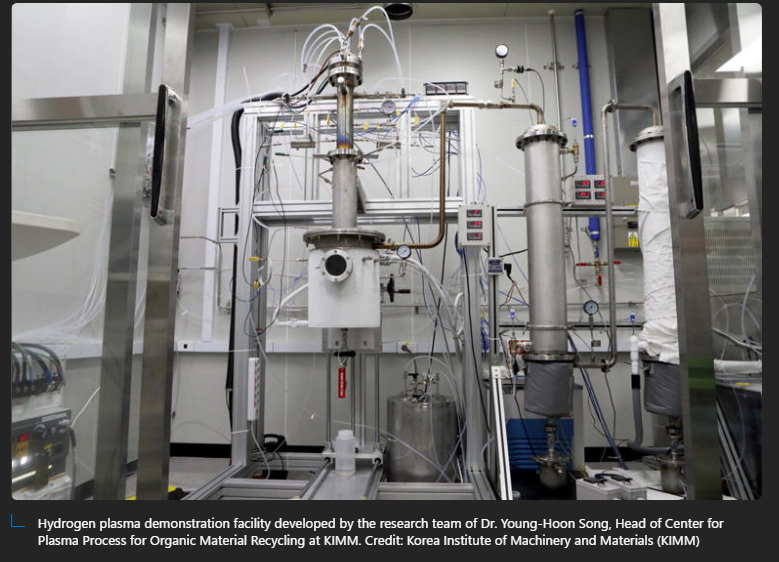
- Researchers at the Korea Institute of Machinery and Materials have developed the world’s first plasma-based chemical recycling technology that can process mixed waste plastics without sorting or label removal.
- How it works:
- This process uses hydrogen plasma, a superheated, ionized gas, to break down mixed plastic waste into reusable chemicals like ethylene and benzene—key building blocks for new plastics.
-
Side note:
- Ethylene is used to create polyethylene used in plastic bags, bottles, containers, and insulation.
-
Side note:
- Benzene is used for packaging, foam, utensils, and for electronics, lenses and adhesives.
- Process Temperature Range: 1,832–3,632°F (1,000–2,000° Celsius)
- Process Reaction Time: <0.01 seconds—faster than a blink
- Process Fuel Source: 100% hydrogen, which suppresses carbon soot formation
- The plasma torch exploits rapid energy transfer and bond dissociation kinetics to instantly convert polymers into simpler molecules. It’s a clean, controlled reaction with minimal byproducts.
- Side note: Bond dissociation kinetics refers to the rate and mechanism by which a chemical bond breaks, typically under thermal, photochemical, or catalytic conditions.
- By controlling the reaction temperature and time, the researchers achieved selectivity levels of 70–90% and ethylene yields exceeding 70%. After purification, more than 99% of the output could be secured as high-purity raw materials for plastic manufacturing.
- Again, the big news is this method eliminates the need for manual separation, which is a major bottleneck in conventional [plastic] recycling.

Story 2: MIT spinoff achieves major milestone in pursuit of limitless energy beneath our feet: ‘Could fundamentally change how we power our world’
Source: The Cool Down via MSN.com Story by Craig Gerard
See video here: https://www.youtube.com/watch?v=oYHcCsFlD2Q
See also: https://www.quaise.com/
- Geothermal energy offers limitless heat from beneath Earth’s surface. It could dramatically expand grid output, reduce costs, and eliminate reliance on fossil fuels. [My comment -The news here has to do with a radical alternative to current technologies for drilling deep into the Earth to tap geothermal energy. Below is a recap of current techniques].
-
Side note – Common Drilling Techniques for Geothermal Wells
- 1. Rotary Drilling (Conventional)
- Most widely used for deep geothermal wells.
- A rotating drill bit grinds through rock while drilling fluid (mud) cools the bit and carries cuttings to the surface.
- Requires high-temperature-resistant equipment due to extreme subsurface heat.
- 2. Air Drilling
- Used in dry formations or where water-based mud might damage the reservoir.
- Compressed air replaces drilling mud to lift cuttings.
- Reduces risk of formation damage and improves penetration rate in certain rock types.
- 3. Coiled Tubing Drilling
- A flexible, continuous tube is used instead of traditional drill pipe.
- Offers faster deployment and is useful for directional drilling or re-entry into existing wells.
- 1. Rotary Drilling (Conventional)
-
Side note – Common Drilling Techniques for Geothermal Wells
- Here’s the news – Quaise Energy, an MIT spinoff, has successfully drilled 100 meters [that’s 330 feet approximately] into superhot rock using millimeter wave technology.
- This is the first time such drilling has succeeded outside a lab setting, marking a major milestone.
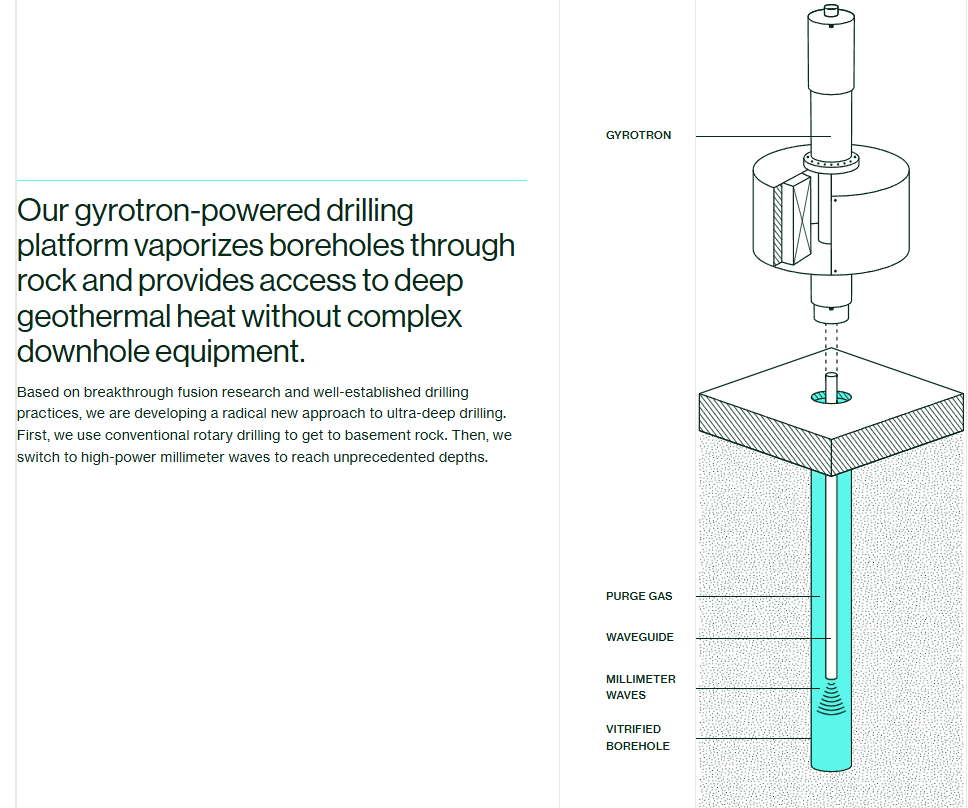
- The technique uses millimeter waves to vaporize rock at temperatures around 752°F (400° Celsius). Millimeter waves are high-frequency electromagnetic waves (30–300 GHz) with wavelengths between 1–10 mm.
- Here’s how the drill system works:
- Dielectric Heating: Similar to microwave ovens, millimeter waves heat rock by exciting molecules, causing them to vibrate and break apart. This vaporizes the rock into fine ash.
- Gyrotron Source: A device called a gyrotron generates millimeter waves. These are powerful enough to reach temperatures that melt or ablate tough basement rock like granite and basalt.
- Side note: A gyrotron is a high-power vacuum electronic device that generates coherent electromagnetic radiation in the microwave, millimeter-wave, and even terahertz frequency ranges.
- Waveguide Delivery: millimeter waves are transmitted down a metallic pipe (waveguide) to the rock face. The beam is focused to maintain energy density and precision.
- Non-Contact Drilling: Unlike mechanical bits, millimeter waves don’t touch the rock. This eliminates wear and tear, allowing deeper penetration without tool replacement.
- Ash Removal: A circulating gas flushes the vaporized rock ash to the surface, keeping the borehole clean and stable.

Story 3: Scientists build micromotors smaller than a human hair – Tiny light-powered gears could revolutionize medicine by powering machines the size of human cells.
Source: ScienceDaily.com Story from University of Gothenburg
Link: https://www.sciencedaily.com/releases/2025/09/250918025025.htm
See research paper here: https://www.nature.com/articles/s41467-025-62869-6
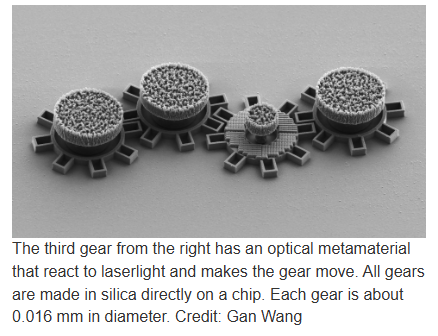
- Scientists at the University of Gothenburg in Sweden have built the smallest on-chip motors ever, with gears just 16–20 micrometers wide—smaller than a human hair.
- These gears are made of silica and etched directly onto a chip using traditional lithography.
- Instead of mechanical drive trains, the gears use optical metamaterials that respond to laser light.
-
Side note – What Are Optical Metamaterials?
- Definition: Artificially structured materials designed to control electromagnetic waves—specifically light—at scales smaller than the wavelength itself.
- Structure: They consist of periodic, nanoscale “cells” that act like artificial atoms. These cells are much smaller than the wavelength of light they interact with, allowing precise control over optical properties.
- Functionality: Unlike conventional materials, their behavior isn’t dictated by chemical composition but by geometry and arrangement of these subwavelength structures.
- Laser intensity controls speed; polarization controls direction. This enables motion without physical contact, allowing for rotation, linear movement, and even light deflection via micro-mirrors.
- Previous gear miniaturization stalled at 0.1 mm due to mechanical limits. This light-driven approach breaks the size barrier, opening doors to complex microsystems.
- These micromotors could act as pumps or valves inside the human body, regulating flows at the cellular level. Their size and precision make them ideal for lab-on-a-chip systems, nanomachines, and targeted therapies.
- Quote from Lead Researcher – “This is a fundamentally new way of thinking about mechanics on a microscale.”

Story 4: New Ultrasound Helmet Reaches Deep Inside the Brain Without Surgery
Source: ScienceAlert.com Story by Russell McLendon
Link: https://www.sciencealert.com/new-ultrasound-helmet-reaches-deep-inside-the-brain-without-surgery
See research paper here: https://www.nature.com/articles/s41467-025-63020-1
- Deep-brain structures like the basal ganglia or the thalamus wield major influence on our behavior. If something goes awry, dysregulation in the deep brain may trigger neurological conditions like Parkinson’s disease or depression.
- Despite the clear importance of these structures, our knowledge about them remains limited by their location, making them difficult to study and treat.
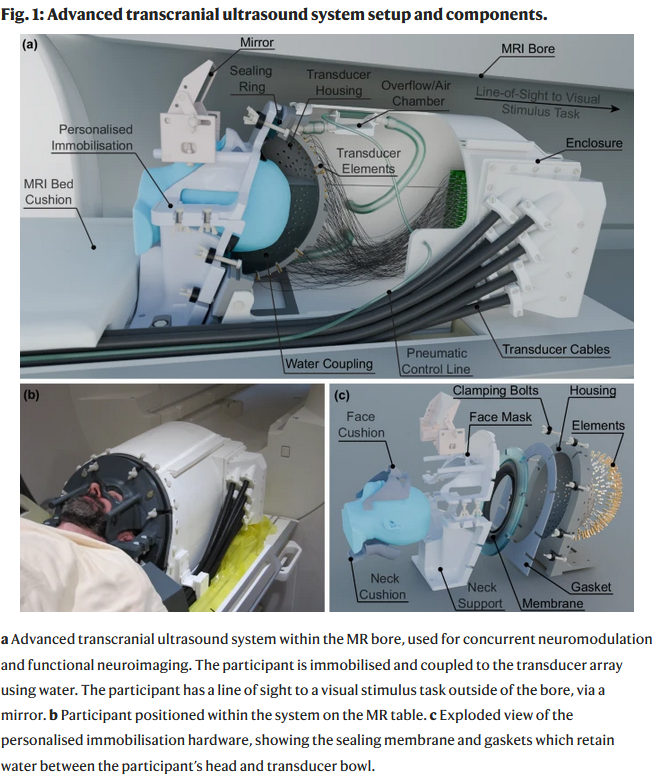
- In a new study, researchers from University College London, in collaboration with the University of Oxford’s Nuffield Department of Clinical Neurosciences, document a new device that might offer an alternative to invasive procedures. Featuring a novel ultrasound helmet, it not only modulates deep-brain circuits without surgery but reportedly can do so with unrivaled precision.
- How the Ultrasound Helmet Targets the Brain:
- The helmet uses an array of 256 ultrasound emitters arranged inside its shell. These emit focused beams that converge precisely on deep-brain targets.
- It can stimulate regions 1,000× smaller than conventional ultrasound and 30× more precise than other deep-brain devices.
- Targeting Mechanism: A soft plastic face mask stabilizes the head, ensuring accurate delivery of ultrasound pulses.
- Real-Time Monitoring: The system is compatible with fMRI [functional Magnetic Resonance Imaging], allowing researchers to observe brain activity as it happens.
- One of the lead researchers noted, “The ability to precisely modulate deep-brain structures without surgery represents a paradigm shift in neuroscience, offering a safe, reversible, and repeatable method for both understanding brain function and developing targeted therapies.”

Honorable Mentions
Story: NASA Is Testing a Nuclear Battery That Could Last 433 Years
Source: Popular Mechanics Story by Elizabeth Rayne

Link: https://www.popularmechanics.com/science/a65964293/nuclear-battery-433-years/
- What It Is:
- A coin-sized nuclear battery that uses nickel-63 isotopes as its energy source.
- Converts radiation into electricity using a diamond semiconductor—specifically, a layer of artificial diamond that captures beta particles.
- How It Works
- Nickel-63 emits low-energy beta radiation, which is safe and easily shielded.
- The diamond layer absorbs this radiation and converts it into a small but steady electric current.
- The battery is encased in a radiation-proof shell, making it safe for use in consumer and industrial applications.
- Ideal for space missions, medical implants, deep-sea sensors, and remote infrastructure—anywhere long-term, maintenance-free power is needed.
- Could revolutionize IoT devices, especially those in hard-to-reach or hazardous environments.
- Offers a maintenance-free power source for centuries.
- Represents a major leap in energy density and longevity compared to traditional batteries.
- Opens doors to sustainable, long-duration technologies without the need for recharging or replacement.

Story: China’s transparent coating to turn ordinary windows into solar power generators
Source: Interesting Engineering Story by Georgina Jedikovska
Link: https://interestingengineering.com/energy/colorless-coating-turn-windows-into-solar-panels
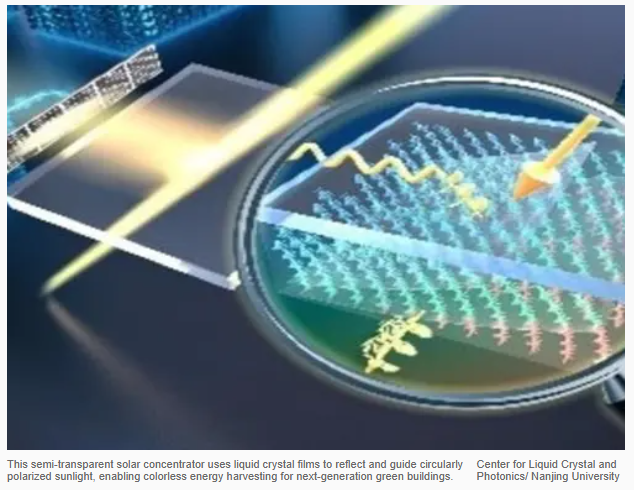
- Researchers at Nanjing University developed a transparent, colorless solar concentrator coating.
- It can be applied directly to standard window glass without altering appearance.
- Uses cholesteric liquid crystal (CLC) multilayers with submicron lateral periodicities.
- Selectively diffracts circularly polarized light, guiding it into the glass at steep angles.
- Light is directed to the edges of the window, where photovoltaic (PV) cells are installed
- Unlike luminescent or scattering-based concentrators, this coating:
- Maintains visual clarity (no distortion).
- Offers broadband, polarization-selective diffraction.
- Enables efficient waveguiding for energy harvesting.
- Is scalable and potentially cost-effective.

Story: Scientists Pitch Bold Plan to Turn Nuclear Waste Into Nuclear Fuel – Tapping into discarded nuclear waste could help generate a self-sufficient source of a key ingredient for nuclear fusion, a new plan proposes.
Source: Gizmodo Story by Gayoung Lee
Link: https://gizmodo.com/scientists-pitch-bold-plan-to-turn-nuclear-waste-into-nuclear-fuel-2000643875
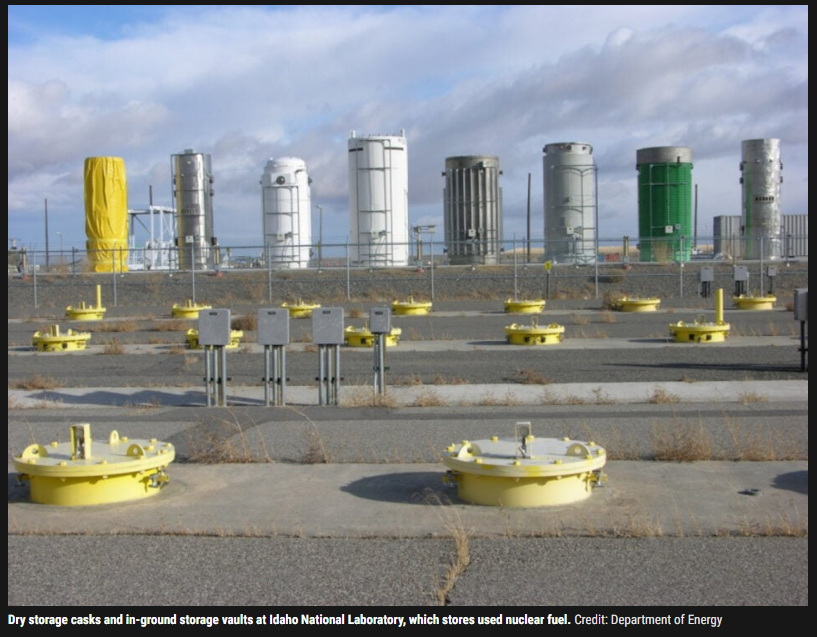
- A bold new proposal from Terence Tarnowsky, a nuclear physicist at Los Alamos National Laboratory, aims to solve one of fusion energy’s biggest bottlenecks: the scarcity of tritium. His team suggests repurposing radioactive waste—specifically spent nuclear fuel—as a source for tritium production.
- Key Points:
- Fusion vs. Fission: Fusion uses tritium and deuterium to generate energy, unlike current fission reactors that split heavy atoms like uranium and produce long-lived waste.
- Tritium Crisis: Tritium is rare, unstable, and decays quickly (half-life: 12.3 years). Global supplies are dangerously low.
- The Proposal:
- Use a superconducting linear accelerator to bombard nuclear waste surrounded by molten lithium salt.
- This process would trigger neutron bursts and nuclear transitions that produce tritium.
- Tarnowsky estimates this method could yield over 10× more tritium than a fusion reactor of equivalent thermal power.
- Challenges Ahead:
- Requires major investment and long-term planning.
- Tritium cannot be stockpiled easily due to its decay and hydrogen-like behavior.
- Nuclear waste continues to accumulate—about 2,000 metric tons annually in the U.S.—adding urgency to the problem.
- Tarnowsky remains optimistic, noting that public perception of nuclear energy is shifting, and the fusion conversation is finally gaining traction.

Story: Scientists Made ‘Jelly Ice’ That Never Melts. It’s Edible, Compostable and Reusable
Source: ZME Science Story by Tibi Puiu
- What Is Jelly Ice?
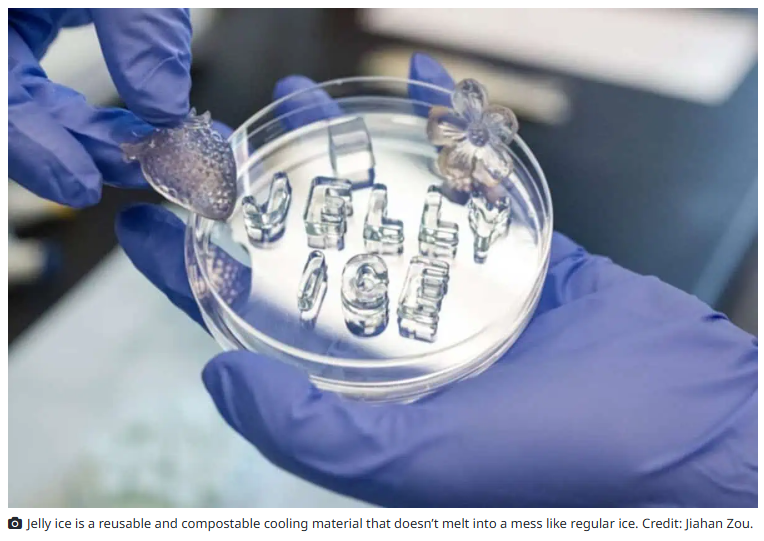
- A reusable, compostable cooling material developed by researchers at UC Davis.
- It looks like Jell-O, but functions like ice—without melting into liquid.
- Composed of 90% water, held in a gelatin-based hydrogel structure.
- Scientific Inspiration
- Originated from a food safety concern: meltwater in seafood displays can spread pathogens.
- Inspired by tofu’s water retention and refined using gelatin, which forms hydrogels that trap water even during freeze-thaw cycles.
- Practical Benefits
- Doesn’t leak or create puddles, reducing contamination risks.
- Can be washed, frozen, thawed, and reused multiple times.
- Edible and biodegradable, making it environmentally friendly.