


Show Notes 3 October 2025
Story 1: Some Layers of Your Brain Actually Get Stronger as You Age
Source: ScienceAlert.com Story by Michelle Starr
Link: https://www.sciencealert.com/some-layers-of-your-brain-actually-get-stronger-as-you-age
See research paper here: https://www.nature.com/articles/s41593-025-02013-1
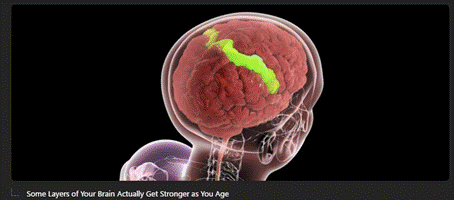
- Contrary to the common belief that aging leads to uniform brain degeneration, some layers of the brain—specifically in the primary somatosensory cortex—can actually thicken with age.
- These layers are responsible for processing sensory information and appear to retain or even enhance functionality over time.
- The somatosensory cortex is composed of multiple ultra-thin layers, each with distinct architecture and function.
-
Side notedetails – The somatosensory cortex is a vital region of the brain responsible for processing sensory information from your body. Here’s a breakdown of its key features and functions. Interprets signals related to:
- Touch
- Pressure
- Pain
- Temperature
- Your sense of body position and movement
- Helps you recognize textures, shapes, and even objects by touch alone.
- Plays a role in sensory memory—like remembering the feel of velvet or the sting of a burn.
- Researchers from four institutions in Germany [see list below] found that while the overall cerebral cortex thins, certain layers remain stable or grow thicker, likely due to continued use and stimulation.
The study was a joint effort between:
- DZNE (German Center for Neurodegenerative Diseases)
- Otto von Guericke University Magdeburg
- Hertie Institute for Clinical Brain Research
- University of Tübingen
- This supports the concept of neuroplasticity—the brain’s ability to adapt and reorganize—even in older adults.
- One of the neuroscientists noted that this discovery challenges previous assumptions and highlights the brain’s resilience and adaptability.
- The findings suggest that mental engagement and sensory stimulation may help preserve or even strengthen brain function with age.
- It opens new avenues for understanding aging and cognitive health, potentially influencing therapies and lifestyle recommendations.

Story 2: Engineers harness light to help heart cells beat stronger and healthier
Source: Knowridge.com News from UC Irvine
See research paper here: https://www.pnas.org/doi/10.1073/pnas.2509467122
- Traditionally, scientists have relied on synthetic materials to grow heart tissue in the lab. While these materials can provide structural support, they typically act only as a passive scaffold, offering no active stimulation to the cells.
- Engineers at the University of California, Irvine, have developed breakthrough technology that uses light to stimulate heart cells in the lab.
- The approach could pave the way for new therapies to improve heart function without relying on genetic modification or invasive medical procedures.
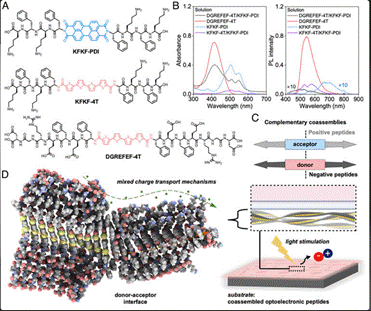
- The research team created new biomolecules that allow heart muscle cells to respond to light.
- This means that light can be used as a trigger to send signals to heart cells, helping them beat more rhythmically and develop features closer to those of mature human heart tissue.
- Here’s the key capability the new system developed by the UC Irvine team delivers: When exposed to certain wavelengths of light, it generates tiny electrical signals that interact with the cells. These signals prompt the cells to contract in a coordinated way and encourage stem cell–derived heart cells to take on characteristics of adult cardiac cells.
- The research team leader explained that this is the first demonstration of light being directly converted into signals that heart cells can use.
- The implications of this technology are wide-ranging. For one, it could help researchers build better lab-grown models of the human heart, which are crucial for studying heart diseases and testing new drugs.
- The research is still in its early stages. The UC Irvine team is now working to better understand how heart cells respond to the engineered biomolecules and the light-triggered signals.
- They also plan to develop three-dimensional heart tissues that can respond to light in a similar way.
- If successful, this could represent a major step toward combining bioengineering, materials science, and medicine to create innovative solutions for heart health.
Story 3: UCSB-designed soft robot intubation device could save lives – The innovative tool, designed specifically for non-expert users, improves airway access and raises survival odds in critical medical emergencies
Source: UC Santa Barbara “The Current” Story by Sonia Fernandez
Link: https://news.ucsb.edu/2025/022019/ucsb-designed-soft-robot-intubation-device-could-save-lives
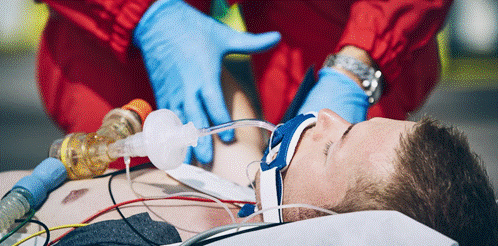
- Maintaining an open airway is a critical priority in emergency medicine. Without the flow of oxygen, other emergency interventions can become ineffective at saving the patient’s life. However, creating this airway through endotracheal intubation is a difficult task for highly trained individuals and under the best of circumstances.
- In the field and in the ER, where seconds matter, emergency medical personnel face many unknown and wildly challenging conditions which lower their chances of success.
- But what if successful endotracheal intubation could be less reliant on ideal conditions and years of specialized training?
- In a paper published in the journal Science Translational Medicine, UC Santa Barbara researchers and collaborators demonstrate a non-electronic soft robotic device that quickly and autonomously guides a soft tube into the trachea.
- Initial device testing with highly trained users yielded a 100% success rate, and a 96% overall success rate with prehospital medical providers (EMTs and paramedics).
- Current technology calls for the rescuer to first visualize the tracheal opening then manually direct a tube through the serpentine anatomy of the airway into the trachea.
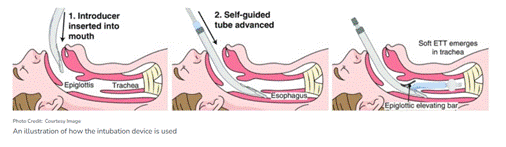
- [To simplify the process] The researchers’ device uses a soft, inflatable tube that everts from its tip. Called the soft robotic intubation system, it consists of a curved “introducer” that slides into place at the back of the throat and stops at the esophagus.
- Side note: The verb “everts” means to turn outward or inside out.
- With that in place, a soft, pre-inflated tube is threaded through the introducer, emerging near its tip at the opening of the trachea. As the user advances the tube, it everts from its tip, carrying inside it a soft breathing tube as it enters the trachea.
- One of the team members noted, “So instead of trying to push this tube and bend it to get into this complex configuration, we can just mechanically create that complex configuration as we go.”
- Once the endotracheal tube is at its destination, the user can inflate a cuff at its distal end to seal the opening and begin ventilation. The introducer can be removed, leaving the breathing tube in place.
- Side note: The distal end refers to the part of a structure that is farthest from its point of origin or attachment—especially in anatomy or engineering contexts.

Story 4: Wi-Fi sleep monitoring method offers a non-intrusive, accurate alternative to more cumbersome techniques
Source: MedicalXpress.com Story by David Bradley
Find research paper here: https://www.inderscience.com/info/inarticle.php?artid=148201
- Researchers at the School of Electronic Information and Engineering, Liaoning Technical University, China have developed a technique using Wi-Fi signals to monitor sleep behavior without wearable devices or clinical setups.
- Technology Used:
- Relies on Channel State Information (CSI) from Wi-Fi signals.
- Side note – what is Channel State Information:
- Channel State Information refers to the detailed knowledge of how a wireless signal travels from a transmitter to a receiver. It’s a cornerstone concept in wireless communications, especially in systems like Wi-Fi, 5G, and MIMO (Multiple Input Multiple Output).
- What CSI Includes – CSI captures the current condition of the communication channel, including:
- Signal strength and attenuation
- Phase shift and delay spread
- Scattering and fading effects
- Noise characteristics
- Detects changes in signal amplitude caused by body movements and posture shifts during sleep.
- Uses statistical modeling (probability density functions) to interpret these variations.
- Advantages of using Wi-Fi signals to monitor sleep behavior over traditional methods:
- Non-intrusive: No need for smartwatches, sensors, or sleep labs.
- Accurate: Achieves over 95% recognition of sleep positions and movements.
- Comfortable: Allows subjects to sleep in their own beds without disruption.
- Broader Applications:
- Elderly & Mobility-Impaired Monitoring: Can detect irregular movements, falls, or sleep disturbances in real time.
- Sleep Research: Offers scalable, cost-effective data collection for long-term studies.

Honorable Mentions
Story: A new catalyst could make mixed plastic recycling a reality
Source: Phys.org Story by Robert Egan
Link: https://phys.org/news/2025-09-catalyst-plastic-recycling-reality.html
See research paper here: https://www.nature.com/articles/s41557-025-01892-y
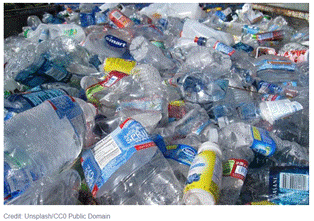
- The future of plastic recycling may soon get much less complicated, frustrating and tedious. In a new study, Northwestern University chemists have introduced a new plastic upcycling process that can drastically reduce—or perhaps even fully bypass—the laborious chore of pre-sorting mixed plastic waste.
- The process harnesses a new, inexpensive nickel-based catalyst that selectively breaks down polyolefin plastics consisting of polyethylenes and polypropylenes—the single-use kind that dominates nearly two-thirds of global plastic consumption. This means industrial users could apply the catalyst to large volumes of unsorted polyolefin waste.
- When the catalyst breaks down polyolefins, the low-value solid plastics transform into liquid oils and waxes, which can be upcycled into higher-value products, including lubricants, fuels and candles. Not only can it be used multiple times, but the new catalyst can also break down plastics contaminated with polyvinyl chloride (PVC), a toxic polymer that notoriously makes plastics “unrecyclable.”
////////////////////////////////////////////////////////////////////////////////////////////////////////////////////////////////////////////
Story: A New Solar Panel Shield Made From Onion Peels Outlasted Industry Plastics in Tests
Source: ZME Science Story by Tudor Tarita
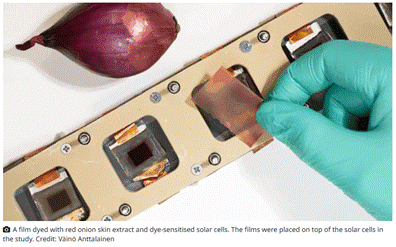
- Researchers in Finland (University of Turku, with Aalto University and Wageningen University) developed a bio-based UV protection film for solar cells using red onion skin extract.
- The film is made from nanocellulose treated with onion dye, offering strong UV-blocking capabilities.
- Dye-sensitized solar cells (DSSCs) are flexible and perform well in low light but are vulnerable to UV damage, especially to their electrolytes.
- Traditional UV shields use PET plastic, which degrades over time and is hard to recycle.
- The onion-based film is biodegradable, renewable, and outperformed commercial plastic films in lab tests.
- It represents a **promising alternative** for eco-friendly solar panel protection.
////////////////////////////////////////////////////////////////////////////////////////////////////////////////////////////////////////////
Story: Bio-oil made with corn stalks, wood debris could plug orphaned fossil fuel wells
Source: Iowa State University

- Researchers at Iowa State University, led by Prof. Mark Mba-Wright, propose using bio-oil—produced from corn stalks, forest debris, and other biomass—to plug abandoned fossil fuel wells. This approach offers a dual benefit:
- Carbon Removal: Bio-oil, rich in carbon captured via photosynthesis, can be injected into deep well shafts for long-term underground storage.
- Well Remediation: The U.S. has hundreds of thousands of orphaned oil wells that pose environmental risks and are costly to seal.
- How It Works
- Fast Pyrolysis: Biomass is rapidly heated in an oxygen-free environment to produce bio-oil, biochar (a soil additive), and reusable gas.
- Mobile Units: Small-scale pyrolysis units (about the size of a combine) could process 10 tons of feedstock daily, making the system scalable and cost-effective.
- Economic Feasibility
- Estimated carbon removal cost: ~$152/ton, competitive with direct air capture.
- Infrastructure law funding: $4.7B allocated to seal ~120,000 wells, though up to 800,000 may exist.
- Bio-oil could sell for ~$175/ton; costs vary by feedstock type.
- Broader Impact
- Charm Industrial, a startup backing the study, sees bio-oil sequestration as a high-quality, cost-effective carbon removal method.
- The system could create new revenue streams for rural communities and offer a scalable path to net-zero goals.
////////////////////////////////////////////////////////////////////////////////////////////////////////////////////////////////////////////
Story: Biochar yields triple win for cotton: Healthier soil, less water, and 87% less nitrogen runoff
Source: Anthropocene Magazine Story by Emma Bryce
Link: https://www.realclearscience.com/2025/08/11/biochar_yields_a_triple_win_for_cotton_1127969.html

- Triple Benefits of Biochar in Cotton Farming
- Improved Soil Health: Biochar enhances the structure of sandy loam soil, making it less porous and better at retaining nutrients and water.
- Water Efficiency: Cotton typically requires over 200 liters of water per kilo in the Lower Mississippi Delta. Biochar helps reduce this demand by improving soil moisture retention.
- Reduced Nitrogen Runoff: The study found up to 87% less nitrogen runoff when biochar was applied, mitigating fertilizer loss and environmental pollution.
- Research Details
- Material Used: Biochar derived from sugarcane bagasse (a carbon-rich byproduct).
- Experiment Setup: Conducted between 2020–2022 with varying biochar treatments compared to a control plot.
- Location: Lower Mississippi Delta, a region known for intensive cotton cultivation.
- Environmental Implications
- Biochar offers a scalable solution to reduce agricultural pollution, conserve water, and improve crop resilience—especially in regions with fragile soil structures.