


Show Notes 24 October 2025
All Medical Tech and Science Special this Week!
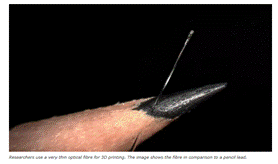
Story 1: 3D-Printer Prints Living Tissue Inside Human Body – A micro-optics breakthrough enables in-body 3D printing of living tissue using laser-guided bio-inks through a fiber thinner than a pencil lead.
My comment: much, much thinner than a pencil lead, as you will see
Source: electronicsforu.com Story by Janarthana Krishna Venkatesan
Link: https://www.electronicsforu.com/news/3d-printer-prints-living-tissue-inside-human-body
See also the University’s announcement: Miniature 3D-printed objects inside the body at this link: https://www.uni-stuttgart.de/en/university/news/all/Miniature-3D-printed-objects-inside-the-body/
- Traditionally, living tissues like cartilage and muscle can be printed, but transplanting them into the body remains a major challenge. These printers cannot operate inside organs, and pre-grown tissue often struggles to integrate once implanted.
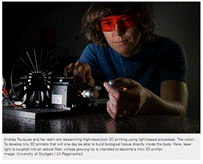
- To solve this, researchers at the University of Stuttgart are developing a miniature 3D printer that can directly print living tissue inside the human body. The project links bioengineering, robotics, and AI.
- The device is designed to travel through thin optical fibers and operate via endoscopic access. The goal is to print complex biological structures exactly where they are needed, without open surgery or external tissue growth.
- The core of the University of Stuttgart system is a light-based 3D printing process. Laser light is guided through a glass fiber, and at its tip sits a 3D-printed lens no larger than a grain of salt. This lens focuses the light to cure layers of bio-ink into living tissue with micrometer-level precision.
- Reminder, a micrometer (also spelled micrometre, symbol: μm) is a metric unit of length equal to one millionth of a meter (0.000001 m or 0.001 mm).
- Side note – Bio-ink is a specially formulated material used in 3D bioprinting to create engineered or artificial living tissues. Here’s a breakdown of what it is and how it works:
- Composition
- Cells: The core component, often stem cells or other living cells.
- Biopolymer gels: These act as scaffolds, enveloping the cells and helping them survive and grow.
- Nutrients & growth factors: Tailored to support specific cell types and promote tissue development.
- Key Properties
- Biocompatibility: Must be safe and supportive for living cells.
- Rheology: Flow characteristics that allow smooth extrusion through a printer nozzle.
- Mechanical stability**: Holds its shape after printing.
- Biofunctionality: Encourages cell adhesion, proliferation, and differentiation.
- Applications
- Tissue engineering: Building skin, cartilage, or even organ-like structures.
- Regenerative medicine: Repairing or replacing damaged tissues.
- Drug testing & cosmetics: Creating realistic tissue models for safer, more accurate testing.
- Think of bio-ink as the “filament” of bioprinters—except instead of plastic, it’s alive and designed to grow into functional tissue.
- Because the light can be shaped and controlled through the fiber, it can print complex cellular structures in confined areas inside the body.
- Side note – how laser light is used in 3D bio printing – Laser light plays a transformative role in bio 3D printing of living tissue, enabling precision, control, and even in-body fabrication. Here’s how it’s being used:
- Key Roles of Laser Light in Bio 3D Printing
- Photopolymerization of Bio-Inks
- Lasers are used to selectively cure or solidify bio-inks—materials containing living cells and hydrogels—by triggering chemical reactions at precise locations. This allows for layer-by-layer construction of tissue structures with high spatial resolution.
- Xolography for Cell-Level Precision
- A novel technique called Xolography uses intersecting light beams to initiate polymerization only at their crossing point. This enables printing of features as small as 20 microns (about the size of a human cell), allowing for intricate tissue architectures like muscle fibers or kidney structures.
- In-Body Tissue Printing via Optical Fibers
- Researchers at the University of Stuttgart have developed a miniature 3D printer that uses laser-guided bio-inks delivered through ultra-thin optical fibers. This setup allows tissue to be printed directly inside the human body via endoscopic access, bypassing the need for transplantation and improving integration with native tissue.
- Microgel Structuring with Light
- At the Terasaki Institute, scientists use light to shape microgels—tiny hydrogel units that guide cell behavior. By adjusting light properties, they control the internal architecture of these gels, mimicking natural tissue environments and influencing how cells grow and organize.
- Why Lasers Matter in Bioprinting
- Non-contact precision: Lasers can manipulate materials without physical contact, reducing contamination and mechanical stress on delicate cells.
- Speed and scalability: Light-based methods can rapidly cure materials, making them suitable for high-throughput tissue fabrication.
- In vivo potential: Laser-enabled devices can operate inside the body, opening doors to minimally invasive regenerative therapies.
- The team aims to refine the printing resolution and develop biodegradable bio-inks that safely integrate into human tissue. The next step is to combine this capability with biologically compatible materials to make it usable for regenerative medicine.
- The long-term goal is to create a medical tool that can build or repair tissues inside the body using precision photonics and micro-optics.

Story 2: Breakthrough Brain Implant from NYU Abu Dhabi Enables Safer, More Precise Drug Delivery
Source: NYU Abu Dhabi website Story by external relations staff
See research paper here [requires subscription]: https://iopscience.iop.org/article/10.1088/1741-2552/ae0523
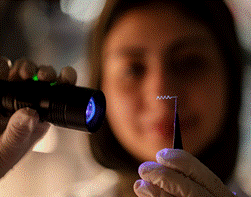
- Researchers at NYU Abu Dhabi (NYUAD) have developed a new type of brain implant that can deliver drugs to multiple regions of the brain with high precision, offering fresh possibilities for the treatment of neurological disorders.
- Side note – NYU Abu Dhabi is officially part of New York University. It’s a degree-granting portal campus within NYU’s Global Network University, alongside NYU’s campuses in New York and Shanghai
- The device, called SPIRAL (Strategic Precision Infusion for Regional Administration of Liquid), is a thin, flexible tube designed to release medication at several points inside the brain.
- This approach allows doctors and scientists to reach larger and more complex areas of brain tissue than current tools, while keeping the implant small and minimally invasive.
- Published in the Journal of Neural Engineering, the study shows how SPIRAL uses carefully designed openings along its structure to release medication in a controlled way. The team combined advanced computer modeling with extensive laboratory testing to confirm the device’s safety and effectiveness.
- Key point – the implant did not cause higher levels of inflammation compared to standard devices, suggesting it could be safely used for long-term treatment.
- A research assistant and co-lead author of the team’s paper note, “Our design solves a big problem with existing brain implants, which usually deliver drugs from just one or two points. SPIRAL makes it possible to distribute drugs more evenly and across larger regions, while still being safe and minimally invasive.”
- Looking ahead, NYU Abu Dhabi’s SPIRAL could also be adapted to provide electrical stimulation or other advanced therapies, potentially benefiting people with conditions such as epilepsy, Parkinson’s disease, and other neurological disorders.

Story 3: Tiny living robots made from human cells could one day deliver medicine
Source: Knowridge.com Story from Carnegie Mellon University
- Imagine tiny, living robots swimming through your body to deliver medicine right where it’s needed.
- Scientists at Carnegie Mellon University are moving closer to making that vision a reality [with the creation of an innovative biobot].
- Biological robots, or “biobots,” are man-made living machines that can move on their own and perform tasks.
- In earlier research, scientists built biobots that relied on muscle fibers, which contract and relax like real muscles, to create motion.
- But the Carnegie Mellon team has taken a completely different approach—using cilia.
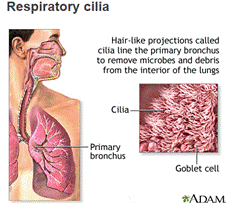
- Cilia are tiny, hair-like structures that act like natural propellers. In our lungs, they sweep away mucus and debris.
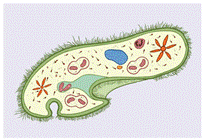
- In water-dwelling creatures, such as paramecium, cilia beat rhythmically to help them swim.
- For scientists, using cilia as a propulsion system seemed promising. The problem, however, was figuring out how to shape and arrange these cilia-powered robots so that they moved in predictable ways.
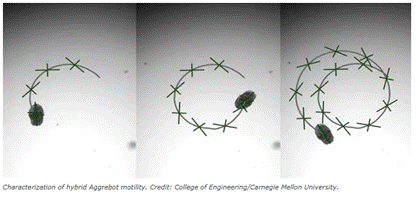
- Their strategy involves building robots out of small spherical clusters of lung stem cells, called tissue spheroids.
- By carefully arranging these spheroids into different shapes, the researchers can control where the cilia are located on the robot’s surface. To fine-tune this even more, they can use some spheroids with a genetic mutation that makes the cilia in that region nonfunctional.
- These AggreBots are not only controllable but also entirely made of biological material. This makes them both biodegradable and biocompatible—key features if they are ever to be used inside the human body.
- Side note – What Are AggreBots? These are biological robots created using human lung cells, specifically leveraging the natural motion of cilia—tiny hair-like structures that sweep mucus in our lungs.
- Self-propelled: These bots can swim, spin, and navigate on their own thanks to the coordinated beating of cilia.
- Modular design: Scientists at Carnegie Mellon University’s Ren lab shape and control AggreBots by arranging cell clusters in specific patterns, allowing for programmable behavior.
- According to the Carnegie Mellon University researchers, AggreBots could one day travel through complex bodily environments to deliver drugs or perform medical interventions.

Story 4: Smart shoe insert could improve mobility for people with walking problems
Source: MedicalXpress.com Story by Tess Malone, Georgia Institute of Tech
Link: https://medicalxpress.com/news/2025-09-smart-insert-mobility-people-problems.html
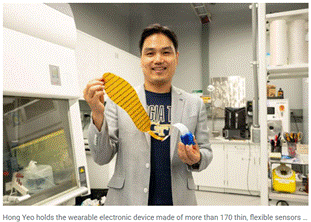
- Researchers at Georgia Tech have developed a low-cost, flexible smart shoe insert designed to improve mobility for people with walking impairments, such as those caused by stroke or Parkinson’s disease.
- Key Features:
- 170+ pressure sensors: These thin, screen-printed sensors monitor foot pressure to detect balance issues.
- Bluetooth-enabled: Sends real-time data to smartphones, with potential for integration into health monitoring apps.
- Comfortable and adaptable: The insert is thin and lightweight, making it suitable for everyday use and compatible with assistive devices.
- Innovation and Impact:
- Affordable production: Uses scalable screen-printing technology, aiming for a price under $100.
- Fall prediction potential: High-resolution data could train machine learning models to anticipate falls.
- Broad applications: Could benefit not only patients but also athletes seeking performance insights.
- The team has tested the device on healthy individuals and plans to expand trials to those with gait impairments, with hopes of commercial availability soon.

Honorable Mentions
Story: Engineers Create Soft Robots That Can Literally Walk on Water
Source: SciTechDaily.com Story by University of Virginia’s School of Engineering and Applied Science
Link: https://scitechdaily.com/engineers-create-soft-robots-that-can-literally-walk-on-water/
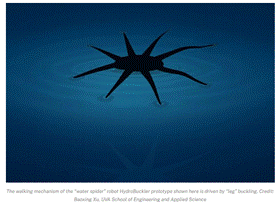
- Researchers at the University of Virginia have developed a groundbreaking method called HydroSpread to fabricate soft robots directly on water surfaces. Here’s a quick overview:
What Is HydroSpread?
– A novel technique that uses liquid surfaces as a fabrication platform.
– Liquid polymer droplets naturally spread into ultrathin sheets on water.
– A laser then carves precise shapes into these sheets, avoiding damage common in traditional methods.
Robot Prototypes
– HydroFlexor: Moves with fin-like paddling motions.
– HydroBuckler: “Walks” using buckling legs, mimicking water striders.
– Powered by infrared heat, these robots can adjust speed and direction.
Potential Applications
– Environmental monitoring (e.g., pollution tracking, water sampling).
– Medical sensors and wearable electronics.
- Flexible, durable devices for hazardous or delicate environments.
////////////////////////////////////////////////////////////////////////////////////////////////////////////////////////////////////////////
Story: First drug treatment for sleep apnea may be within reach
Source: MedicalXpress.com Story by Elin Lindstrom
Link: https://medicalxpress.com/news/2025-10-drug-treatment-apnea.html
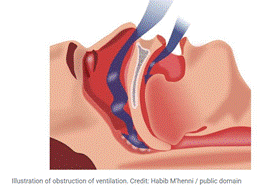
- A new clinical study suggests that the drug sulthiame may become the first effective pharmaceutical treatment for obstructive sleep apnea.
- Conducted across four European countries and published in The Lancet, the trial involved 298 patients with moderate to severe sleep apnea. Those receiving higher doses of sulthiame experienced up to 47% fewer breathing interruptions and improved oxygen levels compared to the placebo group.
- Sulthiame, originally approved for childhood epilepsy, works by stabilizing breathing control and increasing respiratory drive during sleep. Most side effects were mild and temporary.
- Researchers from the University of Gothenburg, including Jan Hedner, Ludger Grote, and Kaj Stenlöf, played key roles in the study. They view the results as a potential breakthrough, especially for patients who struggle with CPAP masks—currently the standard but often poorly tolerated treatment.
////////////////////////////////////////////////////////////////////////////////////////////////////////////////////////////////////////////
Story: Bricklaying robot stacks 360 blocks an hour to speed up homebuilding
Source: Electronics360 Story by Marie Donlon
See also the company’s website: https://www.fbr.com.au/view/hadrian
See video here: https://www.youtube.com/watch?v=eMIDJB3Pd-M

- The article highlights a new bricklaying robot developed by Monumental, a Dutch startup, designed to accelerate home construction.
- This autonomous robot can stack up to 360 blocks per hour, significantly outpacing human labor.
- It uses computer vision and AI to identify block types and placement and works alongside human teams to streamline the building process.
- Monumental aims to address labor shortages and housing demands by deploying these robots in real-world construction sites, with plans to expand their fleet and capabilities.
////////////////////////////////////////////////////////////////////////////////////////////////////////////////////////////////////////////
Story: Tumbleweed rover tests demonstrate transformative technology for low-cost Mars exploration
Source: Phys.org Story by Robert Egan
Link: https://phys.org/news/2025-09-tumbleweed-rover-technology-mars-exploration.html
See research paper here: https://meetingorganizer.copernicus.org/EPSC-DPS2025/EPSC-DPS2025-1775.html
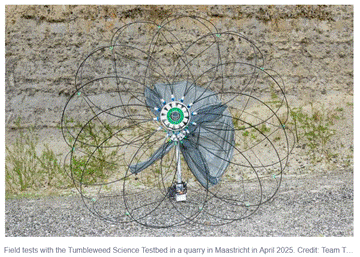
- The article discusses the promising development of Tumbleweed rovers—lightweight, spherical robots designed to roll across the Martian surface powered by wind. Recent wind tunnel and field tests, including experiments in a Maastricht quarry and at Aarhus University’s Planetary Environment Facility, demonstrated that these 5-meter-diameter rovers can move across various Mars-like terrains with wind speeds as low as 9–10 m/s. The rovers successfully collected environmental data while tumbling, validating their design and fluid-dynamics models.
- Key highlights:
- Tumbleweed rovers are designed to be low-cost, wind-driven, and capable of autonomous exploration.
- Scaled prototypes (30–50 cm) were tested under low-pressure conditions, simulating Mars’ atmosphere.
- They can climb slopes up to 11.5° in Earth tests—equivalent to ~30° on Mars.
- Onboard sensors (camera, magnetometer, GPS, etc.) successfully gathered data during field trials.
- Data from NASA’s Insight and Ingenuity missions suggest Martian winds are sufficient to propel the rovers.
- Future plans include more advanced sensors, improved models, and a field campaign in Chile’s Atacama Desert to test swarm coordination.
- This innovative approach could revolutionize planetary exploration by enabling widespread, cost-effective data collection across Mars’ surface.