


Show Notes 10 October 2025
Story 1: Solar-powered ‘artificial plant’ purifies radioactive soil by 95% in 20 days – This technology is highly effective, drastically speeding up a process that would typically take many months.
Source: Interesting Engineering Story by Aman Tripathi
Link: https://interestingengineering.com/innovation/artificial-plant-cleans-radioactive-soil
See also: https://www.eurekalert.org/news-releases/1099362
See research paper here: https://pubs.acs.org/doi/10.1021/acs.est.5c03657
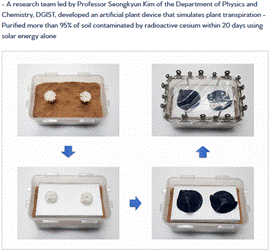
- Researchers at South Korea’s Daegu Gyeongbuk Institute of Science & Technology have developed a solar-powered artificial plant. It mimics natural transpiration to extract radioactive cesium from contaminated soil. It has achieved 95% purification of cesium-137 contaminated soil within 20 days.
- Side note – Natural transpiration refers to the process by which plants release water vapor into the atmosphere through small pores called stomata, primarily located on their leaves. It’s a passive, energy-free mechanism that plays a vital role in plant physiology and the water cycle.
- Side notes:
- Cesium-137 (¹³⁷Cs) was introduced into the soil following the Chernobyl nuclear accident in April 1986.
- Cesium-137 binds strongly to clay particles and organic matter in soil, especially in forested areas, making it relatively immobile but long-lasting. It has a half-life of about 30 years, meaning contamination can persist for decades.
- Environmental Significance:
- Cesium-137 is water-soluble, making it highly mobile in ecosystems and dangerous to plants and animals.
- The new solar-powered artificial plant device offers a low-tech, scalable solution for nuclear accident sites and polluted farmland.
- How it works:
- Mimicking Transpiration
- [As noted above] The device simulates how real plants draw water from soil via capillary action and release it through leaves.
- Instead of biological roots and leaves, it uses engineered channels and adsorbent materials to selectively extract contaminants.
- How it achieves Cesium Ion Selectivity
- The device uses a specialized adsorbent in its “leaves” that binds cesium ions while allowing pure water to evaporate.
- This selectivity is key—it avoids pulling up other harmless ions and focuses on the radioactive threat.
- Solar-Driven Evaporation
- Sunlight powers the entire process: heating the system, driving water movement, and enabling evaporation.
- No external electricity or water input is needed, making it ideal for remote or disaster-stricken areas.
- Regeneration & Sustainability
- Once the adsorbent leaves are saturated with cesium, they can be replaced or washed with an acidic solution to recover the cesium.
- The adsorbent material is recyclable, reducing cost and waste.
- Closed-Loop Water Cycle
- Evaporated water is condensed and returned to the soil, maintaining hydration without external irrigation.
- Research Implications
- Demonstrates the feasibility of solar-driven soil remediation without complex infrastructure.
- Could be a game-changer for post-nuclear disaster recovery and agricultural safety.

Story 2: Microsoft claims a ‘breakthrough’ in AI chip cooling – It could be up to three times more effective than current methods
Source: Engadget.com Story by Will Shanklin
Link: https://www.engadget.com/ai/microsoft-claims-a-breakthrough-in-ai-chip-cooling-193106705.html
See also Microsoft’s information: https://news.microsoft.com/source/features/innovation/microfluidics-liquid-cooling-ai-chips/?msockid=3234617e11b66d9c06b0770c100c6c8d
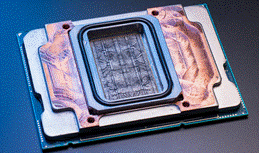
- AI is an enormous energy drain, contributing to greenhouse gas emissions at a time when the planet desperately needs progress in the opposite direction. Although most of that comes from running Graphics Processing Units [GPUs], cooling them is another significant overhead. So, it’s worth noting when a company of Microsoft’s stature claims to have achieved a breakthrough in chip cooling.
- Microsoft’s new system is based on microfluidics, a method long pursued but hard to implement. The company claims its approach could lead to three times better cooling than current methods.
-
Side note – other companies exploring microfludics include:
- Corintis
- IBM
- Intel
- TSMC
- Imec
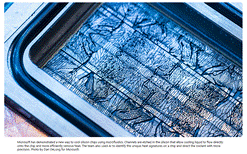
- The liquid in Microsoft’s prototype moves through thread-like channels etched onto the back of the chip. The company also used AI to more efficiently direct the coolant through those channels.
- Another aspect separating this prototype from previous attempts is that it drew inspiration from Mother Nature. The etchings resemble the veins in a leaf or a butterfly wing.
- Microsoft says the technique can reduce the maximum silicon temperature rise inside a GPU by 65 percent. (However, that number depends on the workload and chip type.)
- This would enable overclocking without worrying about melting the chip down. It could allow the company to place servers closer together physically, reducing latency. It would also lead to “higher-quality” waste heat use.
- Side note – Overclocking in chip technology refers to the practice of increasing the operating frequency of a processor—whether it’s a CPU, GPU, or other integrated circuit—beyond its factory-rated specifications to achieve higher performance.

Story 3: Battery made from natural materials could replace conventional lithium-ion batteries
Source: TechXplore on MSN Story by Lesley Henton
See Texas A&M post here: https://stories.tamu.edu/news/2025/09/24/battery-made-from-natural-materials-could-replace-conventional-lithium-ion-batteries/
See research paper here: https://www.pnas.org/doi/10.1073/pnas.2509325122
- What if the next battery you buy was made from the same kinds of ingredients found in your body? That’s the idea behind a breakthrough battery material made from natural, biodegradable components. It’s so natural, it could even be consumed as food.
- A team of researchers at Texas A&M University has developed a biodegradable battery using natural polymers.
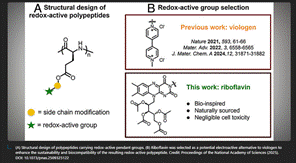
- The new material is made from two key ingredients found in nature: riboflavin, also known as vitamin B2, and L-glutamic acid, an amino acid that helps build proteins in the body.
- What makes this material special is that it’s redox-active, which means it can gain and lose electrons. This is how batteries store and release energy. In this case, the riboflavin handles the energy, while the polypeptide provides structure and helps the material break down naturally.
- Unlike conventional lithium-ion batteries, which rely on metals and petrochemicals, this new material is derived entirely from renewable biological sources. It’s designed to degrade safely when exposed to water or enzymes, making it a promising solution for reducing battery waste, especially in cases where batteries aren’t properly recycled.
- A lead researcher noted, “At this point, we’ve merely confirmed that our materials are cytocompatible, meaning they are non-harmful to cells. This may matter if the materials were to be used in implantable or wearable devices.”
- Side note – Cytocompatible refers to the ability of a material, substance, or surface to interact with living cells without causing harm or adverse effects. In biomedical and tissue engineering contexts, a cytocompatible material supports:
- Cell viability – cells remain alive and healthy
- Cell adhesion – cells can attach to the material
- Cell proliferation – cells can grow and multiply
- Normal cellular function – cells behave as expected without stress or toxicity
- For example, when developing implants, scaffolds, or drug delivery systems, researchers test cytocompatibility to ensure that the material won’t trigger inflammation, cell death, or other negative biological responses.
- The team aims to design batteries that can be reused, recycled, or safely returned to nature, possibly even edible in extreme cases.
- Reality check – Current production costs are too high for commercial viability. Researchers estimate 5–10 years of development to improve affordability and performance.

Story 4: AI spine model developed by Florida Atlantic University and Baptist Health could transform back pain treatment
Source: Florida Atlantic University Story by Gisele Galoustian
Link: https://www.fau.edu/engineering/biomedical/news/2509-ai-spine-modeling-back-pain/
See research paper here: https://www.sciencedirect.com/science/article/pii/S1878875025005923
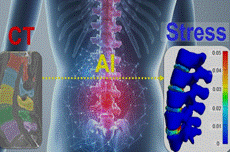
- Nearly 3 in 10 adults in the United States have experienced lower back pain in any three-month period, making it the most common musculoskeletal pain.
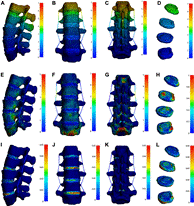
- Researchers and clinicians are increasingly turning to lumbar spine modeling, which bridges engineering and medicine, creating a virtual, patient-specific model of the lower back. This technology simulates how the spine moves, where mechanical stress builds up, and what might be causing pain or dysfunction.
- These detailed models are used to plan surgeries, evaluate spinal implants and develop personalized treatment strategies tailored to each patient’s anatomy.
- Despite its promise, current lumbar spine modeling is slow, manual and demands specialized expertise, limiting scalability and personalization. This hinders clinical application and results in inconsistent outcomes.
- Researchers from the College of Engineering and Computer Science at Florida Atlantic University and the Marcus Neuroscience Institute at Boca Raton Regional Hospital, part of Baptist Health, have reached a major milestone in lumbar spine modeling by integrating artificial intelligence with biomechanics to transform spine diagnostics and personalized treatment planning.
- They are the first to create a fully automated finite element analysis pipeline specifically for lumbar spine modeling. Their breakthrough involves integrating deep learning tools like nnUNet and MONAI with biomechanical simulators such as GIBBON and FEBio.
- Side note – nnU-Net is a powerful, self-configuring deep learning framework designed for biomedical image segmentation. It’s widely used in medical imaging tasks like identifying tumors, organs, or other anatomical structures in CT, MRI, and microscopy scans.
- Side note – MONAI (Medical Open Network for AI) is an open-source, PyTorch-based framework specifically designed for deep learning in medical imaging. It’s a collaborative effort led by NVIDIA, the National Institutes of Health, and King’s College London, aiming to bridge the gap between academic research and clinical deployment.
- PyTorch is an open-source machine learning library developed by Meta AI (formerly Facebook AI) and now governed by the PyTorch Foundation under the Linux Foundation umbrella. It’s one of the most popular frameworks for building and training deep learning models, especially in fields like computer vision, natural language processing, and biomedical imaging.
- Side note – GIBBON and FEBio are powerful open-source tools used in bioengineering and computational biomechanics, often working together to enable advanced modeling and simulation.
- GIBBON (Geometry and Image-Based Bioengineering add-ON)Platform: MATLAB toolbox developed by Kevin M. MoermanPurpose: Bridges image processing, geometry creation, and finite element modelingKey Features: 3D image segmentation and visualizationCAD-style geometry creation and mesh manipulationInterfaces with TetGen for tetrahedral meshingExports models for simulation in FEBioUse Cases: Biomedical modeling, anatomical reconstruction, lattice structure design, and inverse finite element analysisWebsite: gibboncode.org
- FEBio (Finite Elements for Biomechanics)Platform: Standalone software suite for finite element analysisPurpose: Simulates biomechanical systems with a focus on soft tissue mechanicsKey Features: Nonlinear material models (e.g., hyperelastic, viscoelastic)Contact mechanics and fluid-solid interactionsTime-dependent simulations (e.g., growth, remodeling)GUI and scripting support for model setup and analysisUse Cases: Orthopedic research, cardiovascular modeling, tissue engineering, and implant design
- Together, GIBBON and FEBio form a robust pipeline for turning medical images or CAD geometries into detailed biomechanical simulations. If you’re working on anatomical modeling or tissue mechanics, this combo is a goldmine.
- Results of the study, published in the journal World Neurosurgery, show that this new approach reduced lumbar spine model preparation time by 97.9% – from more than 24 hours to just 30 minutes and 49 seconds – without compromising biomechanical accuracy.
- The fully automated pipeline enables rapid, patient-specific simulations that support preoperative planning, spinal implant optimization and early detection of degenerative spine conditions.
- Tests showed that the virtual spine reacted just like a real one, with realistic disc movement, ligament tension and pressure in the back of the spine during bending and stretching. Because the system runs with very little manual work, it’s much faster and more consistent than traditional methods, making it a valuable tool for doctors and researchers alike.
Honorable Mentions
Story: Scientific breakthrough leads to ‘fluorescent biological qubit’ – it could mean turning your cells into quantum sensors
Source: LiveScience.com Story by Roland Moore-Colyer

- Breakthrough in Quantum Biology – Researchers at the University of Chicago have developed a method to turn fluorescent proteins—like those found in glowing jellyfish—into biological quantum bits (qubits) that function inside living cells.
- How It Works
- Fluorescent proteins absorb light and emit it at longer wavelengths. Their fluorophores can enter a metastable triplet state, enabling quantum superposition.
- Using a custom confocal microscope, scientists manipulated the spin state of enhanced yellow fluorescent protein (EYFP) with laser pulses and microwaves.
- The EYFP behaved as a qubit for about 16 microseconds before decaying.
- Applications – These biological qubits can act as quantum sensors to detect magnetic and electrical signals inside cells.
- Potential uses include:
- Monitoring protein folding
- Tracking biochemical reactions
- Observing drug interactions
- Enhancing medical imaging and early disease detection
- Challenges Ahead
- EYFP qubits require cooling to 175 K (–98.15°C) for optimal performance.
- At room temperature, they work in bacterial cells but with reduced contrast and stability.
- Sensitivity still lags behind solid-state quantum sensors like diamond-based systems.
- This innovation opens a new frontier where quantum physics meets cellular biology, potentially revolutionizing how we study life at the nanoscale.
////////////////////////////////////////////////////////////////////////////////////////////////////////////////////////////////////////////
Story: Improving prediction of worsening knee osteoarthritis with an AI-assisted model
Source: MedicalXpress.com Story by Science X staff
Link: https://medicalxpress.com/news/2025-08-worsening-knee-osteoarthritis-ai.html

- Osteoarthritis affects over 303 million people globally. Improved predictions could lead to earlier interventions, potentially delaying or preventing total knee replacement.
- Researchers from Chongqing Medical University developed an AI-assisted model to better predict the progression of **knee osteoarthritis (OA).
- The model integrates three types of data:
- MRI radiomics (imaging features of knee tissue)
- Biochemical biomarkers (from blood and urine tests)
- Clinical variables (patient assessments and history)
- Data was sourced from the NIH Osteoarthritis Biomarkers Consortium, involving:
- 594 patients
- 1,753 knee MRIs over a 2-year period
- The model was trained on half the dataset and tested on the other half.
////////////////////////////////////////////////////////////////////////////////////////////////////////////////////////////////////////////
Story: Laser-blasted ‘black metal’ could make solar technology 15 times more efficient
Source: LiveScience.com Story by Owen Hughes
- Breakthrough in Solar Thermoelectric Generators (STEGs)
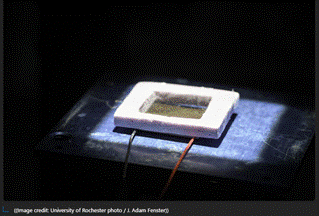
- Researchers developed a laser-etched “black metal” that dramatically boosts the efficiency of STEGs.
- This material absorbs more thermal energy due to its deep, light-trapping surface.
- How STEGs Work
- STEGs convert heat into electricity using the Seebeck effect, where a temperature gradient across semiconductor materials generates voltage.
- They differ from photovoltaic panels, which directly convert sunlight into electricity.
- Current Limitations
- Traditional STEGs are less than 1% efficient, making them impractical for widespread solar use.
- In contrast, standard photovoltaic panels reach around 20% efficiency.
- Efficiency Boost – The new black metal increases STEG efficiency by a factor of 15, a significant leap toward practical solar thermoelectric applications.
////////////////////////////////////////////////////////////////////////////////////////////////////////////////////////////////////////////
Story: This New Solid-State EV Battery Charges Quicker Than Getting Gas
Source: InsideEVs.com Story by Iulian Dnistran
Link: https://insideevs.com/news/771520/rimac-solid-state-battery-specs/
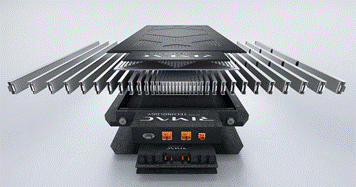
- Rimac has unveiled a groundbreaking solid-state battery at the IAA Mobility show in Munich that could dramatically reshape electric vehicle performance.
- Key highlights include:
- Ultra-fast charging: The battery supports DC fast charging at speeds over twice as fast as current lithium-ion packs.
- High discharge power: It delivers up to 850 kW, enabling rapid energy output for high-performance EVs.
- Compact and lightweight**: The new design is smaller and lighter, improving vehicle efficiency and range.
- Energy density boost: Solid-state chemistry allows for more energy storage in less space, a major leap for EV architecture.
- This innovation positions Rimac at the forefront of next-gen EV battery technology.