


Show Notes 13 November 2026
Text highlighted in blue identifies notes I have inserted.
Story 1: A new way to fight ‘forever chemicals’ – ASU researchers develop technique that can capture and destroy ubiquitous “forever chemicals” PFAS, instead of just filtering them out
Source: Arizona State University Story by Richard Harth
Link: https://news.asu.edu/20261019-science-and-technology-new-way-fight-forever-chemicals

- Researchers at Arizona State University and several international universities have developed a promising new method for destroying harmful chemicals known as PFAS, often called “forever chemicals.” These substances are used in products such as nonstick cookware, waterproof clothing, food packaging, and firefighting foam.
- Side note – PFAS stands for Per- and Polyfluoroalkyl Substances.
- PFAS are a large family of human-made chemicals that have been used since the 1940s in products designed to resist water, grease, stains, and heat. They are often called “forever chemicals” because they break down extremely slowly in the environment and can remain in the human body for many years.
- Common places PFAS have been used include:
- Nonstick cookware (such as some Teflon-coated pans)
- Water-repellent clothing and outdoor gear
- Stain-resistant carpets and furniture
- Food packaging (fast-food wrappers, microwave popcorn bags)
- Firefighting foams
- Some cosmetics and personal-care products
- Research has linked exposure to certain PFAS chemicals with:
- Increased cholesterol levels
- Reduced immune system response
- Liver effects
- Thyroid disorders
- Developmental effects in infants and children
- Increased risk of some cancers, particularly kidney and testicular cancer
- Unfortunately, they can remain in the environment for decades, contaminating water, soil, and food. Exposure to some forever chemicals [PFAS] has been linked to serious health problems, including certain cancers and thyroid disease.
- Forever chemicals [PFAS] are difficult to destroy because they contain extremely strong chemical bonds between carbon and fluorine. Traditional water-treatment methods can remove these chemicals from water but often leave them trapped in filters or concentrated waste that must be disposed of.
- The new technology from Arizona State University uses tiny membrane fibers coated with particles of palladium, a metal that acts as a catalyst. Hydrogen gas passes through the membranes, where the palladium activates the hydrogen. This allows it to attack the strong chemical bonds in forever chemicals [PFAS] molecules, helping break them apart rather than simply capturing them.
- In laboratory testing lasting 58 days, the system removed more than 90% of each of six tested forever chemicals [PFAS] compounds. It also removed about 83% of the fluorine from the treated chemicals.
- Although these results are encouraging, more work is needed before the technology can be widely used.
- Palladium is expensive, so researchers are investigating ways to reduce the amount required.
- Eventually, the system could work alongside existing water-treatment methods to destroy concentrated forever chemicals [PFAS] waste and help reduce long-term environmental pollution.

Story 2: Swiss startup develops a system that wirelessly charges electric buses through their tires
Source: Chargedevs.com Story by Charles Morris
Check out the company’s website: https://www.winduction.com/
See video here: https://x.com/Ronald_vanLoon/status/2117436192299827525
And video interview with co-founder of Winduction: https://www.youtube.com/shorts/WQCBVeEYoqc
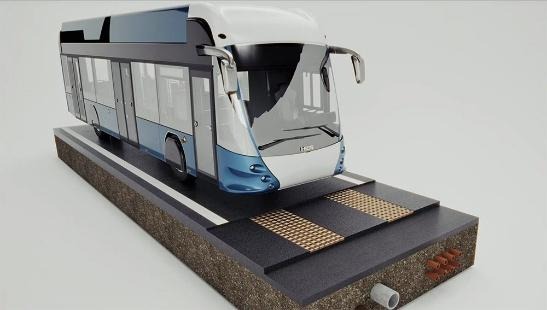
- A Swiss startup called Winduction has developed a new way to charge electric buses wirelessly through their tires. Their technology could reduce the cost of operating electric buses by allowing them to recharge while making their regular stops.
- Today, most electric buses use large batteries and recharge at depots, often overnight. These batteries are heavy and expensive. Winduction’s system could allow buses to use smaller, less expensive batteries by charging them throughout the day.
- The system uses a technology called inductive charging, which transfers electricity through a magnetic field without cables. Coils installed in special road plates generate the magnetic field, while matching coils inside specially designed bus tires receive the energy and transfer it to the vehicle’s battery.
- The company says the system can transfer more than 90% of the energy into the vehicle.
- However, conventional bus tires contain steel belts that can interfere with the magnetic field and generate unwanted heat. Winduction is working with partners to develop tires without steel reinforcement.
- The company estimates that a bus route between Zurich Airport and the Oerlikon district could operate with charging plates at just two of its 24 stops. The buses would accumulate about three hours of charging during a 16-hour operating day.
- Winduction is building testing facilities in Winterthur, Switzerland, and plans its first passenger-carrying pilot project for 2028.
- If successful, their technology could reduce battery costs, lower energy demands and allow more passengers aboard lighter buses. However, its long-term reliability and actual cost savings still need to be demonstrated.

Story 3: Rendezvous Robotics Plans Self-Assembling Tile Demo in Space in ’28
Source: Aviation Week Story by Garrett Reim
Check out the company’s website: https://www.rdvrobotics.com/
Check out this interview: https://www.youtube.com/watch?v=cmgz5wQOdIk

- Seattle-area startup Rendezvous Robotics plans to demonstrate a new approach to building spacecraft in orbit. The company hopes to show that small, modular pieces can assemble themselves in space to create larger structures without requiring astronauts to put them together manually.
- The planned demonstration, targeted for 2028, will involve seven specially designed tiles. The tiles are expected to autonomously connect to form a single spacecraft. They will then separate and reassemble into a different configuration, demonstrating that the system can build and rebuild structures in orbit.
- The technology could change how satellites and other large space structures are manufactured.
- Today, spacecraft generally must fit inside a rocket’s limited payload space during launch. Large structures may require complicated deployment mechanisms or assembly by astronauts after reaching orbit.
- With self-assembling tiles, future missions could launch smaller components and combine them in space. This approach could potentially support much larger structures than could be launched as one piece. It might also allow spacecraft to be reconfigured or repaired by replacing individual modules rather than an entire vehicle.
- The concept may eventually be useful for constructing large communications platforms, scientific instruments, solar-power systems, or other infrastructure in orbit. However, these are potential applications, not capabilities established by the planned demonstration.
- The 2028 test will be an important early step in determining whether the technology can work reliably in the space environment. Rendezvous Robotics will need to demonstrate that the tiles can connect, separate, and reconnect autonomously under actual space conditions.
- If successful, the approach could offer a more flexible way to build and maintain space infrastructure. Instead of designing every spacecraft as a single, fixed object, engineers might one day create larger systems from interchangeable building blocks.

Story 4: AI platform identifies synergistic drug combination for resistant prostate cancer
Source: Bioengineer.org
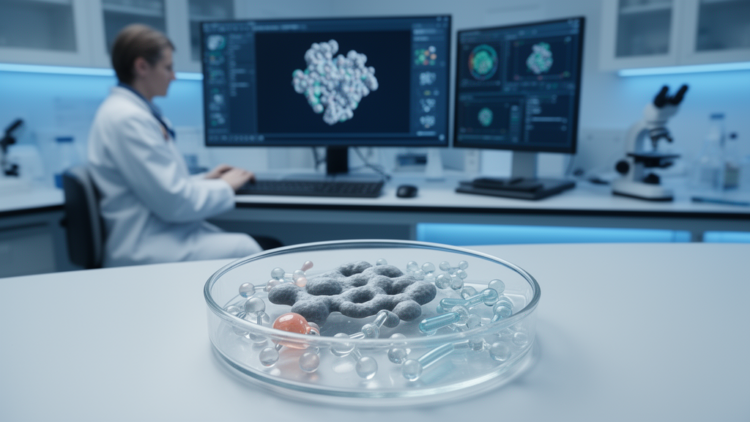
- Researchers at the University of California, Los Angeles have developed an artificial intelligence system that could help scientists discover new ways to treat prostate cancer that no longer responds to existing medications.
- The system, called MAESTRO, uses artificial intelligence to analyze scientific research, cancer biology, and the ways cancer cells become resistant to treatment. It searches for drugs that might work better when combined with existing cancer medications.
- The researchers focused on enzalutamide, a drug used to treat advanced prostate cancer. Although it can slow cancer growth, some cancer cells eventually develop ways to survive despite treatment.
- MAESTRO evaluated 3,592 natural compounds and selected 150 promising candidates for laboratory testing. Scientists tested these compounds alongside enzalutamide using three-dimensional clusters of prostate cancer cells designed to better represent actual tumors.
- Of the 150 compounds tested, 23 showed evidence of working better in combination with enzalutamide than expected from either compound alone.
- One particularly promising candidate was berberine, a naturally occurring substance found in several plants. The combination improved the drug’s activity in four cancer models with different forms of treatment resistance.
- Laboratory experiments suggested that the combination affected cellular pathways involved in energy regulation, stress, growth, and cell division. These changes may help explain why the two compounds worked effectively together.
- However, the findings are preliminary. The combination has not been proven effective or safe in people with prostate cancer. Further studies, including animal research and eventually clinical trials, would be needed.

Honorable Mentions
Story: For The First Time, Watch Cells Communicate Across an Entire Living Body
Source: ScienceAlert.com Story by Jess Cockerill
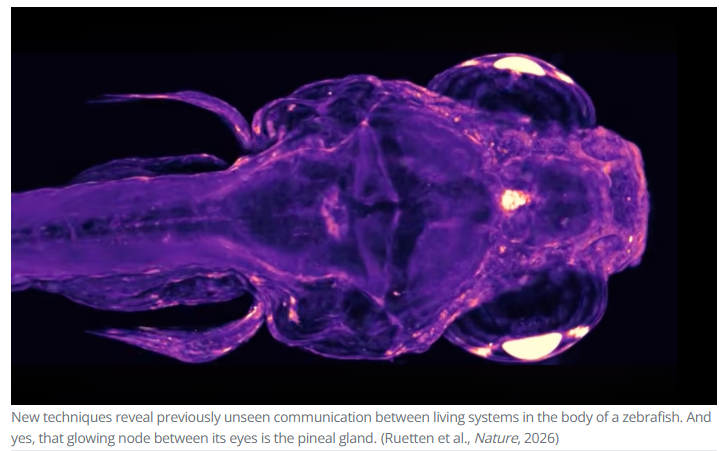
- Scientists at the Howard Hughes Medical Institute have developed a new imaging technique that allows them to watch cells communicate throughout the body of a living animal. The breakthrough could help researchers better understand how different organs work together and how similar processes occur in humans.
- Side note – The Howard Hughes Medical Institute is one of the most respected biomedical research organizations in the United States and is widely recognized throughout the scientific community. It was founded in 1953 by Howard Hughes and operates as a nonprofit biomedical research institution
- The technique, called WHOLISTIC, uses genetic engineering to equip nearly every cell in an animal’s body with fluorescent sensors that respond to changes in calcium levels. Calcium is an important chemical signal involved in many biological activities, including muscle contractions, communication between nerve cells, and the regulation of cell survival.
- When calcium levels change, the sensors light up, allowing researchers to observe cellular activity in real time. The system captures activity throughout the body, second by second, rather than focusing on just one organ or group of cells.
- Researchers developed the method using naturally transparent fish, including young zebrafish and a small freshwater species called Danionella cerebrum. Their transparent bodies make it easier to observe internal activity without major physical interference.
- The technique has already revealed unexpected findings. Scientists discovered that cartilage-forming cells responded to cold temperatures. They also found that the protective membranes surrounding the brain responded to ketamine, a drug known to affect brain activity.
- Researchers could even observe how the brainstem helps redistribute blood flow throughout the body.
- The team hopes WHOLISTIC will help scientists connect research in neuroscience, physiology, and cell biology. By seeing how cells and organs interact, researchers may uncover previously hidden biological processes and gain new insights into health and disease.
////////////////////////////////////////////////////////////////////////////////////////////////////////////////////////////////////////////
Story: Researchers Develop Tiny Probe for Intravascular Imaging in the Brain – A tiny rotating lens could give physicians a 360-degree view inside hard-to-reach brain arteries.
Source: TechnologyNetworks.com
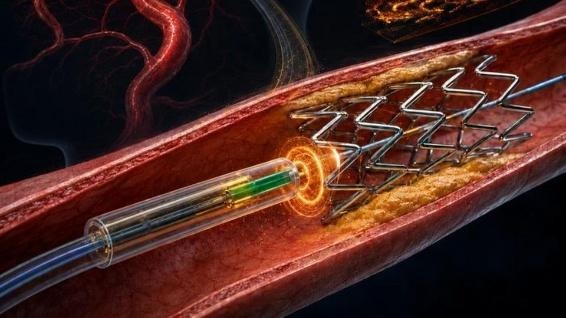
- Researchers at the Medical School of Nanjing University in China have developed a miniature imaging probe that could help doctors see the inside of the brain’s smallest blood vessels in remarkable detail. The technology may eventually improve the diagnosis and treatment of conditions such as blocked arteries and stroke.
- The probe measures just 0.55 millimeters in diameter and 4 millimeters long, making it roughly as wide as a pencil lead and as long as a grain of rice. It uses a technique called optical coherence tomography (OCT), which employs light to produce detailed cross-sectional images of tissues.
- A tiny optical fiber sends near-infrared light through a miniature lens. An electrically activated material called a piezoelectric actuator rotates the lens at the probe’s tip, allowing it to capture images in every direction around the blood vessel. Combining these images can also create three-dimensional views.
- Existing imaging devices can struggle to navigate the brain’s narrow, twisting arteries. Their rotation mechanisms may produce distorted images or block portions of the view. By rotating only the tiny lens at its tip, the new probe is designed to reduce these problems.
- In laboratory experiments, the researchers successfully guided the probe through a model of human brain blood vessels. They also obtained images of blood vessels, implanted stents, and human artery plaque tissue removed from the body. The results agreed with conventional tissue examinations.
- The technology could eventually help doctors examine artery disease and check how well stents fit inside blood vessels. However, further development and safety testing are needed before the probe can be used routinely in patients.
////////////////////////////////////////////////////////////////////////////////////////////////////////////////////////////////////////////
Story: Scientists Find a New Way to Produce Hydrogen from Water Using Light – This could point toward simpler, cheaper ways to make clean hydrogen.
Source: ZME Science Story by Mihai Andrel
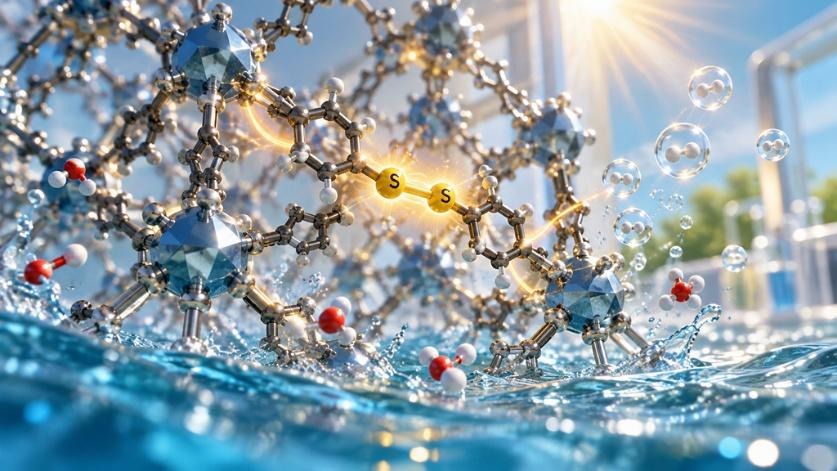
- Scientists at Oregon State University have developed a new material that could make producing clean hydrogen fuel from water and sunlight easier and less expensive. The research offers a promising alternative to conventional hydrogen production, which often relies on natural gas and releases carbon dioxide.
- The research team, led by Kyriakos Stylianou, developed a special light-activated material called a photocatalyst. A photocatalyst absorbs light and uses its energy to speed up chemical reactions. The material belongs to a family of porous crystalline structures known as metal-organic frameworks, or MOFs.
- The researchers focused on a particular material called BVR-19. It contains sulfur-based chemical bonds that respond to light. When illuminated, these bonds temporarily break, creating highly reactive particles that help move electrons and drive the production of hydrogen.
- One important advantage is that the material does not require an additional expensive metal catalyst to perform its job. It also forms in water at room temperature, potentially reducing the energy needed to manufacture it.
- Hydrogen is an important industrial ingredient used to manufacture chemicals, refine metals, and produce plastics. It can also power fuel cells, which generate electricity with water as their main byproduct.
- Currently, hydrogen made using natural gas costs considerably less than hydrogen produced through cleaner methods. The researchers hope their discovery will help close that cost gap.
- The technology is still at the research stage, and further development will be needed before it can be widely used commercially. Nevertheless, the findings provide new guidance for designing materials that could turn sunlight and water into a more affordable source of clean energy.
////////////////////////////////////////////////////////////////////////////////////////////////////////////////////////////////////////////
Story: Yeast paired with electricity can convert CO₂ into a chemical used in biodegradable plastics
Source: Phys.org Story by Swati Mestri
Link: https://phys.org/news/2026-10-yeast-paired-electricity-chemical-biodegradable.html
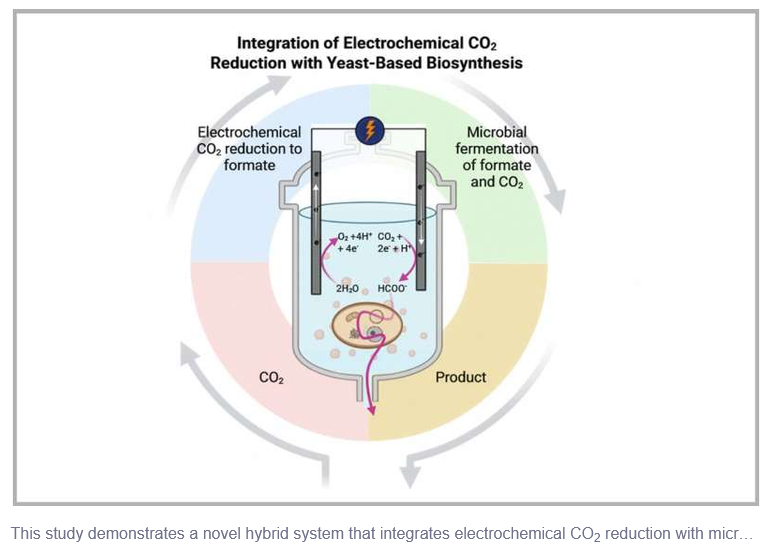
- Researchers have developed a new process that uses electricity and genetically engineered yeast to turn carbon dioxide (CO₂) into itaconic acid, an industrial chemical used to make biodegradable plastics, textiles, adhesives, and resins. The research could provide a way to transform carbon emissions into useful products instead of relying on chemicals made from fossil fuels.
- The research team included scientists from the Helmholtz Centre for Environmental Research in Germany and BOKU University in Vienna, Austria. Their approach combines two processes inside a single reactor.
- First, electricity converts CO₂ into formate, a carbon-based chemical that the yeast can use as an energy source. The yeast, a specially engineered strain called Komagataella phaffii, then uses this material to produce itaconic acid.
- Combining the processes presented a challenge because the chemical reaction and the living yeast work best under different conditions. The researchers had to find a suitable balance of temperature, acidity, and nutrients so both processes could operate together.
- The experiment successfully produced itaconic acid from CO₂. However, the amount produced was lower than when conventional starting materials, such as sugar or methanol, were used.
- The researchers now plan to improve the process and investigate whether other microorganisms could produce additional useful chemicals using the same approach.
- Although the technology is still being developed, it demonstrates a promising way to recycle carbon dioxide into valuable industrial materials. If improved and scaled up, the process could help reduce dependence on petroleum-based chemicals and make manufacturing more sustainable.