


Show Notes 3 April 2026
Text highlighted in blue identifies notes I have inserted.
Story 1: Researchers Develop Photonic Crystal Light Sails for Interplanetary Exploration – New design combines low mass, strong wavelength selectivity, and scalable fabrication potential.
Source: NationalToday.com
Research paper here: https://www.spiedigitallibrary.org/journals/journal-of-nanophotonics/volume-19/issue-04/046008/Design-and-manufacture-of-a-photonic-crystal-light-sail/10.1117/1.JNP.19.046008.full
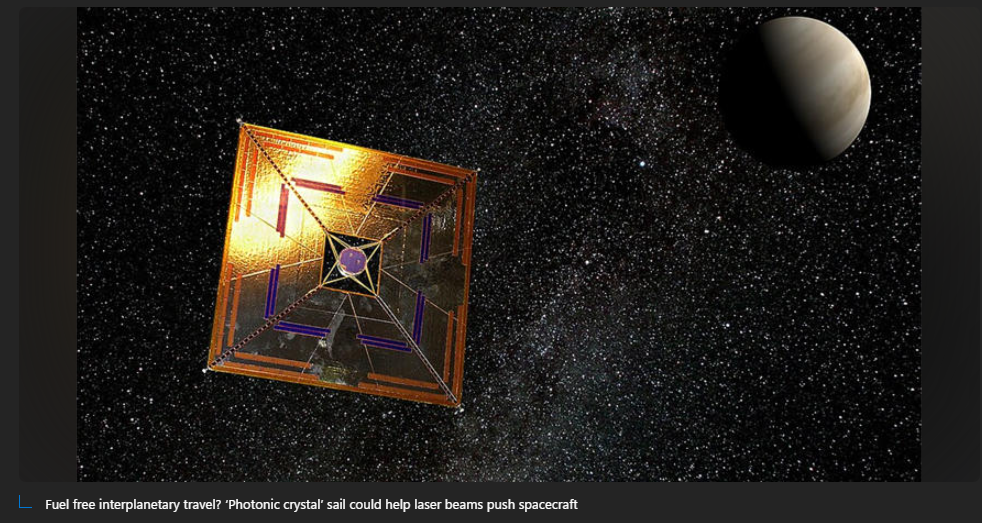
Before we discuss this announcement, I need to highlight what NASA has in the works. They have been exploring a solar sail technology for space exploration. This article only compares a new technology from Tuskegee University with traditional chemical propulsion. But the University’s research paper does acknowledge NASA’s solar sail and cites their research as part of an effort to move away from chemical propulsion. First, here’s what NASA has been up to.
- NASA’s Solar Sail Technology: What They’ve Been Testing
- Core Concept: Propulsion by Sunlight
- Solar sails use radiation pressure from sunlight to generate continuous, low-thrust propulsion.
- No fuel is required as photons impart momentum when they strike the reflective surface.
- Over long durations, this constant push can produce significant velocity changes, ideal for deep-space missions.
- For more about NASA’s program, visit: https://www.nasa.gov/mission/acs3/
- Researchers from Tuskegee University have recently demonstrated a “practical” light sail design that could revolutionize space travel by using lasers rather than chemical fuel.
- Side note – lasers can be beamed extremely far into space—even light-years—but only if the transmitting optics are enormous. In practice, the useful propulsion range for a realistic light sail is much shorter, because diffraction causes the beam to spread. That spreading is the fundamental limiter, not power.
- The photonic crystal light sail developed by Tuskegee University researchers could significantly reshape space travel by addressing the overheating and degradation issues of traditional metal-coated polymer sails.
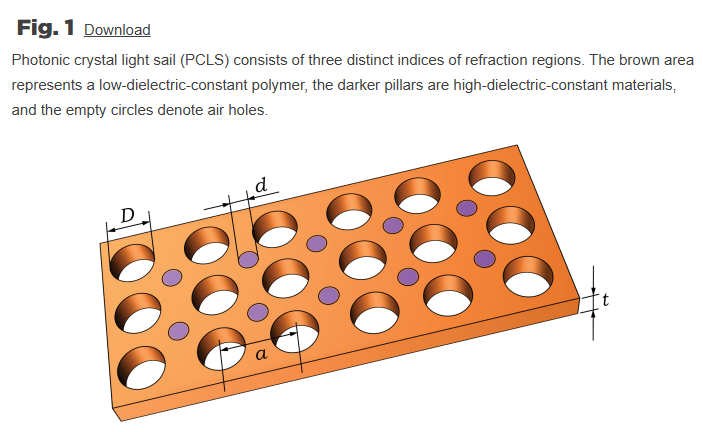
- This new design, which uses a nanoscale pattern of germanium pillars, air holes, and a polymer matrix, aims to maintain high reflectivity without the weight penalty of thicker metal coatings.
- Side note – Germanium pillars are nanoscale or microscale vertical structures made of germanium. They are engineered as part of photonic, electronic, or mechanical devices. They’re typically fabricated as tiny upright “posts” that manipulate light, strain, or electrical behavior in advanced materials systems.
- The structure’s photonic band gap is tuned to match the propulsion laser wavelength, allowing for continuous thrust generation and potentially accelerating the sail to speeds of several hundred meters per second within one hour under idealized conditions.
- Side note – A Photonic Band Gap (PBG) is a range of optical frequencies (or wavelengths) that cannot propagate through a specific material. Think of it as a “No Entry” sign for certain colors of light.
- This advancement could lead to more efficient and sustainable interplanetary space travel, reducing the reliance on onboard propellant and increasing the potential for long-duration, high-speed missions.
Story 2: How UCLA scientists helped reimagine a forgotten battery design from Thomas Edison
Source: UCLA
See research paper here: https://onlinelibrary.wiley.com/doi/abs/10.1002/smll.202507934
- A little-known fact: In the year 1900, electric cars outnumbered gas-powered ones on the American road. The lead-acid auto battery of the time, courtesy of Thomas Edison, was expensive and had a range of only about 30 miles.
- Seeking to improve on this, Edison believed the nickel-iron battery was the future, with the promise of a 100-mile range, a long life and a recharge time of seven hours, fast for that era.
- But, that promise never reached fruition. Early electric car batteries still suffered from serious limitations, and advances in the internal combustion engine won the day.
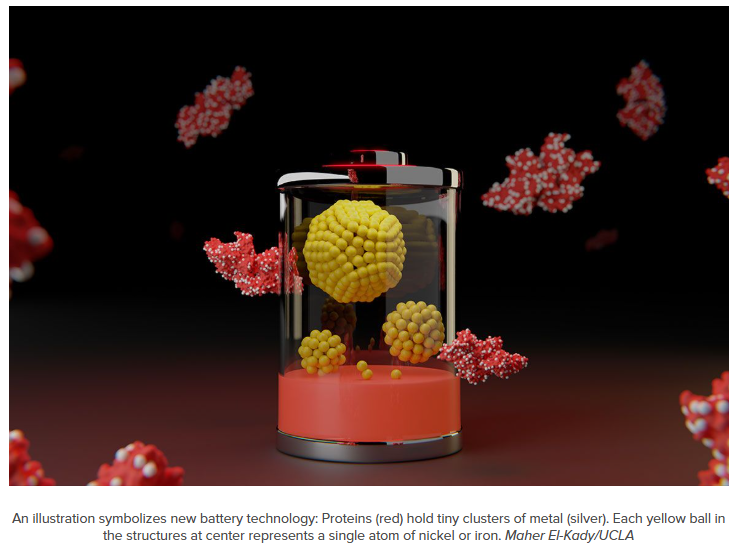
- Now, an international research collaboration co-led by the University of California, Los Angeles [UCLA] has taken a page from Edison’s book, developing nickel-iron battery technology that may be well-suited for storing energy generated at solar farms.
- The prototype battery was able to recharge in only seconds, instead of hours, and achieved over 12,000 cycles of draining and recharging—the equivalent of more than 30 years of daily recharges.
- The technology was built from tiny clusters of metal patterned using proteins that were then bonded to a two-dimensional material, made of sheets only one atom thick.
- Side note – The article does not name any specific proteins. It only describes them functionally—as proteins that act as scaffolds for mineral growth, similar to those used in bone formation or shell formation.
- Despite the innovative ingredients, the techniques are deceptively straightforward and inexpensive.
Story 3: Quantum-inspired laser system delivers distance measurements with sub-millimeter accuracy
Source: Phys.org News from University of Bristol
Link: https://phys.org/news/2026-03-quantum-laser-distance-millimeter-accuracy.html
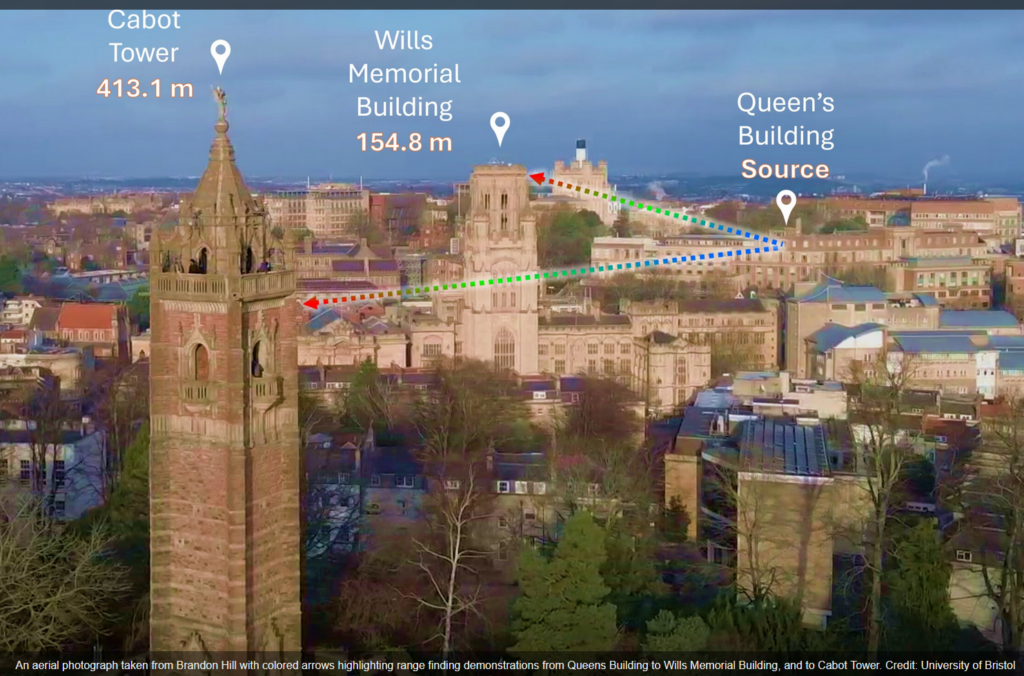
- Researchers at the University of Bristol [in England] have demonstrated a quantum-inspired laser system capable of measuring distances with sub-millimeter accuracy, even under strong sunlight.
- Key challenge – Solving the sunlight [and atmospheric noise] problem:
- Sunlight and atmospheric noise are major obstacles for long-distance optical [laser-based] sensing.
- The new [quantum-inspired laser system] method suppresses background noise while keeping the signal strong, enabling high-precision measurements outdoors.
- Quantum ideas, classical hardware
- The technique borrows from a quantum effect called energy-time entanglement, but instead of using true quantum light, the team recreated its noise-resistant properties using a classical laser. This makes the system more practical and easier to deploy in real-world environments.
- Side note – Energy–time entanglement is a form of quantum entanglement where two particles—usually photons—are linked such that their energies and the times they are created or detected are correlated in a way that cannot be explained classically. It’s one of the most robust and practical types of entanglement used in quantum communication.
- Side note – True quantum light is light whose behavior cannot be described by classical electromagnetic waves and instead requires a fully quantum-mechanical description, typically involving single photons, squeezed states, or entangled states. This is the kind of light that exhibits nonclassical statistics and nonclassical correlations that no classical wave model can reproduce.
- Real-world test results
- The team measured the distance between two buildings on campus—Queens Building and Wills Memorial Building—about 155 meters apart.
- Accuracy achieved: better than 0.1 mm.
- Measurement time: 0.1 seconds.
- Laser power: lower than a common laser pointer!
- Potential applications
- Autonomous vehicles (better sensing in bright conditions)
- High-precision surveying and infrastructure monitoring
- Navigation and positioning systems
- Long-range measurements for space exploration
Story 4: How your virtual twin could one day save your life
Source: IEEE [Institute of Electrical and Electronics Engineers] Spectrum
Story by Steve Levine
Link: https://spectrum.ieee.org/living-heart-project-virtual-twins
See also: https://www.3ds.com/heart
See video here: https://www.youtube.com/watch?v=ae_IqlxgCME
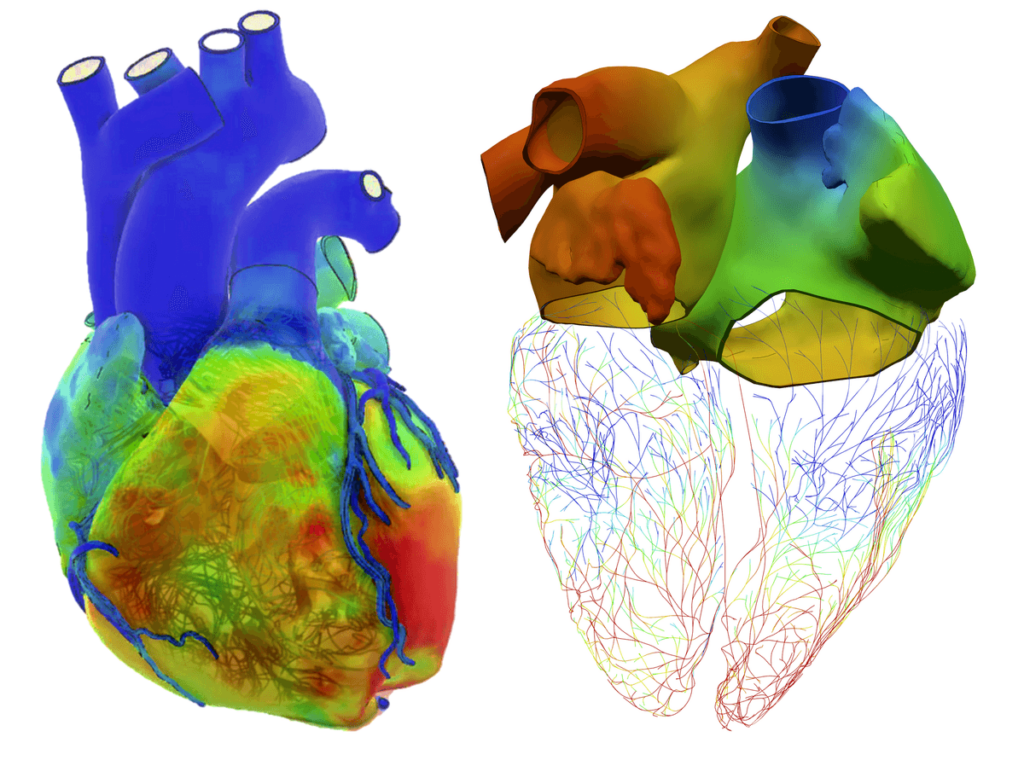
- This article explores the decade-long evolution and medical impact of the Living Heart Project [Living Heart Project has grown into a global ecosystem involving over 100 institutions, including researchers, device manufacturers, and regulatory authorities].
- Launched in 2014 by Dassault Systèmes, the project aims to revolutionize cardiovascular care by creating high-fidelity, physics-based digital replicas of the human heart.
- Core Technology: The “Virtual Twin”
- Unlike traditional 2D images or static 3D models, these “virtual twins” [digital replicas] are dynamic simulations that integrate multiple complex systems including:
- Multiphysics Modeling: The models simulate the interplay of electrical signals (pacing), muscle contraction (mechanics), and blood flow (hemodynamics).
- Data Integration: They are built using industrial-grade simulation software combined with patient-specific data from MRI, CT scans, and echocardiograms.
- Generative AI: Recent phases of the project incorporate generative AI to create thousands of “virtual patients,” allowing for massive computer-based clinical trials.
- Key Medical Applications
- Medical Device Development: Engineers use the models to test pacemakers, artificial valves, and stents in a virtual environment. This provides highly detailed evidence for regulatory bodies (like the FDA), accelerating the approval process while significantly reducing the need for animal testing.
- Precision Surgery: Surgeons can create a virtual twin of a specific patient’s heart to rehearse complex procedures. At hospitals like Boston Children’s, this allows doctors to optimize surgical strategies before the patient even enters the operating room.
- Disease Prediction: By adjusting tissue properties or structural variables at the touch of a button, researchers can simulate how heart disease progresses or how a specific patient population might respond to a new drug.

Honorable Mentions
Story: Lab-grown algae removes microplastics from water
Source: University of Missouri
Link: https://engineering.missouri.edu/2026/lab-grown-algae-removes-microplastics-from-water/
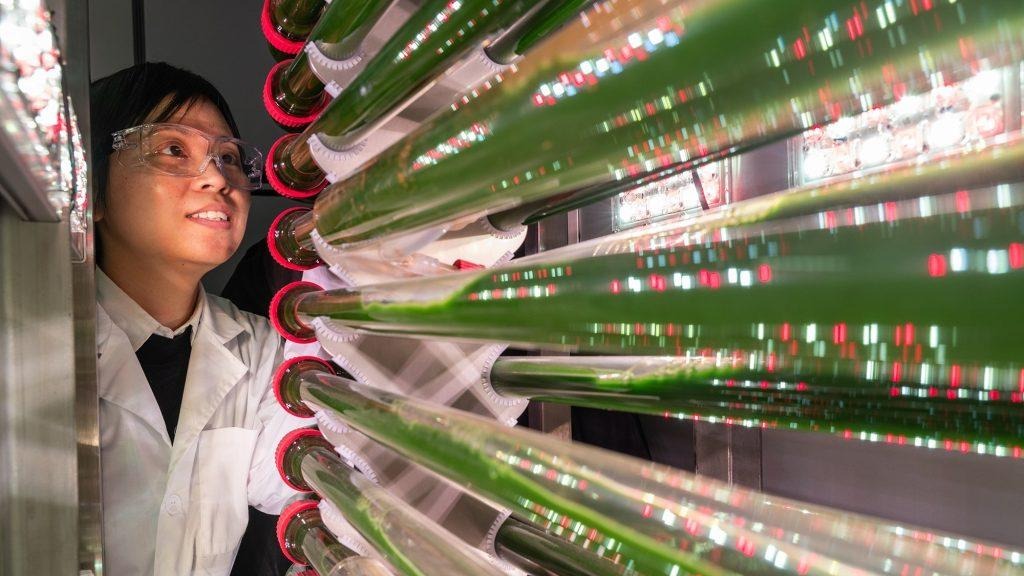
- A University of Missouri researcher is pioneering an innovative solution to remove tiny bits of plastic pollution from our water.
- Mizzou’s Susie Dai recently applied a revolutionary strain of algae toward capturing and removing harmful microplastics from polluted water. Driven by a mission to improve the world for both wildlife and humans, Dai also aims to repurpose the collected microplastics into safe, bioplastic products such as composite plastic films.
- “Microplastics are pollutants found almost everywhere in the environment, such as in ponds, lakes, rivers, wastewater and the fish that we consume,” Dai, a professor in the Department of Chemical and Biomedical Engineering and principal investigator at the Bond Life Sciences Center, said. “Currently, most wastewater treatment plants can only remove large particles of plastic, but microplastics are so small that they slip through and end up in drinking water, polluting the environment and harming ecosystems.”
////////////////////////////////////////////////////////////////////////////////////////////////////////////////////////////////////////////
Story: A wind-powered tumbleweed that heals the desert as it rolls
Source: Yanko Design Story by Ida Torres
Link: https://www.yankodesign.com/2026/03/20/a-wind-powered-tumbleweed-that-heals-the-desert-as-it-rolls/
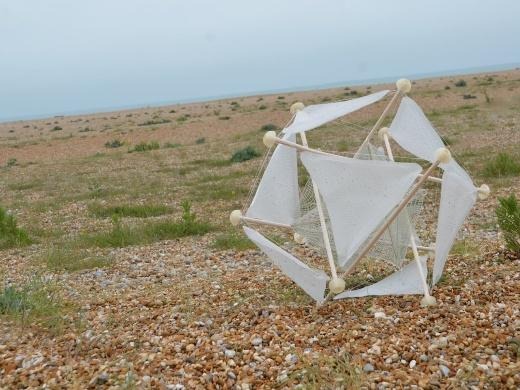
- The article features the “Wasteland Nomads: Bionic Tumbleweed Sower System,” a design by Yizhuo Guo (developed with Daheng Chu) that uses biomimicry to combat desertification.
- The Concept – The project mimics the natural behavior of tumbleweeds—which have traveled across arid landscapes for millions of years to spread seeds—to restore degraded land. Instead of a high-tech, motorized robot, this is a passive robotic device that relies entirely on the wind for propulsion.
- How It Works
- Passive Mechanics: The device requires no batteries, circuits, or external power. It is a lightweight, spherical structure made of biodegradable support rods.
- Smart Materials: Its “skin” is a moisture-responsive biodegradable composite. When the tumbleweed rolls into an area with the correct humidity levels, the skin begins to break down.
- Seeding & Healing: As the skin dissolves, it releases seeds directly into the soil. Beyond planting, the device is designed to boost soil oxygen and contribute to carbon sequestration.
- Zero Waste: Unlike most ecological technology that leaves behind plastic or metal components, this device is designed to fully merge with the ground. By the end of its journey, it has completely biodegraded, leaving nothing but the restored land behind.
////////////////////////////////////////////////////////////////////////////////////////////////////////////////////////////////////////////
Story: These designers made a sustainable new building material from corn
Source: FastCompany.com Story by Hunter Schwarz
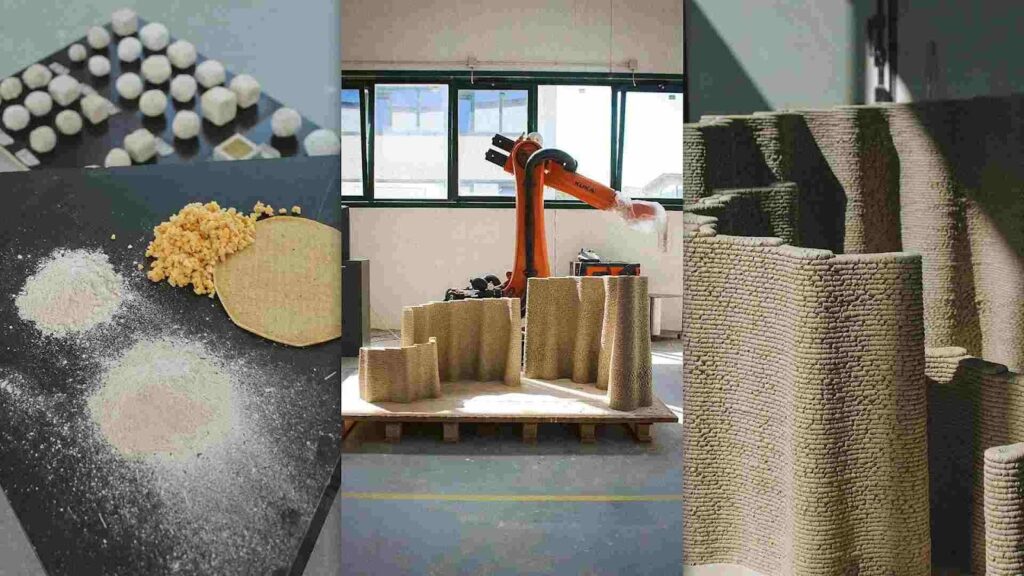
- A new 3D-printed construction technique turns corn into a novel building material.
- Corncretl is a biocomposite made from corn waste known as nejayote that’s rich in calcium. It’s dried, pulverized, and mixed with minerals, and the resulting material is applied using a 3D printer.
- This corn-based construction material was made by Manufactura, a Mexican sustainable materials company, and it imagines a second life for waste from the most widely produced grain in the world. The project started as an invitation by chef Jorge Armando, the founder of catering brand Taco Kween Berlin, to find ways he could reintegrate waste generated by his taqueria into architecture. A team led by designer Dinorah Schulte created corncretl during a residency last year in Massa Lombarda, Italy.
////////////////////////////////////////////////////////////////////////////////////////////////////////////////////////////////////////////
Story: Research group co-led by UC Irvine develops first-of-its-kind ion pump – Ratchet-based device aids in seawater desalination, energy and biomedical applications
Source: University of California, Irvine
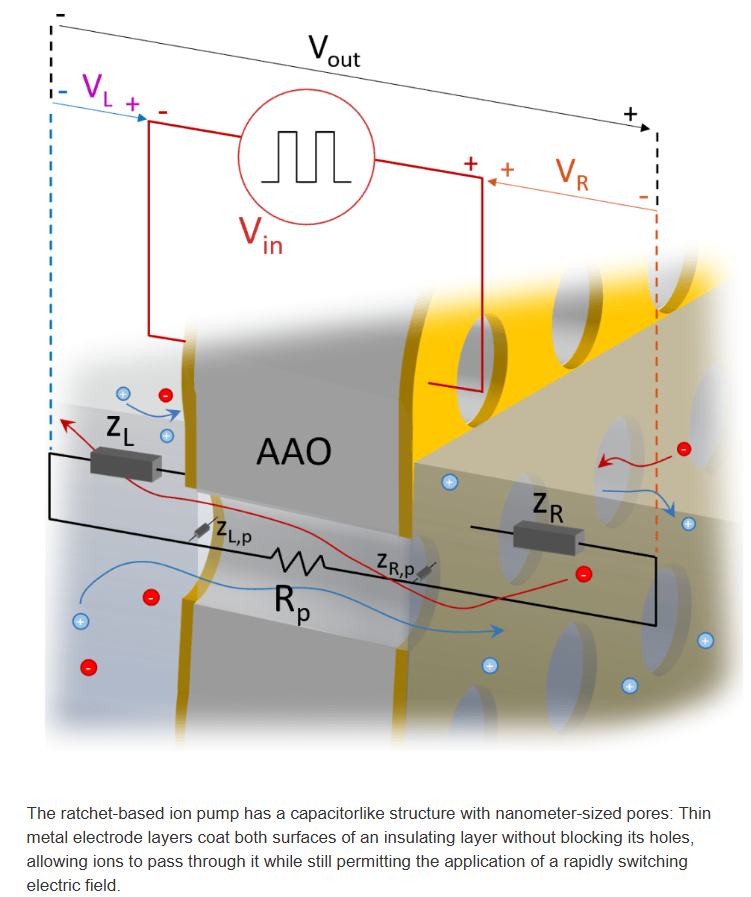
- A research team led in part by the University of California, Irvine has developed a new type of ion pump that can remove salt and other charged particles from water using low-voltage electrical signals. Unlike traditional systems, it has no moving parts and requires no chemical reactions, making it more energy-efficient and simpler.
- The device works using a “ratchet” mechanism: by rapidly switching voltage across a first-of-its-kind designed membrane, it creates a one-way flow of ions through the material. This exploits nanoscale electrical effects to continuously move charged particles in a controlled direction.
- This approach differs from existing technologies, which typically rely on energy-intensive electrochemical processes and complex chemistry.
- Potential applications include:
- Seawater desalination
- Removing heavy metals from drinking water
- Extracting valuable elements like lithium from seawater
- Battery recycling
- Biomedical devices
Overall, the innovation could lead to more efficient and sustainable ways to purify water and separate ions, with broad impacts across energy, environmental, and medical fields.