

Show Notes 19 December 2025
Story 1: New wearable device lets you touch fabric online, read braille, and more – VoxeLite can help you literally feel websites.
Source: Popular Science Story by Mack Degeurin
Link: https://www.popsci.com/technology/touch-websites-wearable-device/
See research paper here: https://www.science.org/doi/10.1126/sciadv.adz5937
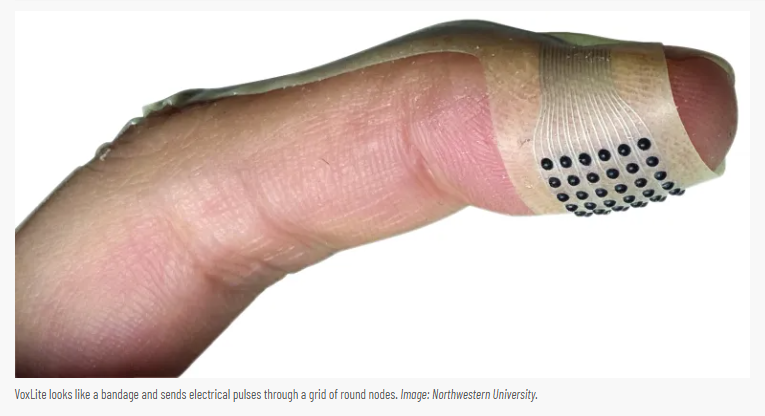

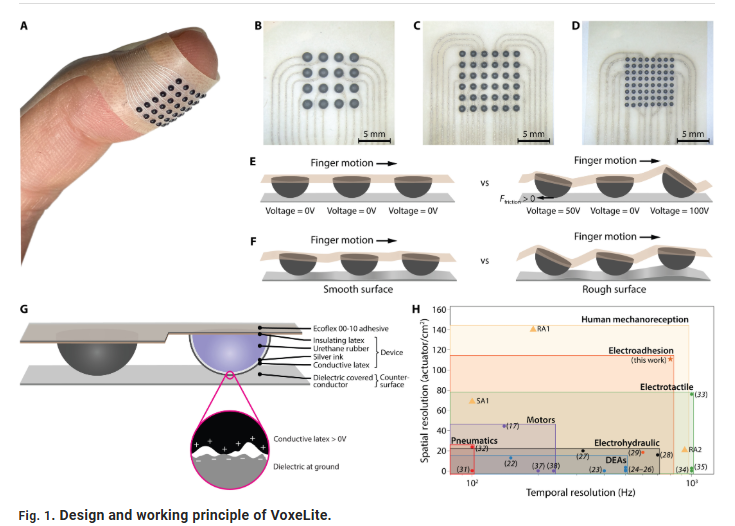
- A team of engineers from Northwestern University has created an ultrathin haptic device called VoxeLite that wraps around a user’s finger (any finger will work).
- The fingertip device sends electric pulses through a grid of round nodes that deliver electrical pulses that mimic the natural resolution of human touch, allowing users to feel textures, ridges, and surfaces on digital devices with lifelike accuracy.
- Smartphone users wearing VoxeLite could theoretically scroll over a sweater displayed on an Instagram post and “feel” the texture of the fabric.
- Gamers in virtual reality could also use the wearable to sense the tightening tension of a bowstring or the slick surface of a well-lacquered doorknob.
- The fingertip wearables developed by Northwestern University engineers open more practical doors as well. In theory, the added sensation of touch in virtual worlds could help people with visual impairments navigate apps more easily.
- And it could also make it possible for blind users to feel the sensation of raised braille dots on a touchscreen.
-
Side Notes – More technical details:
- Structure & Materials
- Form factor: Ultra-thin, lightweight, flexible patch resembling a bandage.
- Material: Made from a stretchable latex sheet that conforms to the fingertip.
- Nodes: Contains a grid of round tactile nodes embedded in the sheet, functioning like pixels on a display.
- Functionality
- Human-resolution haptics: VoxeLite achieves “human resolution,” meaning its tactile signals match the sensitivity and clarity of the human fingertip.
- Electric pulses: Each node delivers precise electrical stimulation, recreating sensations such as ridges, bumps, drag, and texture.
- Pixel-like operation: The nodes act like pixels on a screen, rapidly switching on/off to generate complex tactile patterns.
- Performance
- Speed & clarity: Designed to replicate touch sensations with the same speed and detail that skin naturally detects.
- Versatility: Works on any finger, enabling users to feel digital textures while shopping online, navigating maps, or interacting with flat screens.
- Realism: Users report lifelike sensations—flat surfaces feel textured, fabrics feel rough or smooth, and digital objects gain tactile depth.
- Applications
- Digital shopping: Enables feeling fabrics or materials before purchase.
- Navigation apps: Lets users feel map contours or terrain.
- Gaming & VR: Adds realism by simulating tactile environments.
- Structure & Materials

Story 2: Birch Leaves and Peanuts Transformed into Cutting-Edge Laser Technology
Source: Bioengineer.org
Link: https://bioengineer.org/birch-leaves-and-peanuts-transformed-into-cutting-edge-laser-technology/
See also: https://optics.org/laser/news/16/11/3
See research paper here: https://www.degruyterbrill.com/document/doi/10.1515/nanoph-2025-0312/html
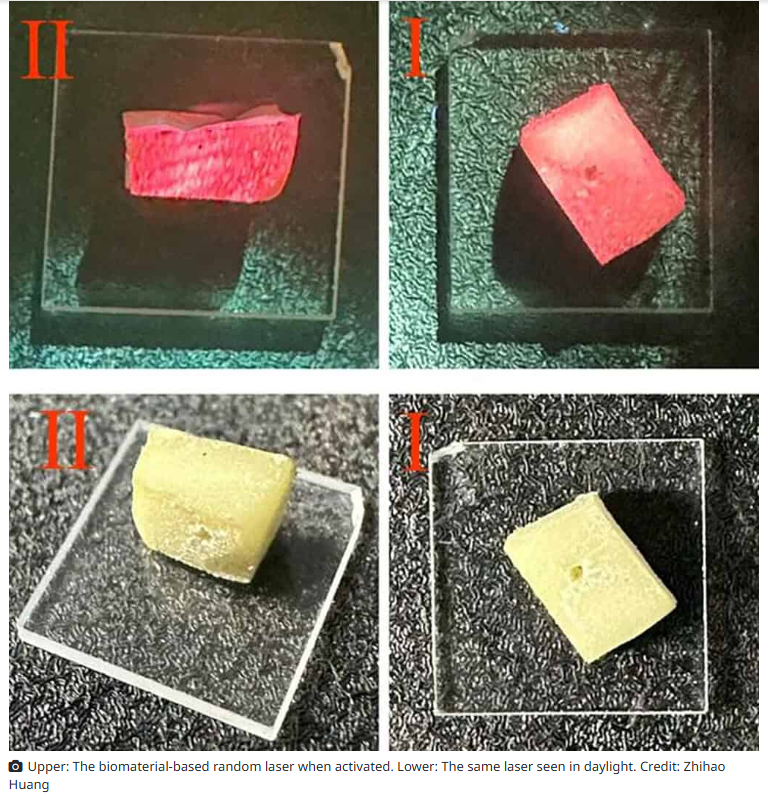
- Physicists at Sweden’s Umeå [sounds like OO-meh-oh] University, working with Chinese collaborators, have developed a fully biomaterial-based random laser using birch leaves and peanut kernels.
- Correction: during the show, and after the introduction to this story, I mistakenly said peanut shells instead of peanut kernels.
- Unlike conventional lasers that depend on synthetic, often non-renewable materials, this approach uses renewable, eco-friendly biomaterials.
- About random lasers:
- Random lasers are used in biomedical imaging, sensing, secure communications, lighting, and material characterization, thanks to their unique properties like low spatial coherence, flexible emission spectra, and simple fabrication.
- A random laser relies on disordered structures to scatter light and achieve lasing.
- Side note – Lasing is the process of a material or device producing coherent light (laser light) through stimulated emission of radiation. In simpler terms, it’s when a laser is actively generating its beam.
- This breakthrough of creating a fully biomaterial-based random laser using birch leaves and peanut kernels demonstrates how everyday natural materials can be transformed into advanced optical devices.
- How they made the random laser:
- The team developed a novel approach utilizing nanometer-sized carbon dots derived from birch leaves, a remarkably straightforward and green synthesis achieved through a single-step pressure-cooking method.
- These carbon dots serve as the gain medium that provides the necessary optical amplification.
- Complementing this, they employed peanut kernels, finely cut into small cubes whose rugged and irregular surfaces efficiently trap and scatter incident light.
- Side note – Incident light is the light that falls onto or strikes a surface before being absorbed, reflected, refracted, or transmitted. It refers to the incoming light rays that interact with an object or medium.
- The intrinsic microstructure of the peanut kernels, untouched by complex fabrication, creates the disordered scattering environment crucial for the laser’s operation.

Story 3: What you need to know about Amazon’s new Starlink rival
Source: Independent.co.uk Story by Anthony Cuthbertson
Link: https://www.independent.co.uk/bulletin/news/amazon-leo-starlink-space-internet-b2872211.html
See also: https://www.aboutamazon.com/news/amazon-leo/amazon-leo-satellite-internet-ultra-pro
See the service’s website here: https://leo.amazon.com
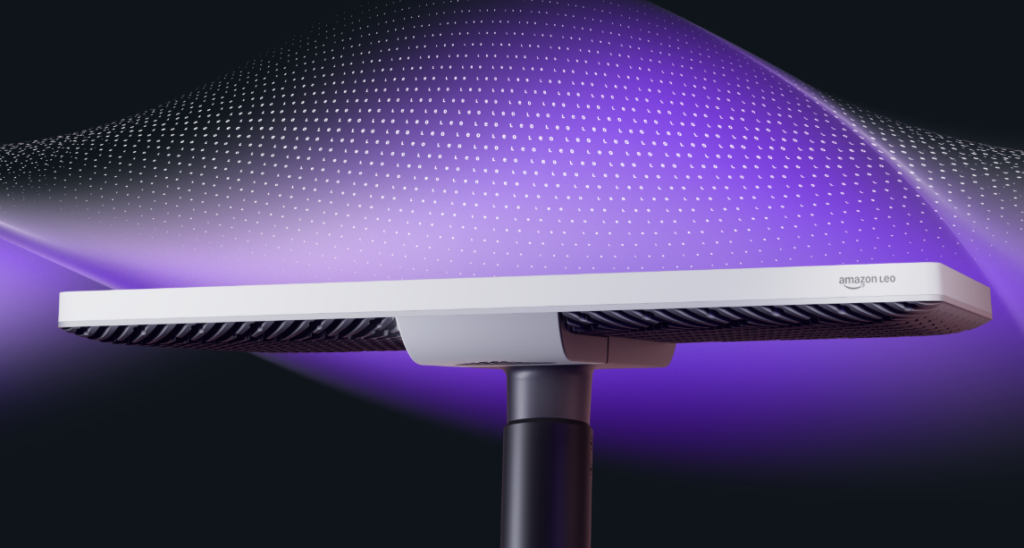
- Amazon has unveiled [late last month] its new satellite internet service, Amazon Leo, formerly known as Project Kuiper, positioning it as a direct competitor to SpaceX’s Starlink.
- Side note – Gerard Kuiper, a Dutch American astronomer often called the “father of modern planetary science.” He is best known for predicting the existence of a belt of icy bodies beyond Neptune, which was later named the Kuiper Belt in his honor.
- Amazon claims Leo offers the world’s fastest commercial satellite internet, with its Leo Ultra antenna achieving download speeds of up to 1Gbps.
- This speed significantly surpasses Starlink’s current 200Mbps (with a peak of 475Mbps). FYI: Amazon Leo currently operates only 150 satellites compared to Starlink’s approximately 8,500.
- Update: On December 16, 2025, Amazon successfully launched 27 new satellites for its Leo service.
- Amazon Leo is presently available to a select group of business customers, including Hunt Energy Network, Vanu Inc, and JetBlue, with a broader rollout expected next year.
- Amazon plans to expand its satellite constellation to 3,236, while SpaceX intends to grow its Starlink network to 12,000 satellites.

Story 4: MIT’s injectable brain chips could treat disease without surgery
Source: NewAtlas.com Story by Abhimanyu Ghoshal
Link: https://newatlas.com/brain/mit-injectable-brain-chips-treat-disease/
See spin-off company website here: https://orbit.mit.edu/launchpad/ideas/cahira-technologies
See video here: https://www.youtube.com/watch?v=gMwiCTl7jHc&t=145s
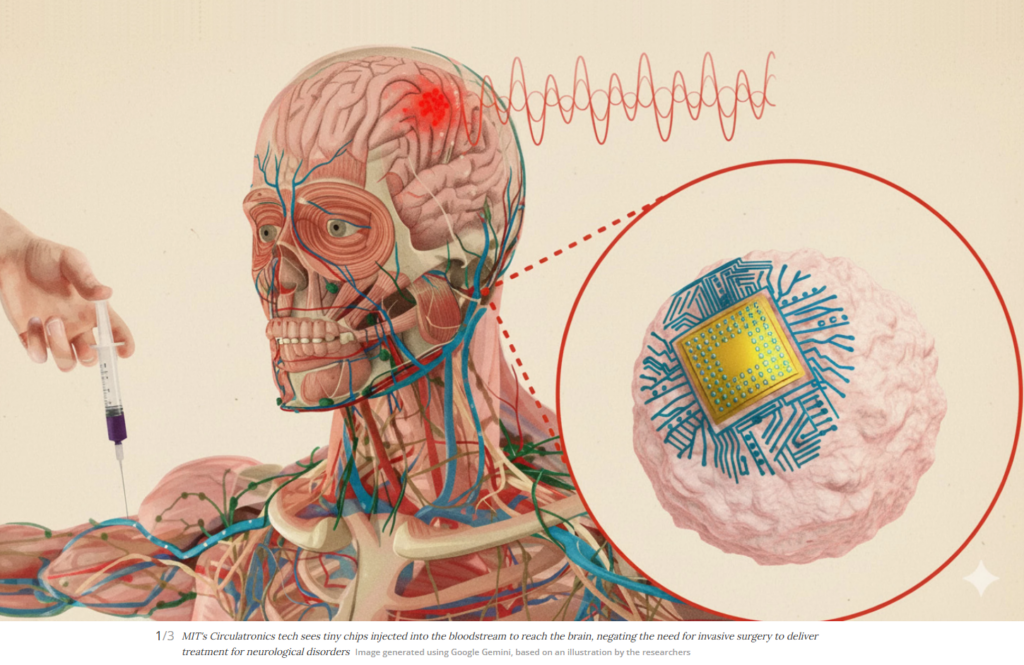
- MIT researchers have developed “Circulatronics,” a groundbreaking technology that uses injectable brain chips to treat neurological diseases without surgery.
- These sub-cellular wireless devices (SWEDs) can cross the blood–brain barrier, self-implant in inflamed brain regions, and deliver precise electrical stimulation when activated by external light.
- The Circulatronics concept combines electronics with biological transport to implant bioelectronics without invasive surgery.
- The motivation is to target neurological disorders like Alzheimer’s, depression, multiple sclerosis, brain tumors, and chronic pain.
- How It Works
- Sub-cellular wireless devices are smaller than a blood cell (about one-billionth the length of a grain of rice).
- They are made of organic semiconducting polymers and metallic layers.
- Powered wirelessly via near-infrared lasers that penetrate the skull.
- Fused with monocytes (immune cells) to cross the blood–brain barrier and naturally migrate to inflamed brain regions.
- Once implanted, they deliver focal neuromodulation—precise electrical stimulation to adjust neuron activity.
- Testing in Mice
- Researchers created inflamed brain regions in mice to simulate disease.
- They then injected sub-cellular wireless device–cell hybrids which successfully self-implanted at target sites within 72 hours.
- Wireless stimulation activated brain cells within 30 micrometers [that’s 30 millionths of a meter] of the inflamed area, proving highly focused treatment.
- Potential Applications
- Could revolutionize treatment for 3 billion people worldwide with neurological disorders.
- May extend beyond the brain to other organs, enabling devices like wireless pacemakers.
- Future versions may include sensing circuits or synthetic electronic neurons.
- Timeline for Human Use
- The MIT spinoff Cahira Technologies aims for clinical trials within three years.
- Commercial availability will take longer due to regulatory approvals.

Honorable Mentions
Story: New semiconductors could allow classical and quantum computing on the same chip, thanks to superconductivity breakthrough
Source: LiveScience.com Story by Anna Demming
- Scientists have developed a new semiconductor material that can host both classical and quantum computing functions on the same chip. This breakthrough hinges on achieving superconductivity within a semiconductor, potentially paving the way for hybrid processors that integrate traditional logic with quantum operations.
- The breakthrough was led by researchers at the Australian Institute for Bioengineering and Nanotechnology (AIBN) at the University of Queensland, working in collaboration with New York University and the School of Mathematics and Physics at UQ
- Superconductivity in semiconductors: Researchers discovered a way to make a semiconductor exhibit superconductivity, meaning it can conduct electricity with zero resistance. This is a major step because superconductivity is usually associated with metals or specialized materials, not semiconductors.
- Hybrid computing potential: The material could allow classical transistors and quantum qubits to coexist on a single chip. This integration would eliminate the need for separate systems and complex interfaces between classical and quantum hardware.
- Efficiency gains: By combining both computing paradigms, chips could process quantum information while still handling everyday classical tasks, reducing energy use and improving speed.
- Scalability: The breakthrough could make quantum computing more practical and accessible, since hybrid chips would be easier to manufacture and integrate into existing technology ecosystems.
- Future implications: If successfully scaled, this innovation could transform fields like cryptography, drug discovery, and materials science by enabling faster, more efficient quantum-classical workflows.
- Bridges two worlds: Classical computing is reliable and widespread, while quantum computing is powerful but still experimental. A chip that merges them could accelerate adoption.
- Practical applications: Hybrid chips could be used in data centers, scientific research, and even consumer devices once manufacturing challenges are solved.
- Long-term impact: This discovery may mark the beginning of a new era in computing, where quantum capabilities are seamlessly embedded into mainstream hardware.
- Would you like me to create a visual timeline of semiconductor breakthroughs leading up to this discovery? That could help put this achievement in historical context.
////////////////////////////////////////////////////////////////////////////////////////////////////////////////////////////////////////////
Story: We took a test-drive of NASA’s new moon rover candidates
Source: National Geographic Story by Robin George Andrews
Link: https://www.nationalgeographic.com/science/article/moon-rover-space-innovation-nasa-artemis

- NASA is running a high-stakes competition to select the next-generation lunar terrain vehicle (LTV) for its Artemis missions. Three U.S. companies—Lunar Outpost, Venturi Astrolab, and Intuitive Machines—have developed radically different rover prototypes designed to withstand the Moon’s extreme environment and support long-term exploration at the lunar south pole.
- The Artemis Program’s Goal: Unlike Apollo, Artemis aims to establish a permanent presence on the Moon, particularly at the south pole where water ice could support life and fuel production.
- Three Competing Designs:
- Lunar Outpost’s Eagle → A retro-futuristic “space truck” with spacious cockpit, rugged suspension, and modular tool panels.
- Astrolab’s FLEX → A nimble, crab-like rover emphasizing robotics and cargo hauling, with versatile wheels and redundant systems.
- Intuitive Machines’ Moon RACER → A dune-buggy-inspired design, fast and maneuverable, with towing capacity for labs or power units.
- Extreme Requirements: Each rover must drive 12 miles per day and 800 miles per year, carry 1,765+ pounds of payload, survive temperatures from 250°F to -410°F, and resist lunar dust, radiation, and micrometeorites.
- Advanced Features:
- Robotic arms with interchangeable tools for construction.
- Remote and autonomous driving capability.
- Lidar and stereo cameras for navigation.
- NASA’s new electrodynamic dust shield to repel corrosive lunar soil.
- NASA will select one winner by the end of 2025, though all three may eventually operate commercially on the Moon.
////////////////////////////////////////////////////////////////////////////////////////////////////////////////////////////////////////////
Story: 3-D printing researchers develop fast-curing, environmentally friendly concrete substitute
Source: Oregon State University
- Cement, the binder in concrete, is responsible for about 8% of global CO₂ emissions.
- Concrete takes up to 28 days to cure and requires structural supports, slowing construction projects.
- Researchers at Oregon State University created a fast-curing, eco-friendly concrete substitute.
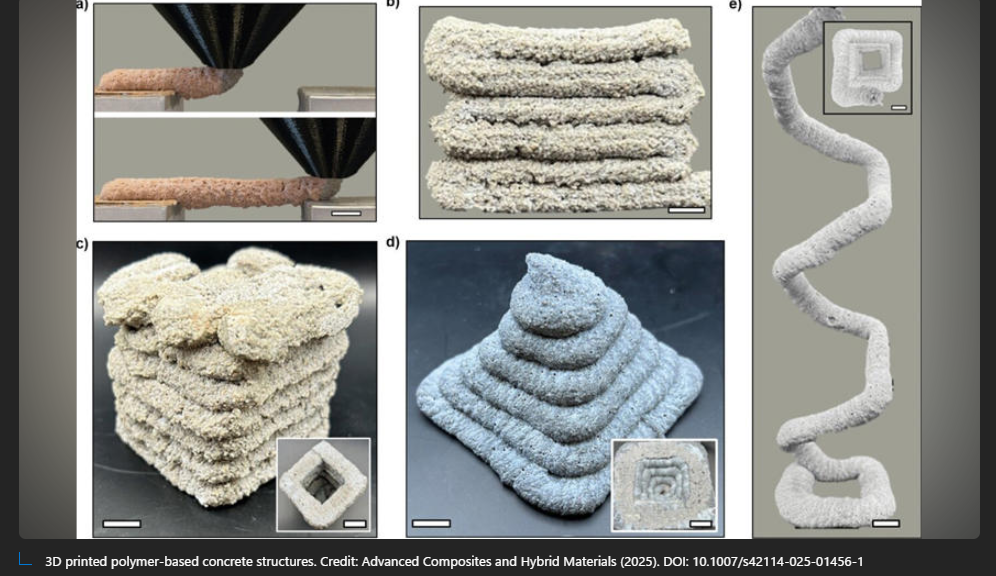
- It uses a clay-based mix with hemp fibers, sand, and biochar (carbon-rich biomass).
- The binder is acrylamide-based, which cures via frontal polymerization as it’s extruded from a 3D printer.
- Can be printed across unsupported gaps (like door/window frames).
-
Performance
- Achieves 3 MPa strength immediately after printing, enough for multilayer walls and overhangs.
- Reaches 17 MPa in 3 days, meeting residential concrete standards (vs. 28 days for traditional concrete).
-
Environmental Benefits
- Much lower carbon footprint compared to cement-based concrete.
- Materials are readily available and more sustainable.
////////////////////////////////////////////////////////////////////////////////////////////////////////////////////////////////////////////
Story: Researchers test soft robotics exosuit in Adelaide to reduce astronaut muscular fatigue
Source: SpaceConnect.com.au Story by Robert Dougherty
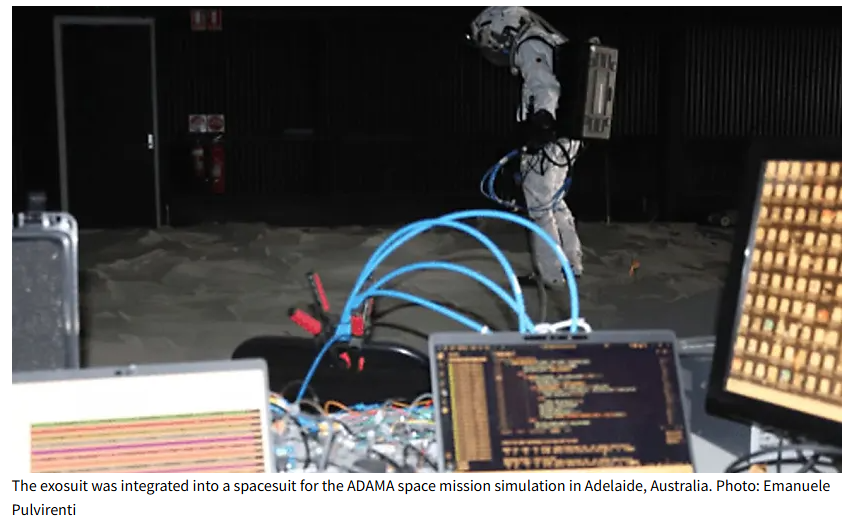
- Researchers from the University of Bristol have travelled to Adelaide in South Australia to test a new soft robotics exosuit.
- The exosuit is designed to help astronauts reduce muscular fatigue while maintaining natural movements during future moon and Mars missions.
- The University of Bristol’s technology could potentially hold extraterrestrial benefits as well as assist people who need support with their mobility on Earth.
- The soft robotic exosuit is designed to resemble a garment and is mostly made of fabric material. Worn underneath the spacesuit, the exosuit features artificial muscles that work automatically to help astronauts reduce muscular fatigue.
- The artificial muscles in the suit consist of two layers: an outer nylon layer and an inner thermoplastic layer that allows airtight inflation. The anchoring components, such as the waistband and knee straps, are made from Kevlar for high strength and tension resistance.
- The research team recently travelled to the University of Adelaide, Australia, home to the Exterres CRATER facility, the largest simulated lunar environment in the southern hemisphere.
- Here the exosuit was tested as part of an international “proof of concept” simulated space mission run by the Austrian Space Forum.
- This was the first time a soft robotic exosuit had been integrated into a spacesuit and the first field test of its kind. The experiments evaluated comfort, mobility and biomechanical effects when performing planetary surface tasks such as walking, climbing and load-carrying on loose terrain.