


Show Notes 6 March 2026
Story 1: Scientists Grew Mini Brains, Then Trained Them to Solve an Engineering Problem
Source: ScienceAlert.com Story by Michelle Starr
- We’ll also mention a related story – see below

- Scientists at the University of California Santa Cruz have created lab-grown mini brains (brain organoids) and then trained them to perform a classic engineering control task.
- Brain organoids are already used to study development and disease but using them for computation is new.
- Side note about “mini brains”
- It’s broadly acceptable to call them “mini brains,” but only in a loose, metaphorical sense. The scientific term is brain organoids, and that term is more accurate for what they actually are.
- What “mini brain” gets right
- The nickname comes from the fact that organoids:
- They are grown from pluripotent stem cells, which can develop into many brain-related cell types.
- Form 3D structures that resemble early developmental features of the human brain, such as cortical layers or ventricles.
- Contain neurons and glial cells that can fire electrical signals and sometimes show coordinated activity.
- These similarities make “mini brain” a convenient shorthand for the public.
- What the nickname gets wrong:
- Despite the resemblance, organoids are not actual brains:
- They lack the full architecture, size, and complexity of a real brain.
- They do not have consciousness, awareness, or cognitive abilities.
- They model only specific aspects of development or disease, not the whole organ.
- Scientists generally prefer “brain organoid” because it avoids implying that these structures are miniature, functioning brains.
- Back to the story – They grew brain organoids from human stem cells, forming small clusters of neurons capable of electrical activity.
- These organoids were then connected to a hybrid biocomputer system, allowing them to receive input signals and produce output signals.
- Side note: A biocomputer system uses biologically derived molecules or living cells to carry out computational tasks. These systems rely on the natural information‑processing abilities of biological structures rather than electronic circuits.
- The goal of the experiment was to test whether biological neural tissue could learn patterns the way artificial neural networks do.
- Here’s the engineering problem they learned to solve:
- The organoids were trained on the cart-pole problem, a classic benchmark in control engineering and AI.
- In this task, the system must keep a pole balanced upright on a moving cart by making continuous adjustments.
- The organoids learned to recognize patterns and adjust outputs to stabilize the pole, demonstrating adaptive learning.
- Why this matters:
- It shows that biological neural networks can be integrated with digital systems to perform computational tasks.
- This hybrid approach could lead to:
- More energy-efficient computing
- New ways to study learning and memory
- Platforms for testing neurological therapies
- It also raises early ethical questions about the future of biological computing and the boundaries of organoid research.
- The experiment suggests that biological systems may excel at tasks involving pattern recognition, adaptation, and real-time control, areas where traditional AI can be resource-intensive.
*Also related to this news is this: 200,000 living human brain cells just learned to play Doom and this is just the start of it
Source: ZME Science [and many other outlets]
Link: https://www.zmescience.com/science/wetware-brain-doom-play/
- Researchers at Australian start-up Cortical Labs have taught human neurons grown on a chip to play the classic Doom game. In 2021, they had already used 800,000 neurons to play Pong. Now, with four times fewer brain cells, they can play a much more complicated game.
- Independent researcher Sean Cole was able to teach the cells to play Doom in about a week.

Story 2: Sub-$200 Lidar Could Reshuffle Auto[mobile] Sensor Economics –MicroVision says its sensor could one day break the $100 barrier
Source: IEEE Spectrum Story by Willie D. Jones
Link: https://spectrum.ieee.org/solid-state-lidar-microvision-adas
See also: https://microvision.com/
Key trend to watch – solid-state Lidar
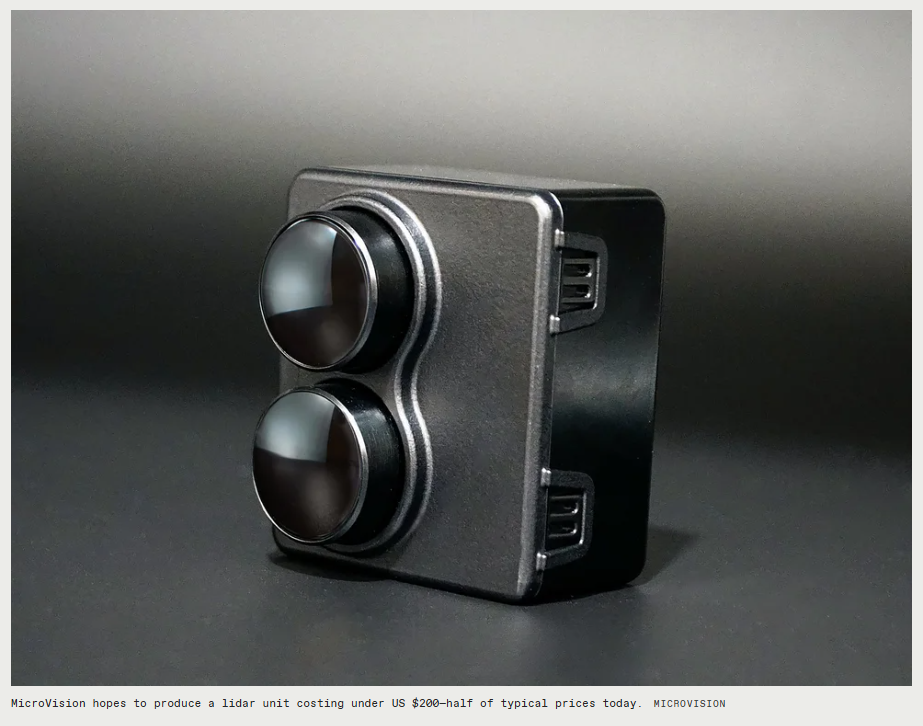
- The article highlights a major shift in automotive sensor economics: the development of highly affordable, solid-state lidar.
- Reminder – Lidar systems emit pulsed laser light toward a surface or object. A sensor then detects the returning light. Because light travels at a known speed, the system can calculate distance with high precision.
- Historically, lidar has been a prohibitively expensive technology (costing thousands to tens of thousands of dollars) reserved for premium vehicles and specialized autonomous fleets.
- Why Solid-State? Unlike traditional lidar that relies on spinning mechanical parts, solid-state lidar has no moving pieces. This makes the sensors drastically cheaper to manufacture at scale, significantly more compact, and highly durable against road vibrations.
- Now, companies like MicroVision [a solid-state sensor technology company located in Redmond, Washington] are developing solid-state lidar units targeting a mass-production price point of under $200, with a long-term goal of hitting $100 per sensor.
- Key Technological Details
- The article highlights MicroVision’s “Movia S” sensor, a corner-mounted, fully solid-state lidar unit.
- How it Works: It utilizes 905-nanometer laser pulses [that’s 905 billionths of a meter] and time-of-flight measurements to create high-definition 3D point clouds of the vehicle’s surroundings.
- The Trade-off: Hardware Cost vs. Software Complexity – Because these low-cost solid-state sensors have a narrower field of view compared to expensive, roof-mounted spinning lidars, a vehicle will need three to four sensors distributed around its perimeter to achieve full situational awareness.

Story 3: Magical Marvel: Tiny Fairy-Like Robot Flies by the Power of Wind and Light – The FAIRY Robot Mimics Dandelion Seeds for Artificial Pollination
Source: SciTechDaily.com Story by Tampere University
Link: https://scitechdaily.com/magical-marvel-tiny-fairy-like-robot-flies-by-the-power-of-wind-and-light/

- The loss of pollinators, such as bees, is a huge challenge for global biodiversity and affects humanity by causing problems in food production.
- At Tampere University in Finland, researchers have now developed the first passively flying robot equipped with artificial muscle. The goal of the research is to see if this artificial fairy could be utilized for pollination.
- Side note: Tampere is Finland’s second‑largest urban area and a major hub for technology, research, and education. The university itself is one of the Finland’s largest.
- The development of stimuli-responsive polymers has brought about a wealth of material-related opportunities for next-generation small-scale, wirelessly controlled soft-bodied robots. For some time now, engineers have known how to use these materials to make small robots that can walk, swim and jump. So far, no one has been able to make them fly.
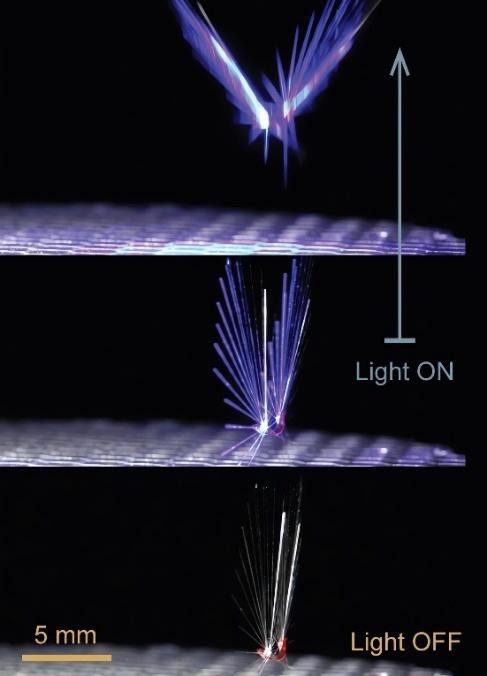
- Researchers of the Light Robots group at Tampere University are now researching how to make smart material fly. They have developed a polymer-assembly robot that flies by wind and is controlled by light.
- A lead researcher noted, “Superior to its natural counterparts, this artificial seed is equipped with a soft actuator. The actuator is made of light-responsive liquid crystalline elastomer, which induces opening or closing actions of the bristles upon visible light excitation. The fairy [flying robot] can be powered and controlled by a light source, such as a laser beam or LED.”
- The artificial fairy [flying robot] includes several biomimetic features. Because of its high porosity (0.95) [A porosity of 0.95 means the material is 95% empty space and only 5% solid] and lightweight (1.2 milligrams) structure, it can easily float in the air directed by the wind.
- Side note – Biomimetic means something that imitates or is inspired by nature’s designs, materials, or processes. It’s used to describe technologies, structures, or products that copy how living organisms solve problems.
- This means that light can be used to change the shape of the tiny dandelion seed-like structure. The fairy [flying robot] can adapt manually to wind direction and force by changing its shape. A light beam can also be used to control the take-off and landing actions of this polymer assembly.
- In the future, millions of artificial dandelion seed-like flying robots carrying pollen could be dispersed freely by natural winds and then steered by light toward specific areas with trees awaiting pollination.

Story 4: Scientists uncover why some brain cells resist Alzheimer’s disease – Study identifies cellular defense system that protects neurons from toxic tau proteins, opening door to new treatments
Source: UCLA Newsroom
Link: https://newsroom.ucla.edu/releases/scientists-uncover-why-some-brain-cells-resist-alzheimers-disease
See research paper here: https://www.cell.com/cell/fulltext/S0092-8674(25)01487-4
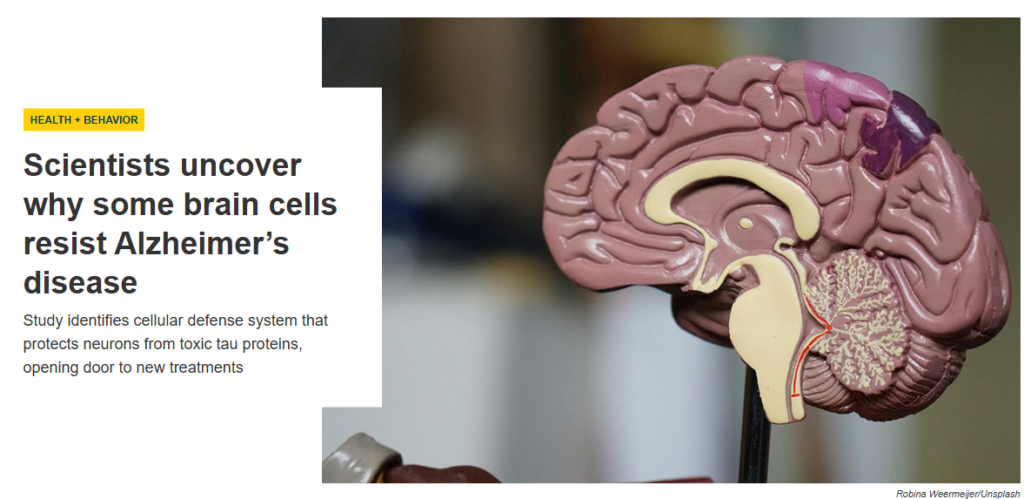
- New research by UCLA Health and UC San Francisco has uncovered why certain brain cells are more resilient than others to the buildup of a toxic protein that is a hallmark of Alzheimer’s disease and related dementias, potentially leading to new targets for therapies or treatments.
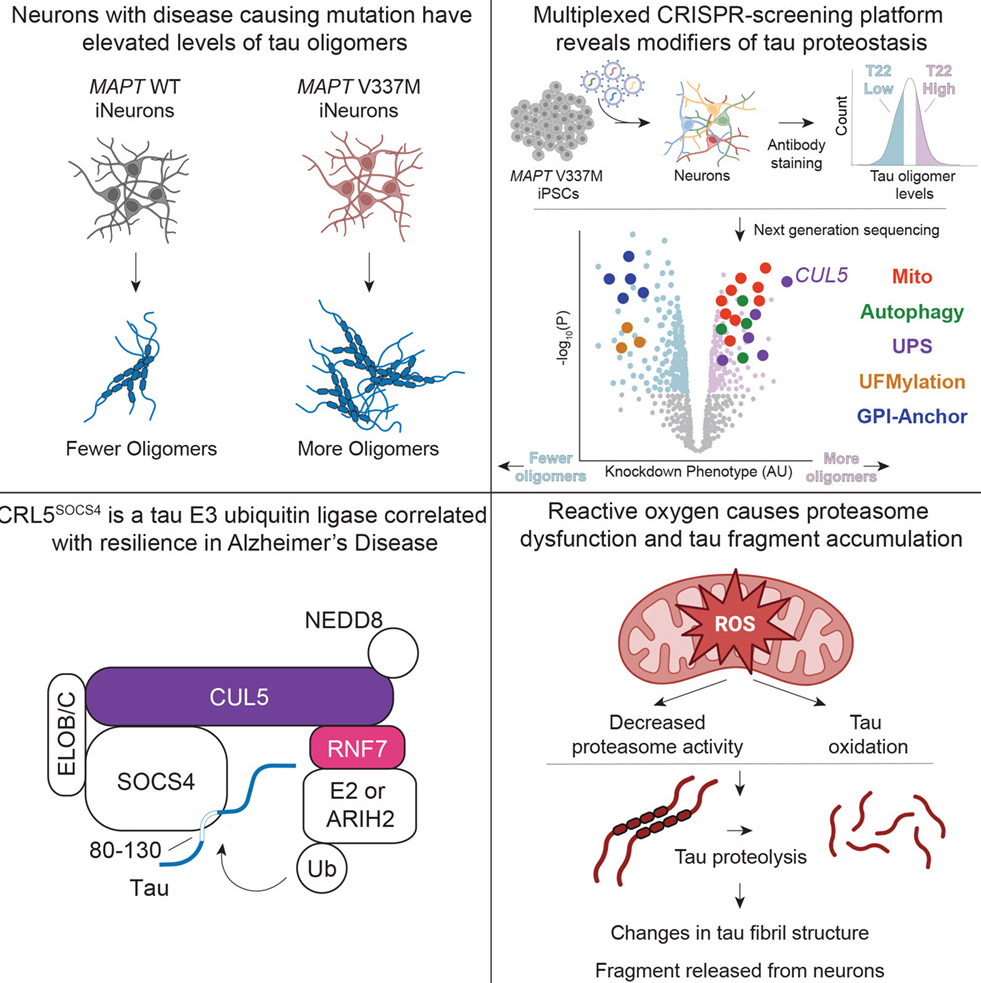
- The study, published in the journal Cell, used a novel CRISPR-based genetic screening approach on lab-grown human brain cells to determine the cellular machinery that controls the accumulation of tau protein in the brain.
- Side note – Tau protein is a microtubule‑associated protein found mainly inside neurons, where it helps stabilize the cell’s internal structural framework. Its normal role is essential for healthy neuronal function, but when tau becomes chemically altered, it can contribute to neurodegenerative disease.
- These proteins can build up as toxic clumps in the brain, killing neurons and leading to neurodegenerative diseases such as frontotemporal dementia and Alzheimer’s disease.
- Tau is the most common protein that aggregates in neurodegeneration diseases. However, researchers had not determined why some types of neurons are affected more than others.
- UCLA and UCSF researchers used lab-grown neurons and the CRISPRi gene editing tool to systematically determine which genes and cell processes affect how tau proteins build up.
- Side note – CRISPRi is a gene-silencing tool that uses a modified CRISPR system to turn genes off without cutting DNA. It’s part of the broader CRISPR toolkit, but it works very differently from the well-known CRISPR-Cas9 gene-editing method.
- The work identified a protein complex called CRL5SOCS4 that marks tau for degradation.
- The findings suggest that strengthening this natural defense mechanism could represent a new therapeutic strategy for neurodegenerative diseases, which affect millions of Americans but currently have no effective treatments.

Honorable Mentions
Story: New plastic material could solve energy storage challenge, researchers report – Novel ‘polymer alloy’ material made of commercially available plastics demonstrates unprecedented performance at high temperatures
Source: PennState News Story by Ashley WennersHerron
See research paper here: https://www.nature.com/articles/s41586-026-10195-2
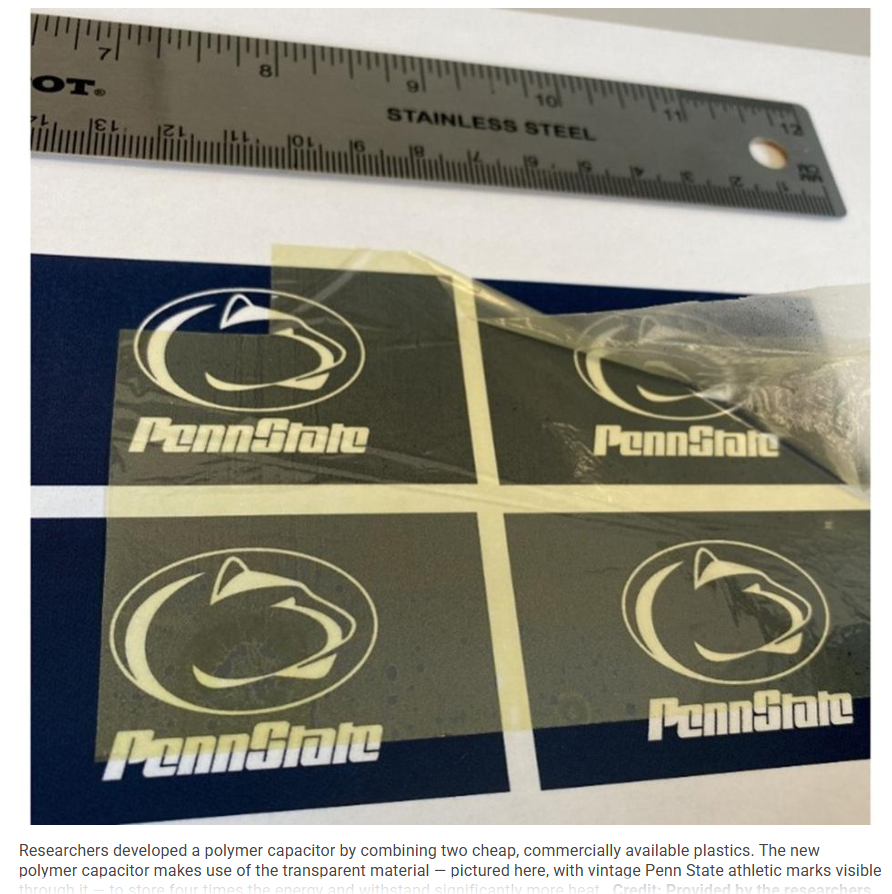
- UNIVERSITY PARK, Pa. — In the race to lighter, safer and more efficient electronics — from electric vehicles to transcontinental energy grids — one component literally holds the power: the polymer capacitor. Seen in such applications as medical defibrillators, polymer capacitors are responsible for quick bursts of energy and stabilizing power rather than holding large amounts of energy, as opposed to the slower, steadier energy of a battery. However, current state-of-the-art polymer capacitors cannot survive beyond 212 degrees Fahrenheit (F), which the air around a typical car engine can hit during summer months and an overworked data center can surpass on any given day.
- Now, today (Feb. 18) in Nature, a team led by Penn State researchers reported a novel material made of cheap, commercially available plastics that can handle four times the energy of a typical capacitor at temperatures up to 482 F.
- “Advances in the full systems for electric vehicles, data centers, space exploration and more can all hindered by the polymer capacitor,” said co-first author Li Li, postdoctoral scholar in Penn State’s Department of Electrical Engineering. “Conventional polymer capacitors need to be kept cool to operate. Our approach solves that issue while enabling four times the power — or the same amount of power in a device four times smaller.”
////////////////////////////////////////////////////////////////////////////////////////////////////////////////////////////////////////////
Story: Why Perovskite LEDs Might Soon Replace Every Light in Your Home – Cheaper, brighter, and greener, perovskite LEDs could change lighting — if they last long enough.
Source: ZME Science Story by Zoe Gordon
Link: https://www.zmescience.com/science/news-science/why-perovskite-could-replace-normal-leds/
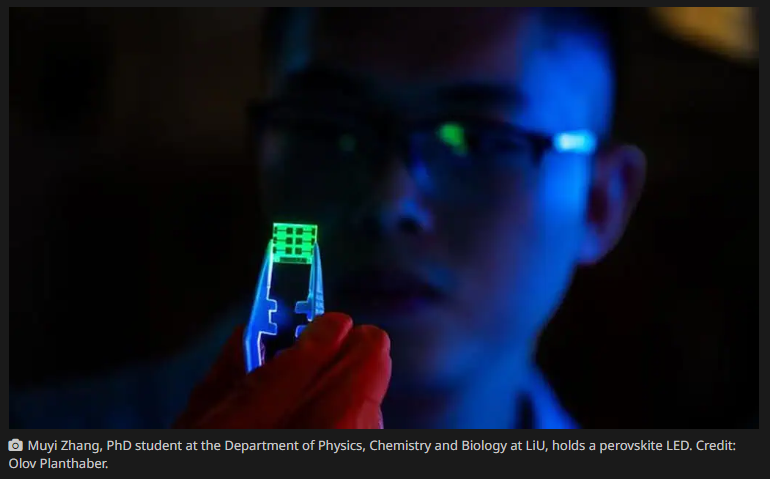
- Perovskite LEDs are emerging as a major alternative to today’s lighting
- Researchers at Seoul National University and other labs are developing LEDs made from metal halide perovskites, which can be deposited as ultra-thin films on many surfaces. These could replace traditional bulb-based lighting with flexible panels, thin sheets, or even lighting integrated into wallpaper.
-
Why they are different:
- Perovskites have strong optoelectronic properties, meaning they convert electricity to light very efficiently.
- They don’t require the expensive III-V semiconductor wafers used in many current LEDs.
- They can be manufactured at lower temperatures and on a wider range of substrates.
-
Potential advantages
- Cheaper: Avoiding sapphire substrates and complex semiconductor fabrication could dramatically reduce production costs.
- Brighter at the same power: Early lab results show high efficiency.
- More environmentally friendly: Lower-energy manufacturing and simpler materials.
- More design flexibility: Thin, flexible, or large-area lighting becomes possible.
-
The big challenge: durability
- The main question is whether perovskite LEDs can survive years of real-world use—heat, humidity, and mechanical stress—while staying cost-competitive. The field is maturing, with coordinated research roadmaps focusing on:
- Efficiency
- Color quality
- Lifetime and stability
- The main question is whether perovskite LEDs can survive years of real-world use—heat, humidity, and mechanical stress—while staying cost-competitive. The field is maturing, with coordinated research roadmaps focusing on:
- This shift suggests the technology is moving closer to commercial viability.
////////////////////////////////////////////////////////////////////////////////////////////////////////////////////////////////////////////
Story: Neither classical nor quantum: This computer lets light solve complex calculations – Built from ordinary components, this light-driven machine stays stable for hours while tackling problems with many possibilities.
Source: Interesting Engineering Story by Rupendra Brahambhatt
Link: https://interestingengineering.com/innovation/computer-uses-light-to-solve-calculations

- A light-based computer developed at Queen’s University uses pulses of light—rather than electronic chips or quantum qubits—to solve extremely complex optimization problems far faster and with far less energy than conventional machines.
- The researchers built a room-temperature optoelectronic Ising machine using only five common components: lasers, fiber-optic cables, and modulators. Instead of representing “spins” with magnets, each spin is encoded as the presence or absence of a light pulse circulating in a fiber loop. As these pulses interact, the system naturally settles into a low-energy configuration that corresponds to a good solution to the optimization problem.
- Many real-world challenges—drug discovery, cryptography, traffic routing, supply-chain planning—explode into astronomical numbers of possible solutions. Even supercomputers and quantum computers struggle because the search space grows exponentially.
- The light-based system:
- Performs billions of operations per second because light moves so quickly.
- Runs at room temperature, unlike many exotic computing systems.
- Remains stable for hours, allowing it to explore huge problem spaces.
- Already solves problems with up to 256 fully connected spins or over 41,000 sparse spins, outperforming other optical Ising machines that often collapse after milliseconds.
////////////////////////////////////////////////////////////////////////////////////////////////////////////////////////////////////////////
Story: A new flexible AI chip for smart wearables is thinner than a human hair
Source: TechXplore.com Story by Robert Egan
Link: https://techxplore.com/news/2026-01-flexible-ai-chip-smart-wearables.html
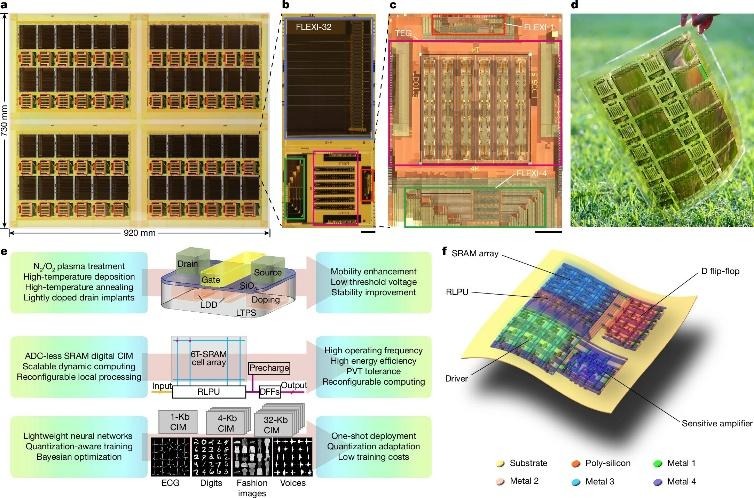
- The promise of smart wearables is often talked up, and while there have been some impressive innovations, we are still not seeing their full potential. Among the things holding them back is that the chips that operate them are stiff, brittle, and power-hungry. To overcome these problems, researchers from Tsinghua University and Peking University in China have developed FLEXI, a new family of flexible chips. They are thinner than a human hair, flexible enough to be folded thousands of times, and incorporate AI.
- In a paper published in the journal Nature, the team details the design of their chip and how it can handle complex AI tasks, such as processing data from body sensors to identify health indicators, such as irregular heartbeats, in real time.
- This is based on one of FLEXI’s most impressive feats: it can process information directly on the chip rather than sending it to an external computer, unlike most current wearables. AI is hardwired into the chip’s circuitry, meaning that memory components perform calculations on the data stored there. This removes the need for data to travel between different parts of the chip, saving time and power.
- The actual chip itself is not a stiff, solid block of silicon but a thin, plastic film. It uses low-temperature polycrystalline silicon (LTPS) circuits built on a flexible plastic base. Because the entire system is printed onto this flexible surface, it can be stretched, twisted, and even crumpled without breaking the tiny AI circuits inside, ideal for use in smart wearables.
- To prove its durability, the team put FLEXI through a series of torture tests. It was subjected to over 40,000 bending cycles and folded to a radius of just one millimeter without losing performance.