


Show Notes 20 November 2026
Text highlighted in blue identifies notes I have inserted.
Quick side note before we jump into this week’s four news items – key announcement earlier this week: A robot just built a structure in space all on its own – for the first time ever
Source: ScienceAlert.com Story by David Nield
It’s a first in the space construction industry: a robot has independently built a structure in space without the help of astronauts.
The achievement points towards a new era of building beyond Earth, an era less confined by what we can fit on a rocket.
The robot used was the Autonomous In-Space Tensioned Reflector Assembly (ASTRA), developed by researchers at the California Institute of Technology (Caltech), and funded by the US Defense Advanced Research Projects Agency (DARPA).

Story 1: Mercedes Wants to Rethink EV Batteries with This Clever New Technology – Instead of charging the battery as a whole unit, micro-converters can charge or discharge each cell individually.
Source: InsideEVs.com Story by Iulian Dnistran
Link: https://insideevs.com/news/814348/mercedes-ev-battery-micro-converter-technology/
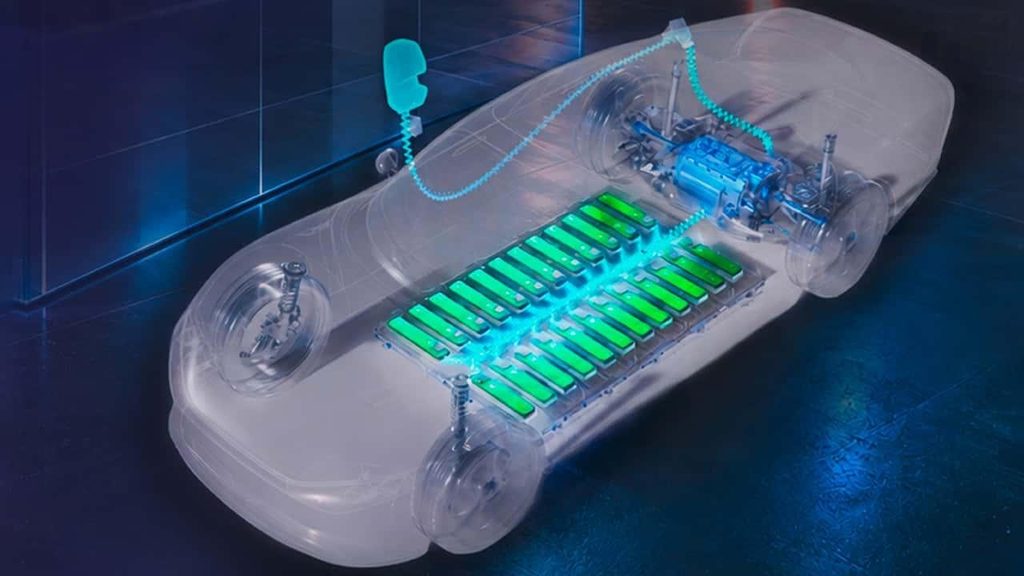
- Mercedes-Benz is developing a new technology that could make electric vehicle batteries last longer, become more efficient, and potentially cost less to repair.
- The system, called the Power Converter, takes a different approach to managing battery power. Today’s electric vehicle batteries contain thousands of individual cells, but most systems charge and discharge those cells together. Mercedes wants to change that by installing tiny electronic devices called micro-converters that can control each battery cell individually.
- This could provide several important advantages. One major benefit involves battery life. Over time, some battery cells deteriorate faster than others. When a cell becomes too weak, it can affect the performance of the entire battery pack. Currently, this can sometimes mean replacing the whole battery, an expensive repair.
- With Mercedes’ new system, a failing cell could simply be disconnected while the remaining cells continue operating. The vehicle would lose a small amount of battery capacity but could remain usable.
- Another advantage is flexibility. The technology could allow batteries containing different types of cells, or cells of different ages, to work together. It could also let the vehicle temporarily put some battery cells into standby mode when their full capacity isn’t needed.
- The system could even improve driving efficiency and support two-way charging, allowing electricity to flow both into and out of the vehicle.
- There is one potential drawback: thousands of individual electronic converters introduce additional components that could eventually fail.
- The bottom line: Mercedes’ technology could represent an important step toward longer-lasting, more adaptable, and potentially less expensive electric vehicle batteries. However, it is still under development.
Story 2: World’s First “Lightsaber” Antenna Uses Plasma to Transmit Radio Waves – Learn how engineers built a novel radio antenna and why it might be so valuable for future space exploration.
Source: Discover Magazine Story by Dr. Katie Spalding
See research paper here: https://ieeexplore.ieee.org/document/11674160
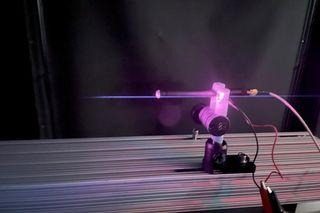
- Scientists at North Carolina State University have developed an unusual new type of radio antenna that looks like something straight out of the Star Wars movies. Instead of using a traditional metal antenna, the device uses a laser to create a glowing beam of plasma that resembles a lightsaber.
- Plasma is sometimes called the fourth state of matter. It is created when a gas becomes electrically charged. In this experiment, researchers used a powerful laser to turn a narrow column of ordinary air into plasma.
- The challenge was figuring out how to transmit radio signals through this unusual antenna. The researchers solved that problem by placing a metal ring around the plasma beam. The ring acts like a capacitor, creating an electromagnetic field that transfers radio signals to the plasma without physically touching it.
- In experiments, the team successfully transmitted radio waves at 30 megahertz, demonstrating that the plasma beam could function as an antenna.
- One exciting feature is that researchers can potentially change the antenna’s length and direction simply by adjusting or steering the laser. This could eliminate complicated mechanical equipment used to position conventional antennas.
- The technology could eventually have applications in satellites, aircraft, radar systems and space exploration, where lightweight equipment and reliable communications are important.
- However, this is still an early experiment. The North Carolina State University researchers have demonstrated transmission but have not yet shown that the plasma antenna can receive radio signals.
- The team hopes to improve its performance and explore additional applications.
Story 3: Beyond transistor limits: Hybrid magnetic-sound waves could boost computing speed and efficiency – An alternative to the transistor, made with multiferroic materials, could make computers up to 1,000 times faster and more energy-efficient
Source: University of Michigan News
- Researchers at the University of Michigan and the University of Wisconsin are developing a new type of computer technology that could eventually outperform today’s conventional computer chips by as much as 1,000 times in speed and energy efficiency.
- The technology, called M3BOLT, takes a completely different approach to processing information. Instead of relying on the movement of electrons through tiny transistors, it uses a combination of magnetic waves and sound waves.
-
Side note – M3BOLT stands for: Multiferroic Magnetoelectric–Magnetoacoustic Beyond-charge Logic via Tunable Transmission.
- It is the name of an experimental computing technology being developed by researchers at the University of Michigan and the University of Wisconsin.
- In simpler terms:
- Multiferroic: Materials that combine different electrical and magnetic properties.
- Magnetoelectric: Interaction between magnetic and electrical properties.
- Magnetoacoustic: Interaction between magnetic properties and sound waves.
- Beyond-charge Logic: Processing information without relying on the conventional movement of electrons.
- Tunable Transmission: Controlling how information signals travel through the device.
- The big idea: Instead of relying on electrical current flowing through conventional transistors, M3BOLT uses magnetic and sound waves to represent and process information.
- The researchers are combining two special materials: a crystal that responds to electrical signals and a thin layer of magnetic iron-gallium alloy. When electricity is applied, the crystal changes shape slightly, causing the magnetic material to produce waves. These waves can travel extremely quickly while losing very little energy as heat.
- The researchers can also switch the magnetic waves on and off. These two conditions represent the digital 1s and 0s that computers use to process information.
- Another important advantage is that the magnetic material can retain its stored information even when the power is turned off. This means the same device could potentially perform calculations and store information, reducing the need to move data between separate computer components.
- The project is supported by up to $6 million from the Defense Advanced Research Projects Agency (DARPA).
- Although the technology is still being developed, researchers believe it could eventually lead to much faster computers, smaller portable devices, and dramatically reduced electricity consumption in large computer centers.
- The long-term goal is to develop a new generation of computers that can do far more work while using considerably less energy.
Story 4: Scientists Test Brain Implant That Could Help Blind People See
Source: Newsweek Story by Jasmine Laws
Link: https://www.newsweek.com/surgeons-implant-brain-device-blind-patient-artificial-vision-12661752

- Surgeons have successfully implanted a special brain device in a third blind patient, bringing scientists one step closer to developing artificial vision for people who have lost their eyesight.
- The device, called the Intracortical Visual Prosthesis (ICVP), was developed by researchers at the Illinois Institute of Technology. The project has been nearly 30 years in development.
- Unlike traditional approaches that attempt to repair damaged eyes, this technology bypasses the eyes and optic nerves entirely. Instead, it sends electrical signals directly to the brain’s visual cortex, the area responsible for processing what we see.
- The system uses tiny wireless stimulators implanted in the brain. In the latest surgery, doctors implanted 34 stimulators containing a total of 544 tiny electrodes. The operation was performed at Rush University Medical Center in Chicago.
- The technology does not restore normal eyesight. Instead, it creates crude visual patterns that may eventually help blind individuals recognize objects, navigate their surroundings, and perform basic everyday activities. Researchers compare the experience to seeing the world through the holes of a kitchen colander.
- The first patient received the implant in 2022, followed by a second in 2024. The latest procedure represents another important step toward testing and improving the technology.
- Researchers are now working to determine how effectively patients can use these artificial visual signals in everyday situations.
- Although much more research is needed, scientists believe this technology could eventually provide greater independence for people with total blindness.

Honorable Mentions
Story: China develops plant to extract hydrogen, fresh water and uranium from the sea
Source: South China Morning Post Article by Zhang Tong
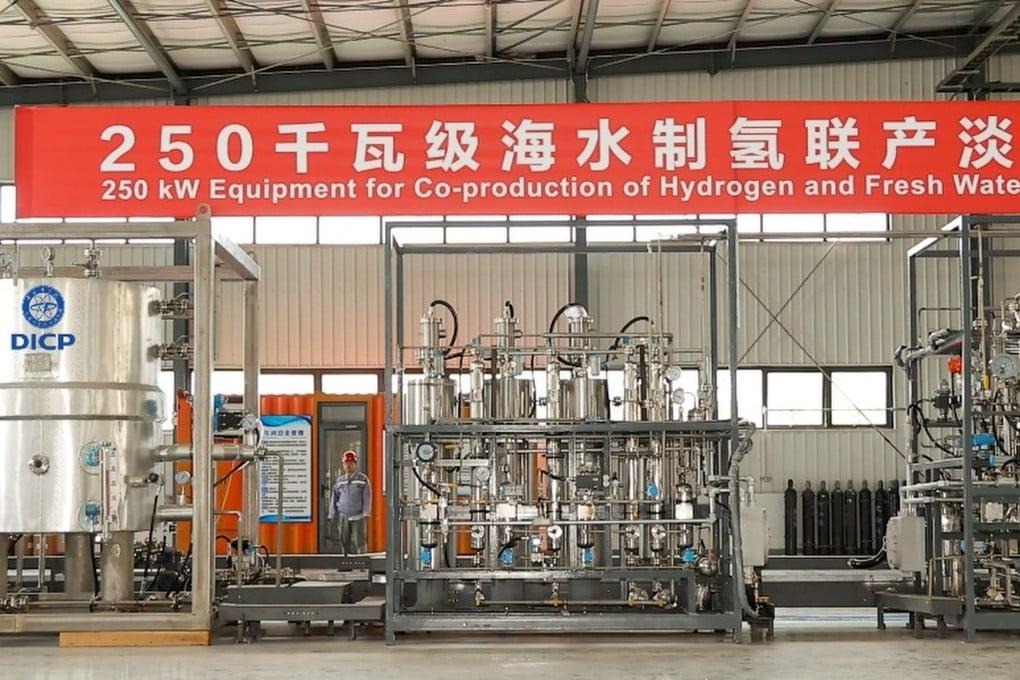
- Chinese scientists have developed a new system that can produce hydrogen fuel and fresh water from seawater while also recovering valuable materials such as uranium and bromine.
- The project is led by researchers from the Dalian Institute of Chemical Physics, part of the Chinese Academy of Sciences. Their new technology improves on existing methods of producing hydrogen from seawater, which can be expensive and require large amounts of electricity.
- Hydrogen is considered an important clean energy source because it can be produced using renewable electricity and produces no carbon dioxide when used as a fuel. However, making hydrogen directly from seawater has proved challenging because of the high costs and technical difficulties involved.
- The Chinese team has designed a system that tackles some of these problems by combining several processes into one plant. It can produce hydrogen and fresh water while extracting useful minerals from the seawater.
- An important achievement is that the system improves electricity efficiency by approximately 15 per cent compared with previous approaches. Researchers have also demonstrated a stable, small-scale plant with a capacity of 250 kilowatts.
- The plant could be important because it makes better use of seawater, producing several useful resources rather than just one. It may eventually offer a more economical and environmentally friendly way to produce clean energy and fresh water.
- However, the technology still needs further development and wider testing before it can be considered a practical, large-scale solution.
- The main takeaway: China may have found a way to turn seawater into a valuable source of clean energy, drinking water and important raw materials, all through one more efficient process.
////////////////////////////////////////////////////////////////////////////////////////////////////////////////////////////////////////////
Story: Scientists shrink Archimedes’ screw to the size of a single molecule
Source: ScienceDaily.com University of Augsburg
Link: https://www.sciencedaily.com/releases/2026/10/261030002940.htm
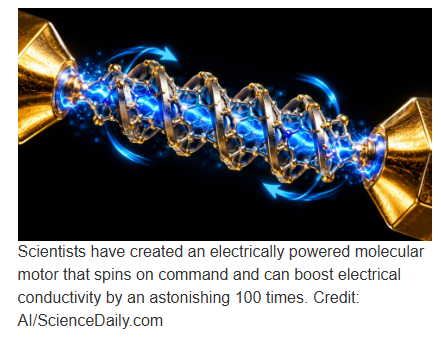
- Researchers have developed an extremely tiny electric motor that operates using a single molecule. Inspired by the ancient Archimedes screw, a device invented more than 2,000 years ago to move water uphill, this new technology could eventually help advance the development of incredibly small electronic devices.
- The motor consists of a specially designed spiral-shaped molecule connected between two tiny gold electrodes. When electricity passes through the molecule, the movement of electrons causes it to rotate. Even more impressive, scientists can reverse the direction of rotation simply by changing the electrical voltage.
- The research involved scientists from the University of Augsburg in Germany, the University of Copenhagen in Denmark, and the Weizmann Institute of Science in Israel.
- The team discovered another surprising feature. When the molecule rotates, its ability to conduct electricity can increase by as much as 100 times compared with when it is stationary. Computer simulations helped explain this unusual behavior: rotation allows the molecule to move into positions that make it much easier for electricity to flow through it.
- The discovery could eventually contribute to a new generation of molecular electronics, extremely small computer components, and technologies that manipulate tiny quantities of fluids.
- Although practical applications are still some distance away, the experiment demonstrates something remarkable: electricity can make a single molecule rotate in a controlled direction, and that movement can actually change how electricity flows through it.
- It is an important step toward building functional machines at the molecular scale.
////////////////////////////////////////////////////////////////////////////////////////////////////////////////////////////////////////////
Story: Texas researchers use rapid heat to reclaim scarce metal from e-waste and limit toxic byproducts
Source: The Cool Down on MSN.com
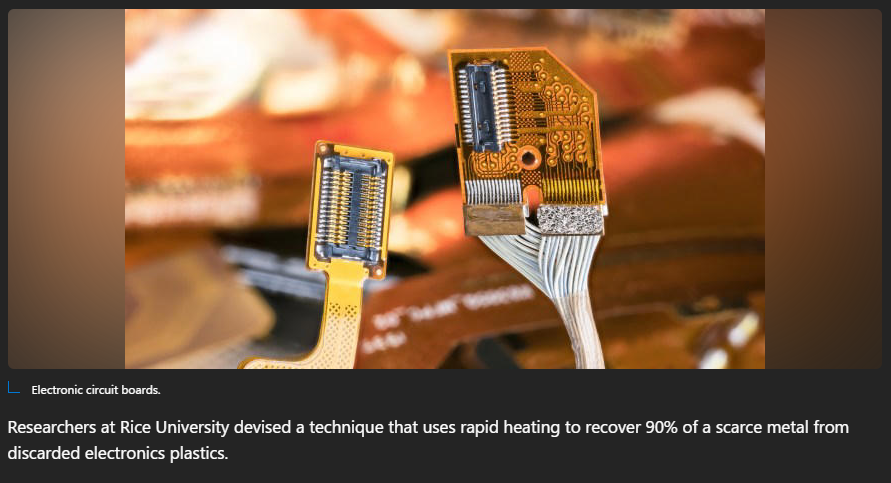
- Researchers at Rice University in Houston, Texas, have developed a promising new technique for recovering valuable metals from discarded electronic equipment while reducing the production of toxic chemicals.
- The research focuses on recovering antimony, a relatively scarce metal commonly used in flame-retardant plastics found in electronic devices. These plastics are used in items such as circuit boards, electrical connectors, and power supply housings to reduce the risk of fires.
- Currently, recovering antimony from these plastics can involve harsh chemicals, powerful acids, or conventional heating methods that may release hazardous substances.
- The Rice University team developed a process called isothermal-clamped flash Joule heating. It uses extremely brief electrical heating pulses to rapidly raise the temperature of the plastic, allowing the antimony to evaporate and then condense so it can be collected.
- In laboratory experiments, the researchers recovered approximately 90% of the antimony. Remarkably, the material was exposed to high temperatures for just 9.4 milliseconds. This extremely short heating period helped prevent the formation of dangerous chemical byproducts.
- The process also recovered another useful material. Approximately 83% of the bromine-containing waste was converted into hydrogen bromide, an industrial chemical with commercial applications.
- The researchers successfully tested the technique on several types of flame-retardant plastics.
- Although additional work is needed to determine whether the process can be used economically on an industrial scale, the discovery could eventually make electronic waste recycling safer, recover valuable materials, and reduce the need for mining.
////////////////////////////////////////////////////////////////////////////////////////////////////////////////////////////////////////////
Story: New recycling method turns discarded plastic bags into industrial-strength adhesives – The method requires neither expensive catalysts nor high processing temperatures, making it considerably simpler than many advanced plastic recycling technologies.
Source: InterestingEngineering.com Story by Muskan Bhatia
Link: https://interestingengineering.com/innovation/recycling-turns-plastic-waste-into-glue

- Researchers at ETH Zurich in Switzerland have developed a new recycling process that transforms discarded plastic bags and bottles into powerful industrial adhesives. The technology could provide a valuable new use for plastic waste that would otherwise end up in landfills or incinerators.
- The process works with two of the world’s most common plastics: polyethylene and polypropylene. These materials are widely used in shopping bags, packaging, and plastic bottles, but they are notoriously difficult to recycle into high-quality products.
- Instead of melting or breaking down the plastic, the researchers use a chemical process involving a special solvent and short-wavelength light. The light activates parts of the plastic’s molecular structure, allowing scientists to attach new chemical chains to it. This changes the plastic’s properties without destroying its original structure.
- The resulting material can function as a strong adhesive capable of bonding metal, glass, and wood. Tests indicate that the glue is strong enough for demanding applications, including vehicle and equipment manufacturing.
- One important advantage is that the process does not require expensive catalysts or extremely high temperatures, potentially making it simpler and less energy-intensive than many existing chemical recycling methods.
- The researchers believe the technology could eventually produce more than just adhesives. It might also help create improved food packaging and strengthen lower-quality recycled plastics.
- The technology has been patented, and ETH Zurich researchers are already working with industry partners to explore commercial applications.
- The bigger idea: Instead of simply recycling plastic into lower-quality materials, scientists may be able to transform plastic waste into entirely new, higher-value products.