


Show Notes 27 February 2026
Story 1: Artemis II to Test Laser-Based Communication from the Moon – The laser system could increase available bandwidth by 100x, enabling new kinds of data transfer.
Source: ExtremeTech.com Story by Jon Martindale
Link: https://www.extremetech.com/aerospace/artemis-ii-to-test-laser-based-communication-from-the-moon

- This article is all about NASA’s plan to test a revolutionary laser-based communication system during the Artemis II mission.
- NASA will deploy the Orion Artemis II Optical Communication System, which, unlike traditional radio waves, uses infrared light to transmit data, acting essentially like a high-speed fiber-optic link through space.
- The Optical Communication System system is expected to increase available bandwidth by up to 100 times compared to conventional radio systems. This allows for the transmission of 4K HD video, complex telemetry, and high-quality voice calls from deep space.
- A Historic First: While laser communication has been tested on seven previous uncrewed missions, Artemis II will be the first time a human crew uses the technology to send information back to Earth.
- Range & Future Potential: During the mission the system will be tested at approximately a distance of 230,000 miles, but NASA estimates it could work over millions of miles. This makes it a critical building block for future crewed missions to Mars.
- To ensure safety, the mission will still utilize traditional radio via the Near Space and Deep Space Networks (with ground stations in the US, Spain, and Australia) as a backup.

Story 2: New solar-powered device extracts lithium for batteries while desalinating seawater
Source: Interesting Engineering Story by Mrigakshi Dixit
Link: https://interestingengineering.com/energy/china-solar-device-extracts-lithium-desalinates-seawater
See research paper here: https://www.cell.com/device/abstract/S2666-9986(25)00341-2
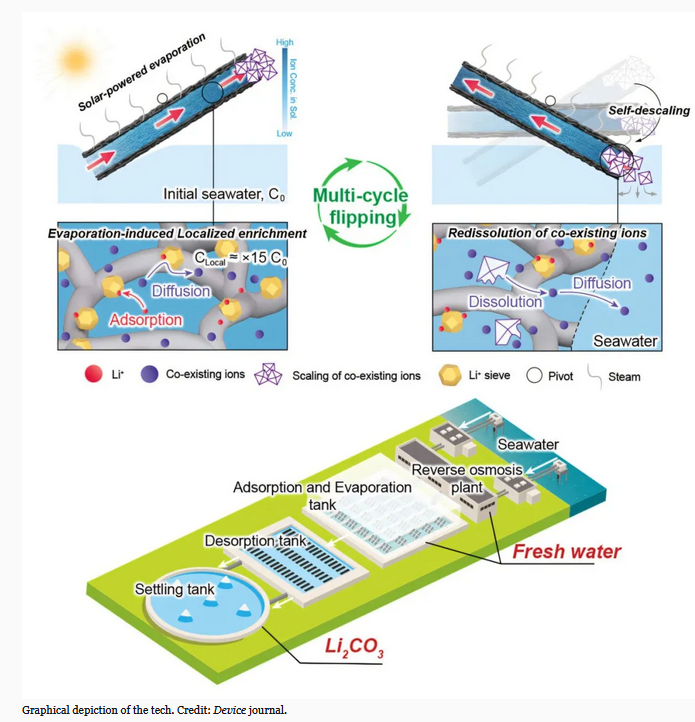
- Researchers at Zhejiang University have developed a solar-powered “seesaw extractor” that can extract lithium from seawater and desalinate the same seawater simultaneously.
- Seawater contains vast amounts of lithium but extracting it efficiently has been extremely difficult. So, this represents a significant scientific breakthrough
- The device the scientists created uses photothermal evaporation powered by sunlight. This enhances lithium-ion adsorption while reducing interference from other salts (“scaling”), which has been a major barrier in seawater extraction.

Story 3: Paralysis treatment heals lab-grown human spinal cord organoids – new therapy triggers neurite growth, reduces scarring in injured organoids
Source: Northwestern University Story by Amanda Morris
See research paper here: https://www.nature.com/articles/s41551-025-01606-2
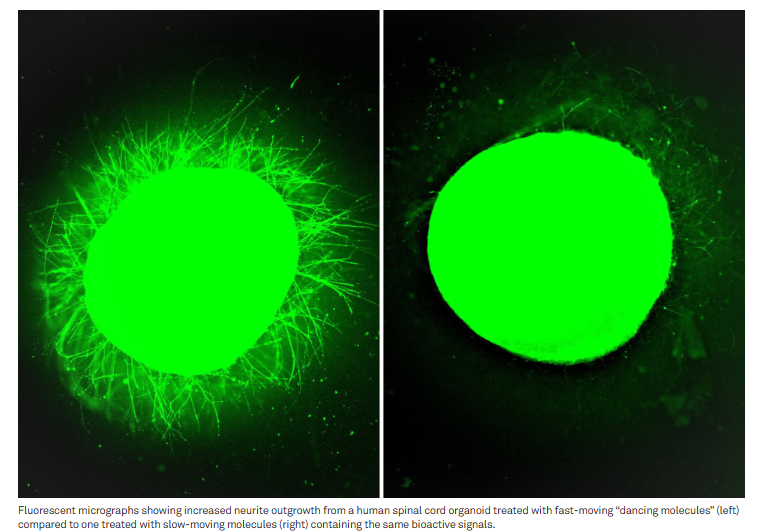
- Northwestern University scientists have developed the most advanced organoid model for human spinal cord injury to date.
- In their study, the research team used lab-grown human spinal cord organoids — miniature organs derived from stem cells — to model different types of spinal cord injuries and test a promising new regenerative therapy.
- For the first time, the scientists demonstrated that human spinal cord organoids can accurately mimic the key effects of spinal cord injury, including cell death, inflammation and glial scarring, a dense mass of scar tissue that creates a physical and chemical barrier to nerve regeneration.
- When treated with “dancing molecules” — a new therapy that reversed paralysis and repaired tissues in a previous animal study — the injured organoids showed significant outgrowth of neurites, the long extensions of neurons that connect the cells to one another.
- Side note – What “dancing molecules” are: They are bioengineered molecules designed to deliver regenerative signals to damaged spinal cord tissue.
- Their key feature is rapid, flexible movement, which allows them to more effectively engage with cell receptors.
- This dynamic behavior helps them promote neurite outgrowth, reduce scar formation, and encourage tissue repair
- The glial scar-like tissues of treated injured organoids also significantly diminished. These results give researchers further hope that the treatment should improve outcomes for patients with spinal cord injuries.

Story 4: Toward regenerative bioprinting: Magnetic mixer enables scalable manufacturing of 3D-printed tissues
Source: TechXplore.com Story by Anne Wilson, MIT
Link: https://techxplore.com/news/2026-02-regenerative-bioprinting-magnetic-mixer-enables.html
See research paper here: https://www.cell.com/device/abstract/S2666-9986(25)00357-6
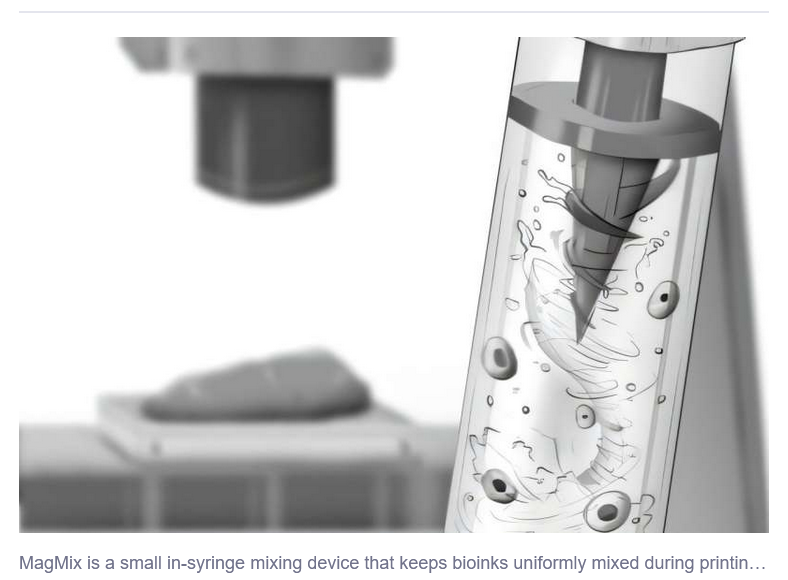
- Current 3D bioprinting systems struggle with clogged nozzles and cell sedimentation, which limit scalability and reliability.
- These issues make it difficult to produce consistent, high-quality tissue constructs at larger volumes.
- MIT Researchers have developed a magnetic mixer designed to keep bioinks uniformly mixed during printing. This prevents cells from settling and reduces clogging, enabling smoother, more continuous printing.
- Here is how the magnetic mixer works:
- Called “MagMix”, a magnetically actuated mixer, is composed of two parts: a small magnetic propeller that fits inside the syringes used by bioprinters to deposit bioinks, layer by layer, into 3D tissues, and a permanent magnet attached to a motor that moves up and down near the syringe, controlling the movement of the propeller inside.
- Together, this compact system can be mounted onto any standard 3D bioprinter, keeping bioinks uniformly mixed during printing without changing the bioink formulation or interfering with the printer’s normal operation.
- To test the approach, the team used computer simulations to design the optimal mixing propeller geometry and speed and then validated its performance experimentally.
- The magnetic mixer supports larger-scale production of 3D-printed tissues, a key step toward regenerative medicine applications.
- This improved consistency and throughput could make bioprinted tissues more viable for clinical use.
- This innovation moves the field closer to regenerative bioprinting, where tissues—and eventually organs—could be manufactured reliably. The approach may integrate with existing bioprinting platforms, potentially accelerating adoption.

Honorable Mentions
Story: How to Compute with Electron Waves
Source: NewsBreak.com Story by Dina Genkina
Link: https://www.newsbreak.com/ieee-spectrum-319637150/4454843506865-how-to-compute-with-electron-waves

- The article “How to Compute With Electron Waves” (originally published in IEEE Spectrum on January 22, 2026, and aggregated by NewsBreak) describes a breakthrough in computing architecture known as Nano-Electron-Fluidic Logic (NFL). Developed by Dr. Hector J. De Los Santos, this paradigm aims to overcome the energy and scaling limits of traditional CMOS technology.
-
Core Concept: From Particles to Waves
- In traditional computers, electrons are treated like “marbles” moving through a circuit (charge-based logic), which generates significant heat and limits how small and fast transistors can get. The new approach treats electrons as a fluid and utilizes their wave-like properties—specifically plasmons (collective oscillations of electrons in a 2D electron gas).
- Key Highlights of the technology:
- Extreme Energy Efficiency: NFL gates are projected to operate with femtojoule power dissipation, which is orders of magnitude lower than current silicon transistors.
- Ultra-High Speed: The logic gates can achieve femtosecond switching speeds, potentially leading to processors that are significantly faster than today’s gigahertz-scale chips.
- CMOS Compatibility: Unlike many “beyond-CMOS” theories (like certain types of quantum computing), this method is designed to be integrated into existing semiconductor manufacturing processes, making it a practical successor or enhancement to current silicon chips.
- Mechanism: It uses the generation, propagation, and manipulation of surface plasma waves (SPWs) to perform logic operations. Instead of waiting for individual electrons to physically travel from source to drain, the system relies on the rapid transmission of wave-fronts.
- Why It Matters – The article positions this technology as a “strong candidate” for the next era of digital logic. By moving from current-based switching to wave-interference-based computation, researchers can continue to improve computing performance without the catastrophic heat issues that currently plague high-density AI and data center chips.
////////////////////////////////////////////////////////////////////////////////////////////////////////////////////////////////////////////
Story: This Silent Wind Turbine Solves Sailing’s Power Problem
Source: Yanko Design Story by Ida Torres
Link: https://www.yankodesign.com/2026/01/18/this-silent-wind-turbine-solves-sailings-power-problem/
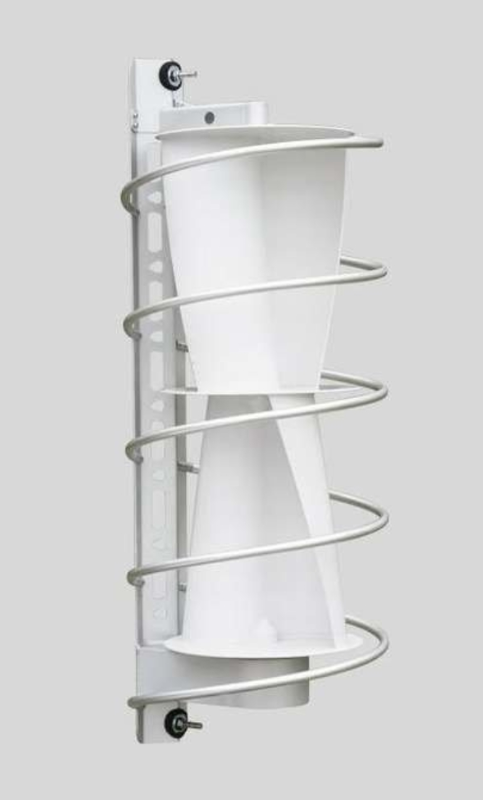


- The article introduces Grain Blanc, a compact, silent vertical-axis wind turbine designed by Belgian startup Phileole to solve a persistent problem for sailors: keeping essential onboard electronics powered without relying on fossil fuels or shore charging.
- Purpose: Sailboats still need electricity for GPS, radar, navigation lights, radios, and personal devices. Traditional solutions—running an engine or plugging in at the dock—are noisy, polluting, or inconvenient.
-
Design:
- Mounts directly on a sailboat mast
- About 100 cm tall and 45 cm wide
- Vertical-axis design captures wind from any direction, ideal for shifting conditions at sea
-
Silent & Eco-friendly:
- Operates with no noise or vibration, reducing disturbance to marine life
- Built mostly from recycled polypropylene and is 95% recyclable
-
Functionality:
- Powers all essential navigation systems while sailing
- Keeps batteries topped up during winter storage
- Can even run a dehumidifier at the dock
-
Smart Features:
- Includes an automatic regulator
- Requires no user adjustments
- Shuts down safely during storms
-
Broader Potential:
- Though designed for sailboats, the same compact, omnidirectional wind-harvesting approach could work for urban balconies, remote cabins, or mobile setups.
////////////////////////////////////////////////////////////////////////////////////////////////////////////////////////////////////////////
Story: Army establishes new AI, machine learning career path for officers [announced in December 2025]
Source: US Army Website

- The U.S. Army has established a new career pathway for officers to specialize in artificial intelligence and machine learning (AI/ML), formally designating the 49B AI/ML Officer as an official area of concentration. It advances the Army’s ongoing transformation into a data-centric and AI-enabled force.
- Full implementation of the new career field will be phased. The first selection of officers will occur through the Army’s Volunteer Transfer Incentive Program (VTIP) beginning January 2026. The officers will be reclassified by the end of fiscal year 2026.
- “This is a deliberate and crucial step in keeping pace with present and future operational requirements,” said Lt. Col. Orlandon Howard, U.S. Army spokesperson. “We’re building a dedicated cadre of in-house experts who will be at the forefront of integrating AI and machine learning across our warfighting functions.”
- Initially, the 49B AOC will be open to all officers eligible for the VTIP. Those with advanced academic and technical backgrounds in fields related to AI/ML will be particularly competitive candidates. The Army is also exploring expanding this specialized field to include warrant officers in the future.
- Officers selected for the 49B AOC will undergo rigorous graduate-level training and gain hands-on experience in building, deploying, and maintaining the Army’s cutting-edge AI-enabled systems. Their primary role will be to operationalize these advanced capabilities across the range of military operations.
////////////////////////////////////////////////////////////////////////////////////////////////////////////////////////////////////////////
Story: Smart chip could slash computing energy use by up to 5,000×
Source: Interesting Engineering via MSN Story by Georgina Jedikovska

- A new smart analogue chip could cut computing energy use by up to 5,000×
- Researchers in Italy, led by Daniele Ielmini, PhD at Politecnico di Milano, have developed a fully integrated analogue in-memory computing chip.
- The chip dramatically reduces the need to shuttle data between memory and processor — one of the biggest energy drains in modern computing.
- Why it matters
- Traditional digital architectures waste enormous energy moving data back and forth.
- This chip performs computation inside the memory itself, which:
- Reduces energy consumption by orders of magnitude
- Speeds up high-performance computing tasks
- Could transform data centers and AI workloads
- Part of a major European research effort
- The work is funded by the ERC ANIMATE project, which received an Advanced Grant in 2022 (about USD 2.9M over five years).
- The project aims to push analogue in-memory computing toward industrial-scale adoption.
- What the researchers claim
- The prototype demonstrates that analogue computation in memory is not just theoretical — it’s feasible at industrial scale.
- It represents a “revolutionary concept” in computer architecture, according to Ielmini.