

Show Notes 8 August 2025
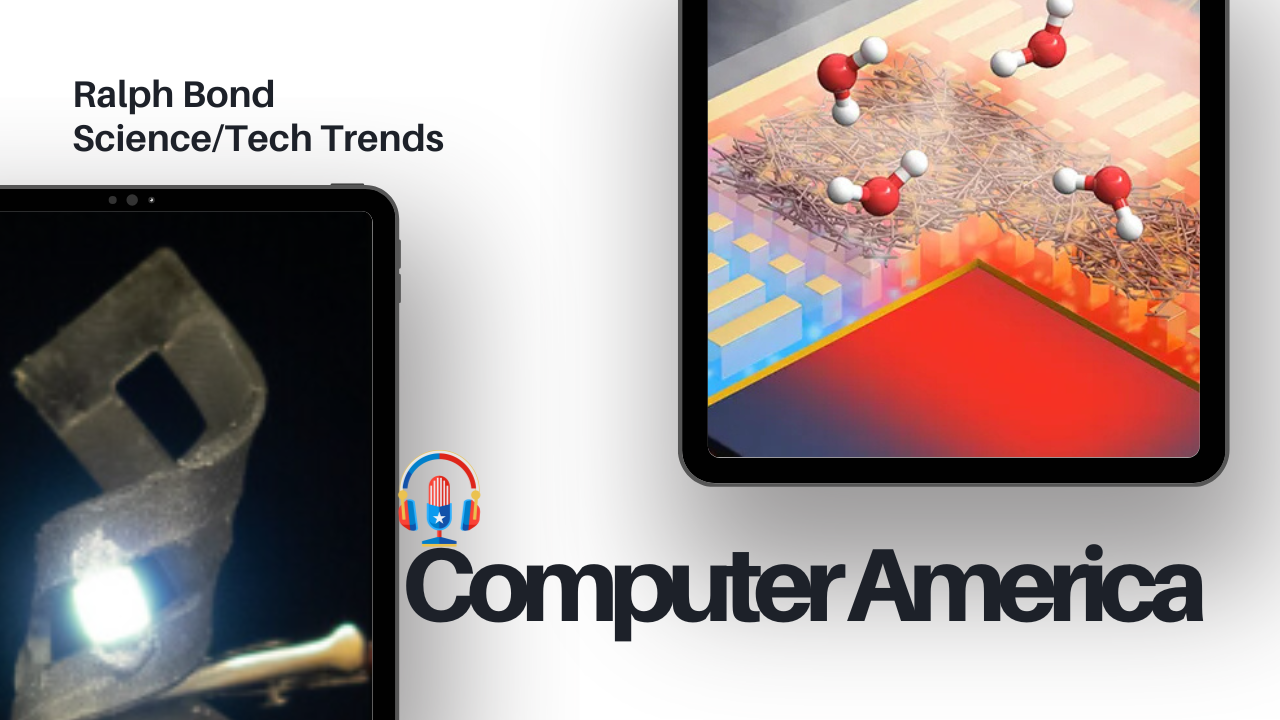
Story 1: ‘Unlike conventional electronics’: New liquid metal-infused circuit boards can self-heal and work after taking heavy damage
Source: LiveScience.com Story by Alan Bradley

- Researchers at Virginia Tech have developed a new type of circuit board that can self-heal, reshape, and remain functional even after significant damage. Here’s the core of the innovation:
-
Key Material: Vitrimer + Liquid Metal
- Vitrimer: A polymer that’s rigid at room temperature but becomes malleable when heated.
- Liquid metal droplets (5% by volume): Provide conductivity and enable self-repair by reconnecting broken pathways.
-
Capabilities
- Self-healing: Damage like cuts or deformation can be reversed with heat.
- Reconfigurable: Boards can be reshaped and reused multiple times.
- Recyclable: Materials can be reclaimed without harsh chemicals, unlike traditional thermoset-based boards.
- Side note – A thermoset is a type of polymer that permanently hardens when heated or chemically cured. Unlike thermoplastics, which can be melted and reshaped multiple times, thermosets undergo irreversible chemical cross-linking during curing. This process forms a rigid, three-dimensional network of covalent bonds that gives thermosets their strength, heat resistance, and dimensional stability.
-
Performance Highlights
- Doubled strain tolerance compared to vitrimer alone.
- Maintained conductivity after repeated damage-repair cycles.
- Withstood temperatures up to 200°C [392 F] during testing.
-
Environmental Impact
- Tackles the growing e-waste crisis—electronic waste has doubled in 12 years to 62 billion kg.
- Traditional boards are hard to recycle due to permanent thermosets; this new composite offers a circular economy alternative.
- https://www.youtube.com/@JerryRigEverything

Story 2: Cooling data centers is a multi-billion-dollar problem – now researchers want to use a common cooling mechanism found in animals to solve it
Source: TechRadar.com Story by Wayne Williams
See research paper here: https://www.cell.com/joule/abstract/S2542-4351(25)00156-4?_returnURL=https%3A%2F%2Flinkinghub.elsevier.com%2Fretrieve%2Fpii%2FS2542435125001564%3Fshowall%3Dtrue

- As AI and cloud computing grow, the rising demand for data processing is driving up heat output, with cooling already making up nearly 40% of a data center’s energy use and projected to more than double worldwide by 2030.
- Researchers at the University of California San Diego have developed a new cooling technology that mimics the way animals regulate body temperature… through sweating.
- The passive system removes heat from electronics using evaporation, offering a potential alternative to traditional cooling methods in data centers and other high-powered computing environments.
- The core of the system is a fiber membrane with a network of tiny, interconnected pores that use capillary action to draw cooling liquid across the surface.
- As the liquid evaporates, it efficiently removes heat without requiring extra energy.
- Here are more details from the team’s research paper:
- Capillary-driven thin-film evaporation in nanoporous membranes has emerged as a promising thermal management strategy for high-power electronic devices, owing to its high theoretical critical heat flux (CHF) enabled by the extensive evaporating areas within the nanopores.
- The research involved fiber membranes with three-dimensional interconnected open pores as efficient evaporators.
- Moreover, the fiber membranes demonstrated long-term stability.
- These findings suggest that 3D fiber membrane evaporators are highly promising for advanced thermal management, offering efficient, stable cooling solutions to meet the demands of modern electronic systems.
Story 3: Scientists invent weird, shape-shifting ‘electronic ink’ that could give rise to a new generation of flexible gadgets
Source: LiveScience.com Story by Owen Hughes

- Scientists at Korea Advanced Institute of Science and Technology and Seoul National University have developed a novel electronic ink that enables circuits to switch between rigid and soft states simply by heating. This innovation could revolutionize flexible electronics, including wearable health devices, brain implants, and adaptable robotics.
-
Key Features
- Material: Gallium, a metal that melts just below body temperature, combined with a polymer and dimethyl sulfoxide (DMSO) solvent.
- Mechanism: Heating breaks down the solvent, creating an acidic environment that removes gallium’s oxide layer, allowing particles to merge and form conductive paths.
- Precision: Can print features as small as 50 micrometers—thinner than a human hair.
- Stiffness Control: Material becomes up to 1,400 times softer when warmed.
-
Demonstrated Applications
- Wearable Health Monitor: Rigid at room temperature, softens on skin contact for comfort.
- Brain Implant: Stiff during surgery for accurate placement, softens inside the brain to reduce irritation.
-
Manufacturing Potential
- Compatible with screen printing and dip coating, making it viable for large-scale or 3D-printed electronics.
- This research tackles long-standing challenges in liquid metal printing and opens doors to electronics that adapt to their environment and usage.
Story 4: A bionic knee integrated into tissue can restore natural movement
Source: MIT News Story by Anne Trafton
Link: https://news.mit.edu/2025/bionic-knee-integrated-into-tissue-can-restore-natural-movement-0710
See research paper “Tissue-integrated bionic knee restores versatile legged movement after amputation” here: https://www.science.org/doi/10.1126/science.adv3223


- MIT researchers have developed a new bionic knee that can help people with above-the-knee amputations walk faster, climb stairs, and avoid obstacles more easily than they could with a traditional prosthesis.
- Unlike prostheses in which the residual limb sits within a socket, the new system is directly integrated with the user’s muscle and bone tissue. This enables greater stability and gives the user much more control over the movement of the prosthesis.
- Participants in a small clinical study also reported that the limb felt more like a part of their own body, compared to people who had more traditional above-the-knee amputations.
- Hugh Herr, a professor of media arts and sciences at MIT noted, “A prosthesis that’s tissue-integrated — anchored to the bone and directly controlled by the nervous system — is not merely a lifeless, separate device, but rather a system that is carefully integrated into human physiology, offering a greater level of prosthetic embodiment. It’s not simply a tool that the human employs, but rather an integral part of self.”
Honorable Mentions
Story: Using AI to make lower-carbon, faster-curing concrete
Source: Engineering at Meta

- Meta has developed an open-source AI tool to design concrete mixes that are stronger, more sustainable, and ready to build faster—speeding up construction while reducing environmental impact.
- The AI tool leverages Bayesian optimization, powered by Meta’s BoTorch and Ax frameworks, and was developed with Amrize and the University of Illinois Urbana-Champaign (U of I) to accelerate the discovery of high-performance, low carbon concrete.
- Meta successfully deployed a concrete mix that was optimized with the AI tool at a data center construction site. Being open-sourced and freely available, the AI-tool could help increase the adoption and optimization of sustainable concrete mixes in the construction industry at large.
////////////////////////////////////////////////////////////////////////////////////////////////////////////////////////////////////////////
Story: A mild spinal zap can cut brain-computer interface learning time in half
Source: Medicine.net

- Through a device called a brain-computer interface (BCI) it’s possible to control a robotic arm or a wheelchair with thoughts alone. But for many users, learning to operate these systems is slow, difficult and, in some cases, unattainable.
- Researchers at The University of Texas at Austin discovered a novel way to accelerate this learning process: a gentle electrical nudge to the spine before BCI training.
- In a study published in the Proceedings of the National Academy of Sciences, researchers from the Cockrell School of Engineering and Dell Medical School found that noninvasive spinal stimulation can help the user focus on the task at hand, significantly speeding up the learning curve for brain-computer interfaces. This stimulation was shown to cut learning time in half.
- “By using spinal stimulation to prime the brain, we’re not just speeding up learning—we’re also making it possible for people who previously struggled to use BCIs to gain control,” said José del R. Millán, professor in the Cockrell School’s Chandra Family Department of Electrical and Computer Engineering and the Department of Neurology at Dell Med.
- “This opens up exciting possibilities for motor rehabilitation and assistive technology.”
////////////////////////////////////////////////////////////////////////////////////////////////////////////////////////////////////////////
Story: Scientists invent photosynthetic ‘living’ material that sucks CO2 out of the atmosphere
Source: LiveScience.com Story by Sascha Pare

- Innovation: Researchers in Switzerland have developed a photosynthetic “living” material incorporating cyanobacteria (blue-green algae) that can absorb atmospheric CO₂.
-
Functionality:
- Converts CO₂, sunlight, and water into oxygen and sugars.
- In the presence of nutrients, it also produces carbonate minerals (e.g., limestone), creating a strong internal scaffold.
- Structural Benefits: This mineral skeleton enhances the material’s strength, making it viable for construction applications, like building facades.
- Carbon Storage: It stores carbon both as biomass and as stable minerals—offering a dual sequestration method.
- Efficiency: Over a continuous 400-day period, it stored ~26 mg of CO₂ per gram of material, outperforming traditional biological CO₂ sequestration methods.
- Potential Usage: The scientists envision its use on buildings to passively extract CO₂ from the air, contributing directly to climate mitigation.
////////////////////////////////////////////////////////////////////////////////////////////////////////////////////////////////////////////
Story: Alzheimer’s gene therapy shows promise in preserving cognitive function
Source: University of California San Diego Story by Miles Martin

- Researchers at University of California San Diego School of Medicine have developed a gene therapy for Alzheimer’s disease that could help protect the brain from damage and preserve cognitive function.
- Unlike existing treatments for Alzheimer’s that target unhealthy protein deposits in the brain, the new approach could help address the root cause of Alzheimer’s disease by influencing the behavior of brain cells themselves.
- Alzheimer’s disease affects millions of people around the world and occurs when abnormal proteins build up in the brain, leading to the death of brain cells and declines in cognitive function and memory. While current treatments can manage symptoms of Alzheimer’s, the new gene therapy aims to halt or even reverse disease progression.
- Studying mice, the researchers found that delivering the treatment at the symptomatic stage of the disease preserved hippocampal-dependent memory, a critical aspect of cognitive function that is often impaired in Alzheimer’s patients. Compared to healthy mice of the same age, the treated mice also had a similar pattern of gene expression, suggesting that the treatment has the potential to alter the behavior of diseased cells to restore them to a healthier state.
- While further studies will be required to translate these findings into human clinical trials, the gene therapy offers a unique and promising approach to mitigating cognitive decline and promoting brain health.