


Show Notes 18 September 2026
Text highlighted in blue identifies notes I have inserted.
Story 1: US stratospheric craft flies 9,300 miles to Japan in world-first sky data network
Source: Interesting Engineering via MSN Story by Aamir Khollam
See also the company’s website: https://sceye.com/

- What this news is all about is creating a communications network in the stratosphere that moves data from one place to another.
- A U.S.-built high-altitude platform from a company called Sceye completed a 9,300-mile flight from New Mexico to Japan, marking the company’s first mission in Asia.
- Side note – per the Sceye company’s website “about” video – their goal is to use the stratosphere to help connect parts of the world underserved by today’s communications technologies.
- Reminder – The stratosphere is a highly stratified atmospheric layer extending from roughly 10–20 km [6.21 to 12.43 miles] at its lower boundary (the tropopause) up to about 50 km at its upper boundary (the stratopause).
- The craft flew at roughly 10.3 miles altitude for 13 days, then spent 7+ days in Japanese airspace conducting connectivity tests with SoftBank Corp.
- The aircraft carried SceyeCELL, a stratospheric telecom payload that connects directly to standard mobile phones (no special hardware needed).
- Engineers successfully demonstrated:
- Text messaging
- Voice calls
- Internet access
- Video streaming
- Emergency communications were also tested using a large-scale disaster alert system.
- Onboard Computing Breakthrough – Engineers installed a mobile core network and web server directly on the high-altitude platform, enabling:
- Data processing in the stratosphere
- Reduced reliance on ground-based cloud services
- End-to-end data flow from smartphone → platform → back to device
- Note – no satellite dish required for reception/transmission

Story 2: Scientists build tiny robots without motors that can fly using sound waves alone – A century-old trick for tuning musical instruments has been repurposed to power robots that fly, float and steer themselves using nothing but sound waves.
Source: LiveScience.com Story by Olivia Maule
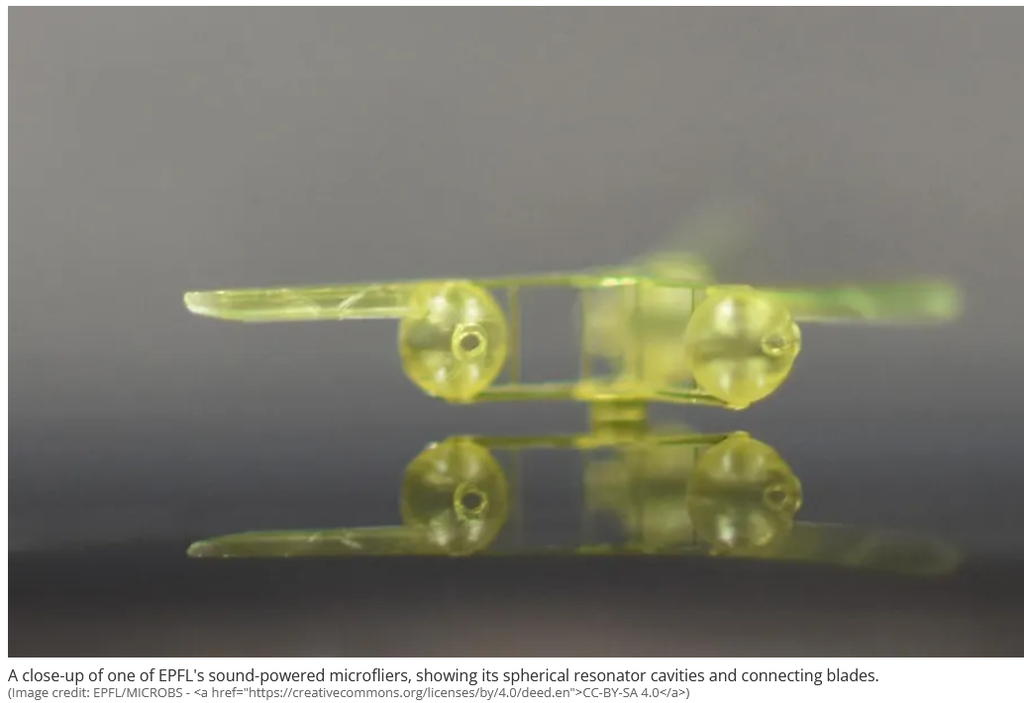
- Scientists at the Swiss Federal Institute of Technology Lausanne have developed tiny robots that can move and even fly without using conventional motors, batteries, or moving mechanical parts. Instead, the robots are powered and controlled by sound waves.
- The technology is based on a physics principle called Helmholtz resonance. It is similar to the way air vibrating inside a bottle can produce a musical tone.
- Side note – Helmholtz resonance occurs when air in a confined cavity connected to the outside through a narrow neck vibrates at a characteristic frequency determined solely by the cavity’s volume, the neck’s cross-sectional area, and its effective length. This is why blowing across the top of a bottle produces one clear pitch: the geometry fixes the resonant frequency; not how hard you blow.
- The researchers built tiny hollow structures, called resonators, that are designed to vibrate when exposed to specific ultrasonic sound frequencies. The vibrating air produces forces that can push the robots through the air or across a surface.
- The team created several experimental robots using 3D printing. Some were tiny boats that could move across water, while others were small flying robots, or “microfliers.”
- One type could produce upward thrust somewhat like a miniature rocket, while another used sound-generated forces to spin small blades, similar to a helicopter.
- Importantly, the robots can be controlled remotely by changing the frequency, or pitch, of the sound waves. This allows researchers to guide their movement without putting motors inside the robots.
- The approach could eventually make robots much smaller than conventional motor-powered machines.
- Researchers believe the technology could have applications in areas such as manipulating very small objects, creating flexible robotic surfaces, and developing tiny medical devices that could operate inside the human body.

Story 3: The ‘wonder material’ graphene can be made using a kitchen blender, a mobile phone and a newspaper
Source: Phys.org Story by Conor Boland
Link: https://phys.org/news/2026-08-material-graphene-kitchen-blender-mobile.html

- Side note: Graphene earned the title “wonder material” because it combines extreme physical, electrical, and thermal properties in a single structure that is just one carbon atom thick.
-
Key Superpowers
- Unmatched Strength: About 200 times stronger than steel by weight, held together by ultra-tight covalent carbon bonds.
- Extreme Conductivity: Electrons zip through its 2D lattice near the speed of light with virtually no resistance, conducting electricity far better than copper.
- Ultra-Light & Flexible: Weighs less than 1 milligram per square meter, yet can stretch up to 20% of its length without breaking.
- Optical Transparency: Absorbs only ~2.3% of visible light, making a single layer almost completely see-through.
- Thermal Conduction: Dissipates heat better than diamonds, making it an exceptional thermal conductor.
-
Real-World Applications
- Electronics & Semiconductors: Next-generation ultra-fast transistors, flexible touchscreens, and efficient sensors.
- Energy Storage: Batteries that charge in minutes instead of hours, plus lightweight supercapacitors.
- Composite Materials: Reinforced carbon fiber for aerospace, lightweight automotive frames, and ultra-durable sports gear.
- Water Filtration: Graphene oxide membranes with pores precise enough to filter salt out of seawater.
- The main bottleneck remaining is mass production: manufacturing defect-free, large-scale graphene sheets cost-effectively remains a major engineering challenge.
- Scientists at Dublin City University, Ireland have found a surprisingly simple way to produce graphene, a remarkable material known for being extremely strong, lightweight, and an excellent conductor of electricity.
- Instead of using expensive laboratory equipment and specialized chemicals, researchers used a kitchen blender, tap water, old newspaper, and graphite recovered from electronic waste [in this case a discarded smartphone].
- Each individual layer is graphene. The challenge is separating those layers without damaging them.
- Graphite is made up of many extremely thin layers of carbon stacked together [each individual layer of graphene is exactly one atom thick!]
- The researchers used a process called liquid-phase exfoliation, in which the graphite is placed in liquid and subjected to enough energy to separate the layers.
- The kitchen blender provided that energy. A simple kitchen sieve was then used to remove larger pieces that had not broken apart. However, the separated graphene sheets tend to stick back together and settle out of the water.
- Side note – A sieve is a device with fine holes used to strain liquids or separate fine particles from coarse ones. Common in cooking, construction, and laboratory work.
- To prevent this, the researchers added material made from old newspapers. The newspaper contains cellulose fibers that temporarily kept the graphene sheets apart. Without the newspaper material, the mixture settled within minutes. With it, the graphene remained suspended for several hours.
- The researchers also demonstrated that graphite taken from an actual discarded smartphone could be processed this way.
- The method is not intended to replace industrial graphene production. Instead, it could make graphene research cheaper, simpler, and more accessible, particularly for schools, small laboratories, and researchers with limited resources.
- It also offers a possible way to give electronic waste and discarded newspaper a useful second life.

Story 4: These Hearing Aids Will Tune in to Your Brain – Tracking brain waves and eye signals could cut through the noise
Source: IEEE Spectrum Commentary by Shruthi Raghavendra
Link: https://spectrum.ieee.org/hearing-aids-biosignals
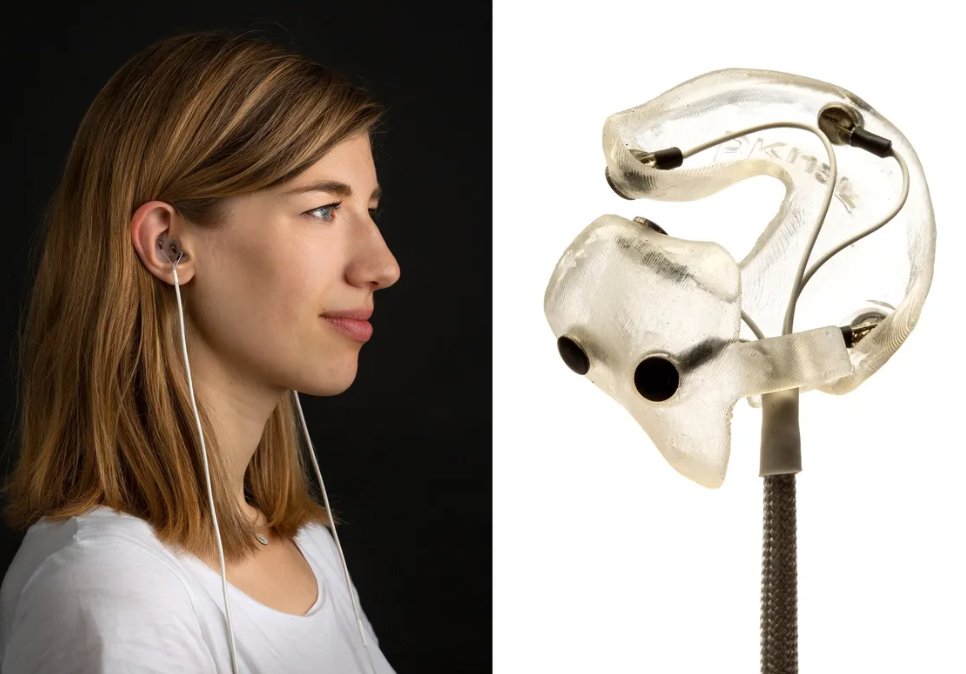
- Side note – this article offer’s the author’s predictions for future hearing aid technology. Here is more on her background:
- The author is Shruthi Raghavendra, a neuroscientist and engineer specializing in auditory neuroscience, speech processing, and brain-computer interfaces.
- She earned her Ph.D. from the University of Texas at Dallas, where her research focused on neural and physiological measures of listening effort and speech perception. She also previously worked as a senior audio research scientist at Harman International in Los Angeles.
- Today’s hearing aids can make sounds louder and reduce background noise, but they do not know how hard the user’s brain works to understand speech. In noisy places, such as restaurants or cars, this can cause mental fatigue, even when the hearing aid is working properly.
- A new generation of hearing aids could address this problem by monitoring signals from the user’s body and brain.
- One promising technology is EEG (electroencephalography), which measures the brain’s electrical activity. Researchers have developed tiny electrodes that can be placed around or inside the ear.
- These sensors can detect brain patterns showing whether someone is paying attention to a particular speaker. If the brain signals indicate that the listener is struggling, a future hearing aid could automatically increase directional microphones, reduce background noise, or change other settings.
- Another possibility is pupillometry, which measures changes in pupil size.
- Research has shown that people’s pupils become larger when they are working harder to understand speech, particularly in noisy environments.
- A hearing device could potentially use this information to recognize when the wearer is experiencing mental strain.
- However, several technical problems remain. EEG signals can be noisy and differ from person to person, requiring individual calibration. Sensors must also be small, comfortable, and energy efficient. Privacy and ownership of brain-related data are additional concerns.
- The author believes these challenges can be overcome. She predicts that biosignal-based hearing aids could become commercially available within about a decade, making hearing assistance more responsive to the user’s actual mental effort rather than simply the surrounding noise.

Honorable Mentions
Story: Making trains and airplanes recyclable – Empa and Elantas develop a sandwich material for aircraft and train interiors combining lightweight performance, fire protection and end-of-life component recovery
Source: Empa.ch [the Swiss Federal Laboratories for Materials Science and Technology] Story by Ann Ettlin
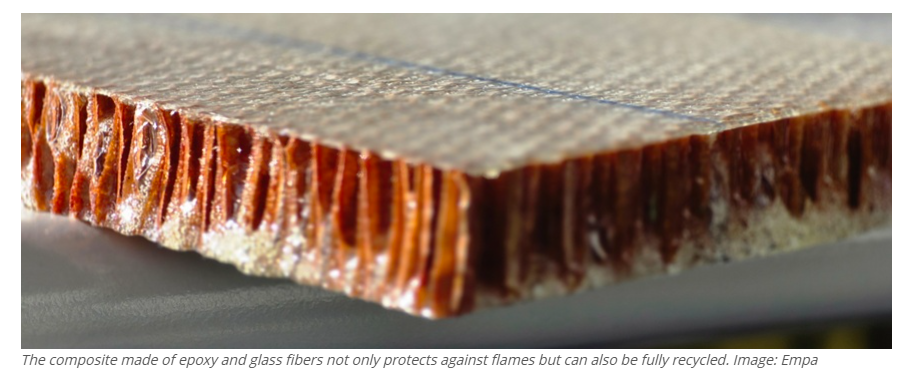
- Researchers at Empa, the Swiss Federal Laboratories for Materials Science and Technology, have developed a new fiber-reinforced composite material that could make airplanes and passenger trains safer and more environmentally friendly. The material is designed to resist fire while also being fully recyclable.
- The composite is a lightweight “sandwich” structure commonly used in aircraft and train interiors, including passenger cabin floors. It contains a honeycomb core made from heat-resistant aramid plastic, covered with layers of glass or carbon fibers. Epoxy resin normally holds these materials together. The problem is that conventional epoxy cannot easily be melted or dissolved, so composite materials containing it generally end up in landfills or are burned.
- The Empa team, working with industrial partner Elantas, developed a phosphorus-containing additive for epoxy. The additive provides flame resistance while allowing the epoxy to become recyclable. With the right solvent and some heat, the finished composite can be separated into its individual components, including the aramid honeycomb and glass or carbon fibers.
- This is important because these fibers and honeycomb materials can be expensive, making recovery potentially valuable as well as environmentally beneficial. Researchers say the new composite meets fire-safety requirements and has nearly the same useful mechanical properties as conventional epoxy.
- The next step is to scale up both production and recycling. The researchers are also investigating other possible uses, including energy technology and construction.
////////////////////////////////////////////////////////////////////////////////////////////////////////////////////////////////////////////
Story: Researchers develop electronic skin for prosthetics to sense temperature and pressure
Source: Washington State University Story by Tina Hilding
See research paper here: https://www.cell.com/cell-reports-physical-science/fulltext/S2666-3864%2826%2900364-4
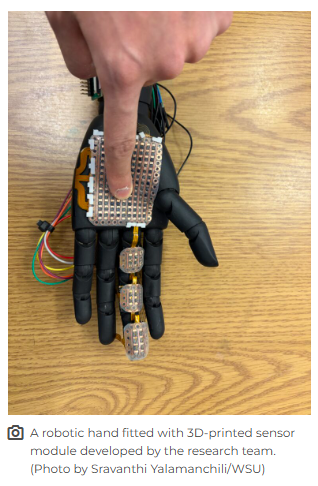
- Researchers at Washington State University (WSU) have developed a new type of electronic skin, or “e-skin,” that could eventually give people with artificial limbs a better sense of touch. The flexible system can detect both pressure and temperature, allowing a prosthetic hand to recognize not only how hard it is touching something, but also whether an object is hot or cold.
- One major problem with existing electronic skin is that it can be expensive, difficult to fit to the complex shapes of prosthetic limbs, and unable to provide enough detailed information quickly. The WSU researchers say their system can sense at a scale about 10 times finer than current commercial glove sensors.
- The researchers developed a “scan-model-print” process. First, a prosthetic limb is scanned. Computer software then uses its shape to determine where the sensors should go. The sensors are produced using 3D printing and laser cutting, allowing them to be customized for different prosthetic shapes. Small sensor modules can snap together like Lego pieces, eliminating the need for adhesives.
- The system can detect differences in surfaces and materials, such as texture and pressure. The researchers hope this will eventually allow prosthetic users to experience a more natural sense of touch.
- However, the technology is not yet able to make an amputee actually feel these sensations. The team is developing another device that could convert the sensor signals into stimulation of nearby nerves. They have also submitted a provisional patent application.
- The research was published in Cell Reports Physical Science and represents an important step toward a future full bionic skin system.
////////////////////////////////////////////////////////////////////////////////////////////////////////////////////////////////////////////
Story: Unprecedented: Scientists Have Built Miniature Brains That Experience the Passage of Time
Source: ScienceAlert.com Story by Ivan Farkas

- Scientists at Harvard University and the Broad Institute of MIT have created miniature human brain-like structures that appear to have an internal sense of time.
- These structures, called brain organoids, are grown in laboratories from human stem cells. The new study, published in Nature, is significant because researchers were able to keep the organoids alive and developing for nearly six years, much longer than most previous experiments.
- The researchers found that the organoids continued to mature in ways that resemble the development of a real human brain. Different types of brain cells appeared and developed, including astrocytes, which support brain function, and oligodendrocytes, which help protect nerve fibers. Some neurons also survived for almost six years.
- Most remarkably, the researchers found evidence that the cells have a kind of internal biological clock. The cells appeared able to keep track of how long they had been developing. To test this, scientists separated cells from organoids of different ages and then combined them into new structures called “chimeroids.” Even after being separated and reassembled, older cells retained signs of their previous age.
- In some cases, older cells quickly produced new cells appropriate for their developmental stage, skipping steps they had already completed. This suggests that brain cells can retain a cellular “memory” of their developmental history.
- The discovery could give scientists a powerful new way to study how the human brain develops after birth, including stages that are difficult to study directly in living people.
////////////////////////////////////////////////////////////////////////////////////////////////////////////////////////////////////////////
Story: Heartbeats power a battery-free pacemaker designed to last a lifetime
Source: MedicalXpress.com Story by Gaby Clark
Link: https://medicalxpress.com/news/2026-08-heartbeats-power-battery-free-pacemaker.html
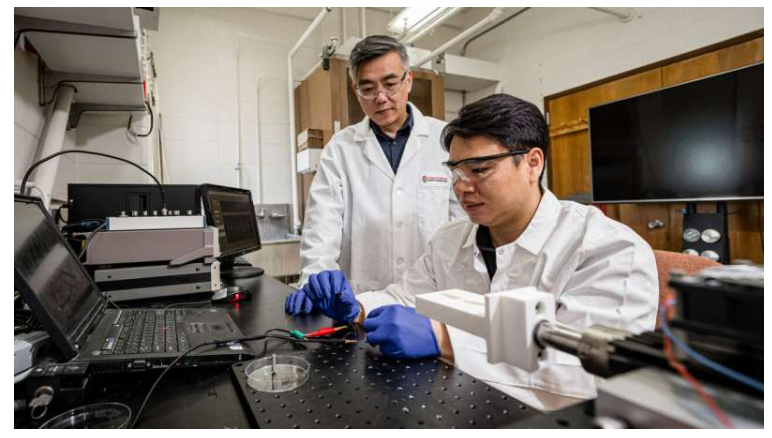
- Researchers at the University of Wisconsin–Madison have developed a new type of battery-free pacemaker that generates its own electricity from the movement of a beating heart. The technology could eventually allow some pacemakers to operate for a patient’s entire lifetime, eliminating the need for replacement surgeries caused by depleted batteries.
- The device uses a tiny triboelectric nanogenerator. When the heart beats, its movement causes two specially designed, oppositely charged surfaces inside the generator to repeatedly come together and separate. This motion produces small amounts of electricity. The energy can either power the pacemaker immediately or be stored in a small capacitor.
- The researchers designed the generator to fit inside the space currently occupied by the battery in a Medtronic Micra leadless pacemaker. These pacemakers are implanted directly inside the heart and normally have batteries that last about seven to 10 years. Replacing them can be particularly difficult because removing an old device from inside the heart is complicated.
- Laboratory testing showed that the new generator produced enough electricity to operate the pacemaker, with a power density significantly higher than previous miniature energy-harvesting devices. The researchers also implanted a prototype in a pig for one month, where it successfully powered cardiac stimulation without significant problems.
- However, the technology is not ready for human use yet. The generator produced less power inside the animal because heart tissue dampens its movement, and the heart’s twisting motion is different from the simple motion that produces maximum energy. Researchers are continuing to improve the design before human clinical trials can begin.